© Glyndebourne Productions Ltd. Photo: Richard Hubert Smith
Puccini’s Tosca is pure 19th century pulp fiction. It is an irresistible, shabby, shocking – according to the critics of the day– little melodrama that hints at political tyranny and social upheaval. With a cast featuring a sadistic, sex-obsessed police chief , a green-eyed diva (with black eyes) and a revolutionary painter, you may wonder why it took Glyndebourne 92 years to stage this absolute masterpiece.
The French dramatist Victorien Sardou wrote La Tosca (1887) for France’s leading actress, Sarah Bernhardt, and the title role became one of her most iconic performances. She toured the play throughout the world, but in Rio de Janeiro her jump in the final scene from the parapet of the Castel Sant’Angelo went wrong and she badly damaged her knee. That wound never healed properly and eventually caused gangrene, leading to the amputation of her leg ten years later. Why is this relevant? You’ll find out towards the end of this review.
George Bernard Shaw – a Nobel Prize-winning playwright – was not particularly impressed by Sardou’s melodramas – inventing the word sardoodledom to describe them– which he considered shallow, mechanical and contrived, favouring suspense over genuine psychology.
The publisher Giulio Ricordi initially offered Puccini a libretto adapted from the La Tosca. Puccini was fired up after seeing Bernhardt’s performance – without understanding much of it, as he didn’t speak French. His interest soon waned, and other projects – Manon Lescaut and La Boheme – took over. Ricordi then passed Luigi Illica’s libretto over to Alberto Franchetti who later admitted that he was unable to deal musically with the drama’s realistic brutality. Years later at a reading of the libretto, Verdi reacted favorably and was deeply moved by Cavaradossi’s execution scene and the aria E lucevan e stelle, but he thought the ending needed to be changed. Apparently, when Puccini heard about Verdi’s reaction, it reignited his interest in Tosca and he took up Ricordi’s offer.
Illica’s adaptation compressed the action from five acts with with 23 characters into three acts with nine. He also managed to stick to the classical unity of time: the story takes place within 24 hours. Giuseppe Giacosa was brought in, to versify Illica’s prose draft. He did complain that the plot was unsuitable, lacked poetry and that the narrative felt like a repetitive cycle of duets. After much to-ing and fro-ing Giacosa delivered a lyrical and singable text. (Giacosa also collaborated with Puccini and Illica on La Bohème and Madama Butterfly)
Sardou was known for being meticulous about the historical facts in his plays. He set the action in Rome on June 14, 1800, the day Napoleon was taking on the Austrian occupying forces in a decisive battle at Marengo, in northwestern Italy. At the beginning of the play, it appears that the Austrians have defeated the French once and for all, which is why their supporters in Rome, the Royalists, are ready to celebrate. The Republicans , who see in Napoleon an advocate for political reform and national unity, have gone underground but maintain clandestine networks.
The director of the Glyndeourne production, Ted Huffman, was inspired by Roberto Rossellini’s neorealist film Roma città aperta (1945) and its aesthetics clearly inform the production.
There are striking parallels in the storytelling. Most notably, in both the opera and the film, all the main characters end up dead. It is well-known fact that verismo opera – with its gritty stories about ordinary people in contemporary settings – has much in common with neorealist cinema, which often used amateur actors and real locations to create a greater sense of authenticity and truth.
REVIEW
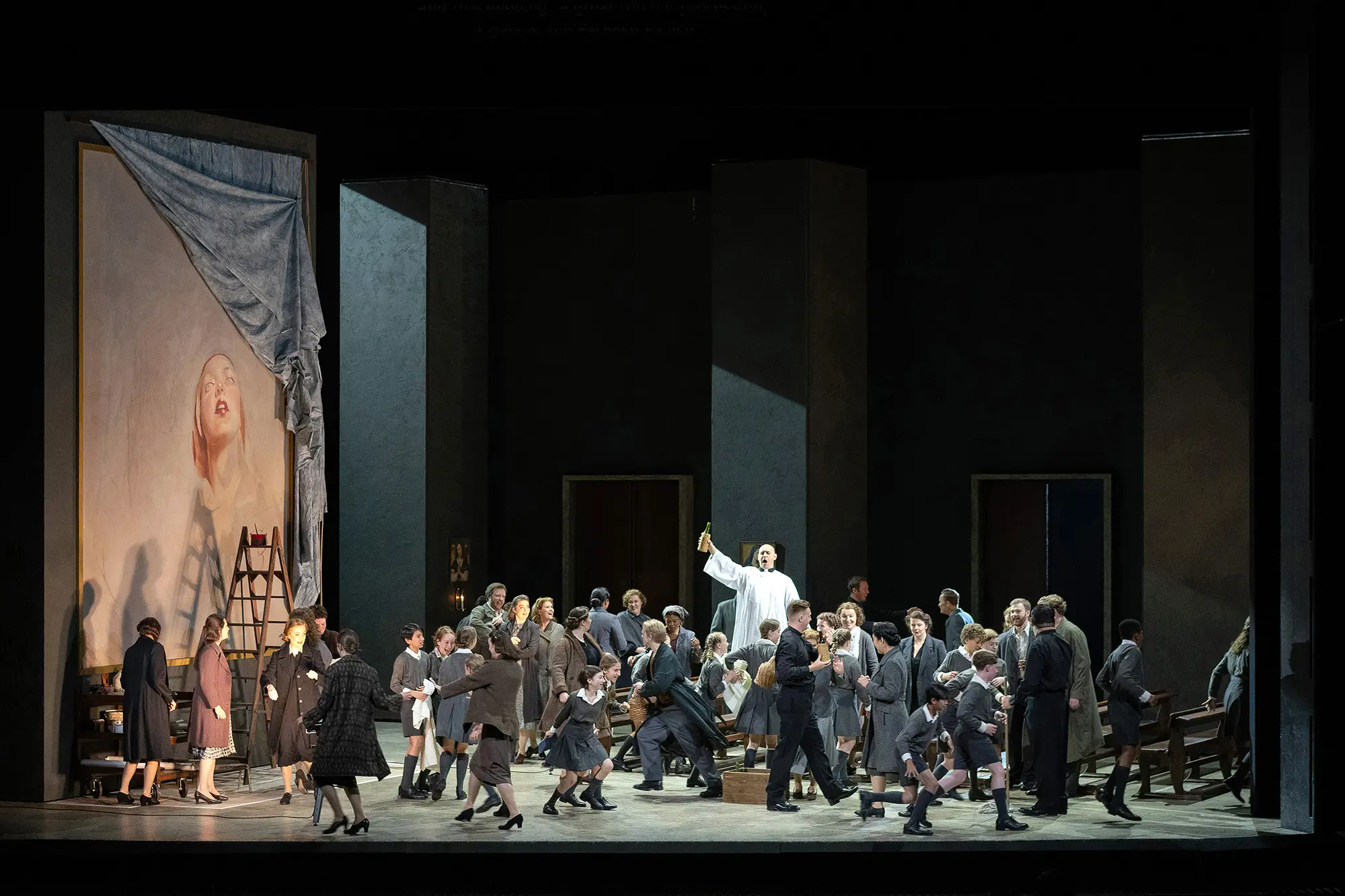
Instead of the 17th century church in Rome where Act I is supposed to take place, Nadja Sofie Eller has created a set more reminiscent of monumental fascist Stile Littorio architecture.
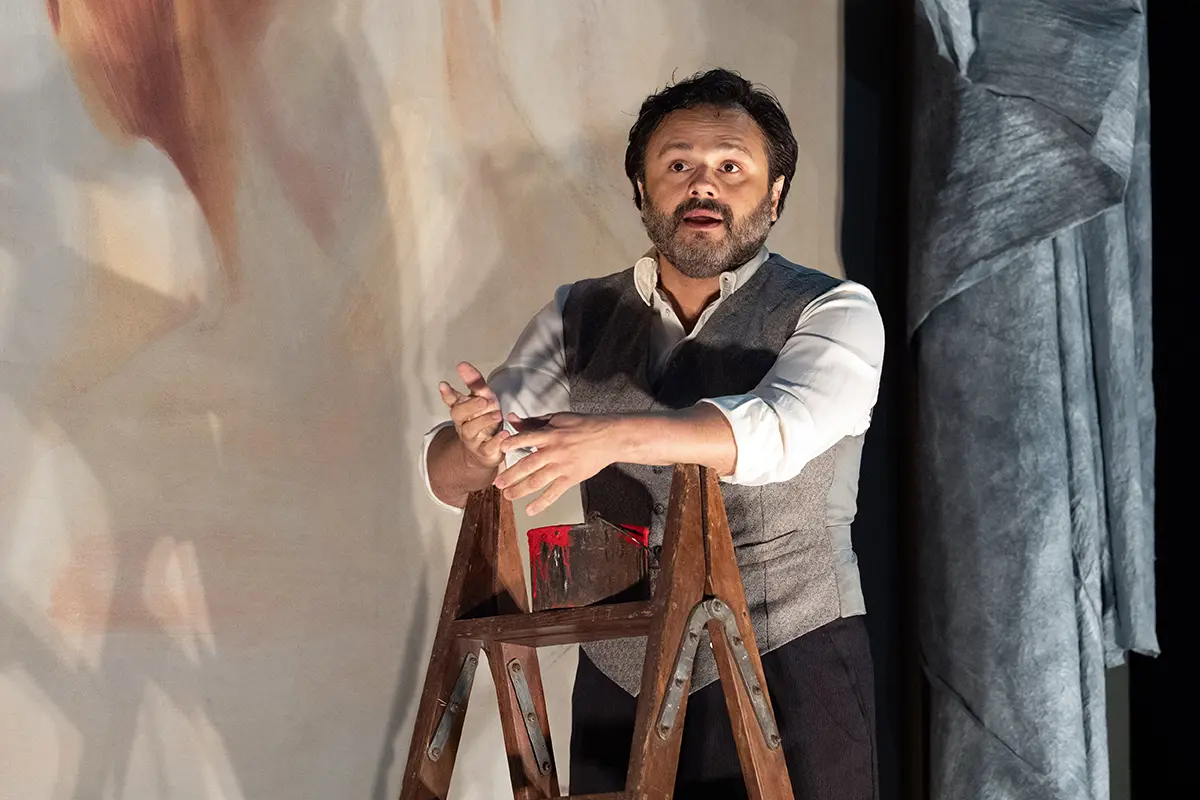
Cesare Angelotti ( Kristian Lindroos), the Consul of the former Roman Republic, has escaped from the Castel del’ Angelo. Staggering into the church, he finds the key left by his sister to access the Attavanti family Chapel. He narrowly avoids the Sacristan (Federico de Michelis) who enters carrying Cavaradossi’s freshly cleaned paintbrushes. Cavaradossi continues work on a large painting of Mary Magdalen, modeled after a beautiful blonde, blue-eyed lady who regularly visits the church to pray. Barely two minutes after after his entrance, Cavaradossi (Atalla Ayan) launches into his first aria (of only two in total), Recondita armoni. It’s a big ask so early on in the performance – requiring a thorough warmup – but the Brazilian tenor pulls it off. With his italianate, lyrical timbre, smooth legato lines, and clear vowels he sets a high bar. He sings of two “contrasting beauties”– the one he admires from afar and paints, and his beloved Tosca. His delicate, sweeping brushstrokes are mirrored in the orchestration, where harp, woodwinds and strings move in parallel fourths and fifths. Unimpressed, the Sacristan mutters about “these various women/in rivalry with the Madonna/smell of the devil ” and he has no truck with the enemies of the Holy Office (i.e. the Republicans). The comprimario roles (supporting roles) carry real weight in Tosca. De Michelis with his pleasant baritone-bass voice, plays a bustling, very reluctant assistant to Cavaradossi and provides welcome comic relief.
With the Sacristan gone, Angelotti emerges from his hiding and recognises Cavaradossi as a political ally. Dragging himself across the stage, Lindroos portrays a thoroughly exhausted Angelotti. What he lacks in acting chops, he makes up for with a voice as deep as a well. Angelotti slips away just as Tosca (Caitlin Gotimer) enters. Immediately suspicious of her lover’s furtive behaviour, she accuses him of conealing a rival. Her jealousy flares into rage when she discovers that the woman in the portrait is the Marchesa Attavanti. Gotimer has a lot going for her: youth, striking looks, and a voice suited to the role. However, she could be more adventurous in her portrayal of the character. In the opening scene Tosca should temper her extreme jealousy by also showing genuine tenderness – a volatile dynamic which Puccini highlighted by fragmenting the recitatives. Sadly, there was very little chemistry between Ayan and Gotimer in the first act, making the magnificent love duet fall flat. Cavaradossi seemed primarily focused on ushering her out so Angelotti could escape. Gotimer’s voice can convey the required emotions, but she often resorts to crossing her arms rather than visibly also expressing those feelings. It is a cliché, but Italians do a lot of gesticulating; Tosca is a fiery diva and not someone prone to bottling up her feelings.
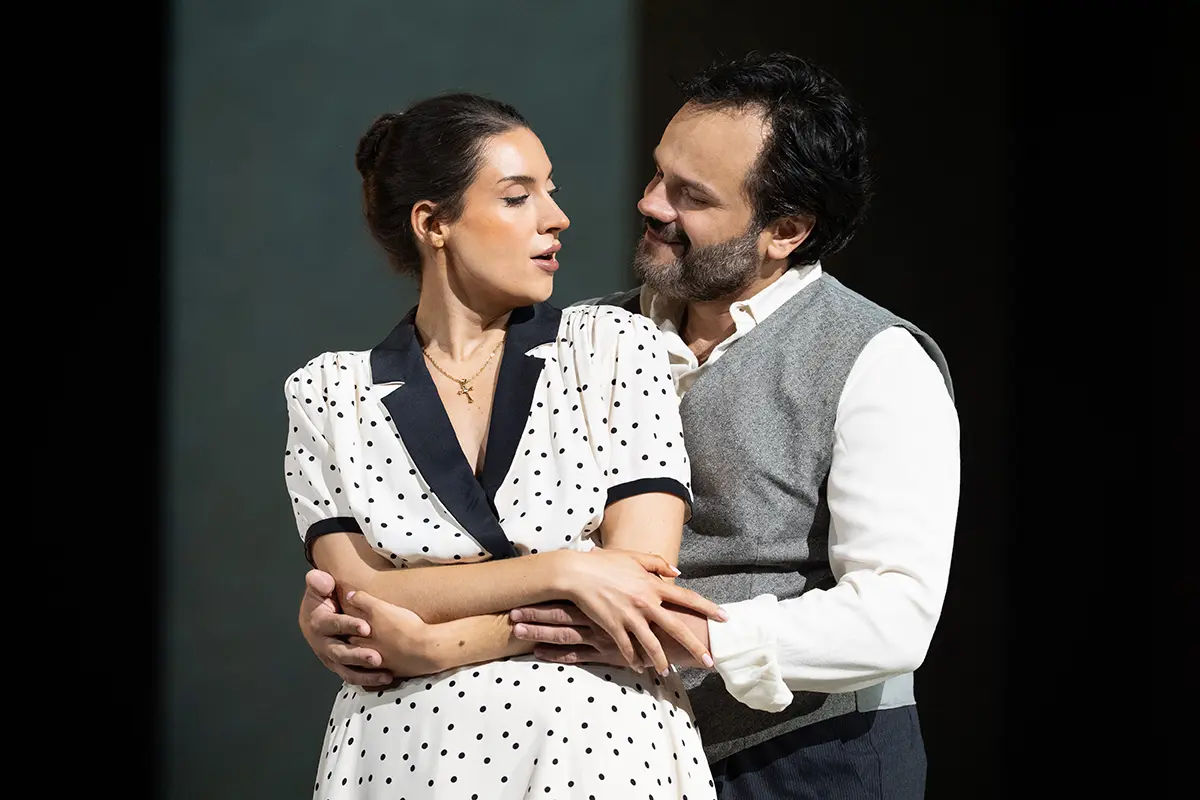
After Tosca departs, Cavaradossi tells Angelotti to hide from the police in the dried-up well at his villa and the two leave together. Angelotti only just about makes it to the exit, while acting his tired socks off. The Sacristan enters excitedly with the choristers, announcing Napoleon’s defeat at Marengo , which is why a Te Deum will be sung as a thanksgiving.
Baron Scarpia’s entrance immediately raises the dramatic intensity. The Chief of Police, searching for the escaped prisoner, finds a fan printed with the Attavanti family crest – left behind by Angelotti’s sister, the Marchesa Attavanti. Scarpia (Vladislav Sulimsky) quickly connects the dots : the Mary Magdalen portrait and the fan will be the evidence to implicate Cavaradossi. When Tosca returns, he fans the flame by suggesting, with feigned civility, her lover’s unfaithfulness. Tosca storms off, intending to catch Cavaradossi and his lover in the act at his villa, prompting Scarpia to order his henchman Spoletta to follow her. Scarpia’s goons – Spoletta and Sciarrone – dress with Sprezzatura, studied effortless grace. Costume designer Astrid Klein has, by looks of it, studied Italian films of the 40s and 50s.
As the bells begin to toll (and cannon shots shake the people in the stalls!), a grand procession accompanies the cardinal to the altar singing the Te Deum. As the sacred music swells, it rouses Scarpia’s lustful fantasies about Tosca and fuels his determination to send Angelotti to the gallows. Sulimsky strikes exactly the right tone in a scene where some singers ham it up, creating a chillingly believable character. Rather than relying on the declamatory style, his approach is supported by smooth melodic flow and resonant breath support.
Act II is traditionally set in Scarpia’s private apartment on the upper floor of the grand Palazzo Farnese. Instead of having supper at his desk, as the stage directions dictate, we find the Chief of Police in a 1940s style restaurant, regaling his guests with plans to dispose of both Cavaradossi and Angelotti by dawn.
Scarpia has summoned Tosca to visit him after the victory concert, held in the courtyard and drifting in through the open window. Meanwhile Spoletta (Didier Pieri) reports that he followed Tosca to the villa, but Angelotti was nowhere to be found. Instead, he has arrested Cavaradossi, who steadfastly denies any knowledge of the fugitive’s whereabouts before being dragged off to the torture chamber – which turns out to be the restaurant kitchen.
Sulimsky proves a master of the insidious smile, and his assured performance helps Gotimer dig deeper into her character. As a result, Act II is more engaging than the first. Cavaradossi urges Tosca to remain silent, but she can’t bear his agonising screams and her resolve finally breaks. She betrays Angelotti in exchange for Cavaradossi’s release from torture. He remains defiant and, when he overhears that the French have turned the tables on the Austrians, finds the strength to extol Napoleon’s victory over the tyrants. This is followed by the opera’s only – very brief but powerful – trio between the three main protagonists, before the painter is dragged away once more.
The last restaurant guests depart, having tacitly witnessed Scarpia’s deceptive interrogation tactics, leaving him alone with Tosca. In the strangely hummable aria Se la giurata fede – rising triplets suggesting his lust – Scarpia explains that he is not after her money, he just wants her. By giving herself to him, she can free Cavaradossi. From outside the sounds of a rather Berliozian March to the scaffold drift into the restaurant, escorting the condemned men to the gallows. Scarpia suggests Mario could be next in line. Sulimsky, dressed in pinstriped black trousers, a white shirt and tie, never reverts to gloating. and even if his burgundy dark voice is rather attractive, he is sure to make your skin crawl.
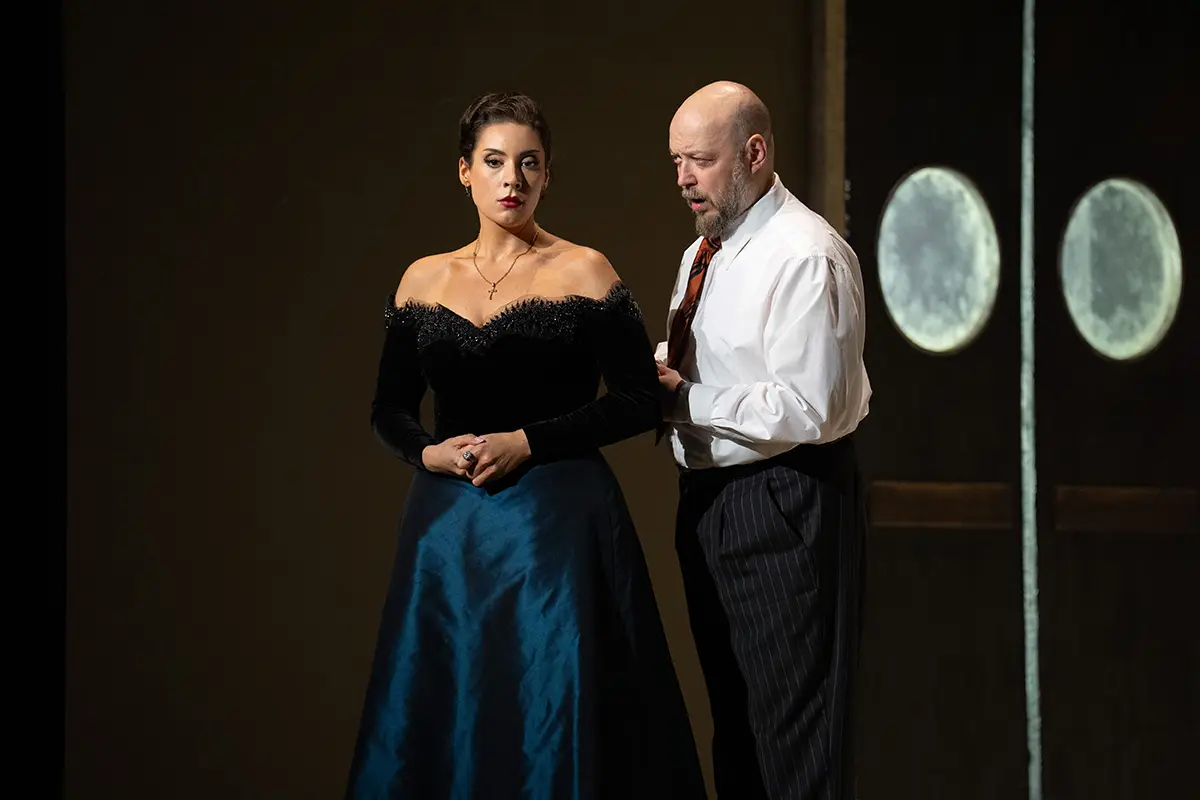
Huffman makes Scarpia exit, leaving Tosca seated on a chair centre stage alone to sing Vissi d’arte , her autobiographical aria in which she confesses only to have lived for love and music.
Gotimer’s dramatic lyrical-spinto voice deals effortlessly with the musical demands, while at the same time creating high expectations for the physical requirements of the role. Yet there is very little sense of her pouring her heart out, despite the momentous decisions she has to make. She will surrender to Scarpia’s lustful wishes, on one condition: that she and Cavaradossi will be given a safe-conduct letter to enable them to leave the country. Scarpia explains that an execution will have to take place, but promises it will be a mock execution.
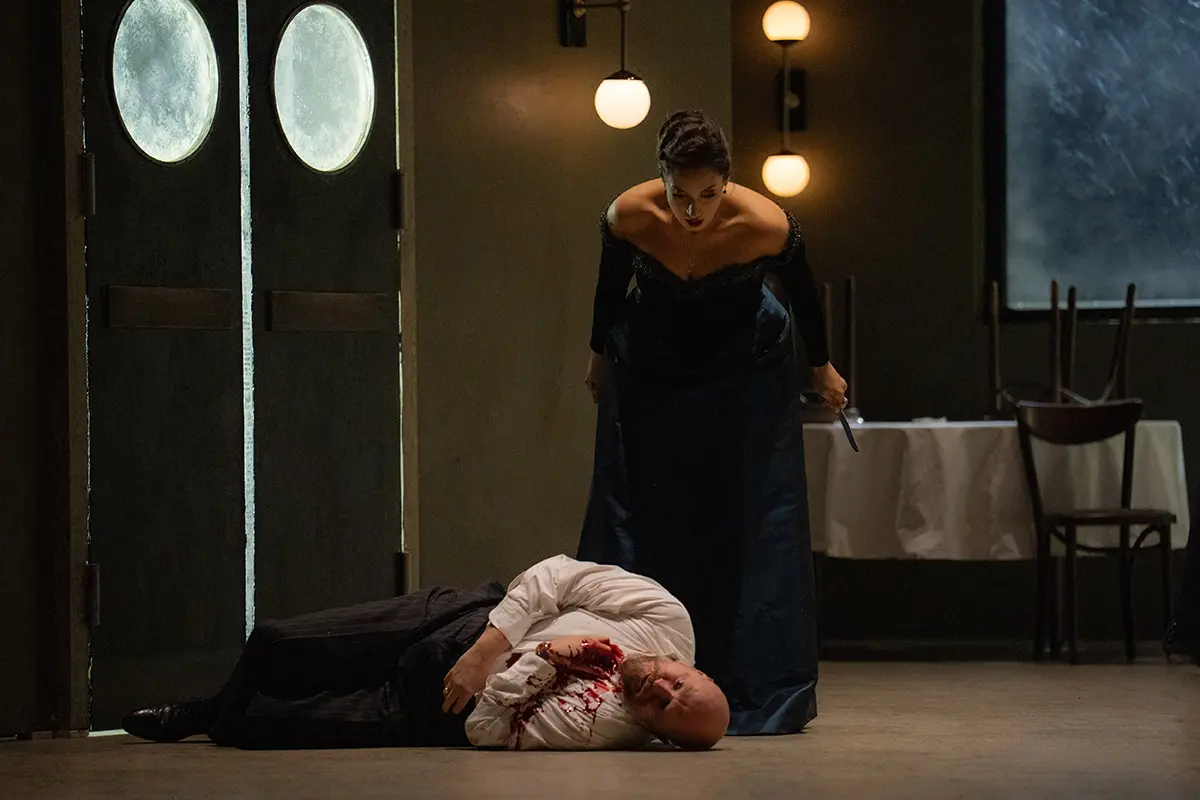
Tosca has no problem finding a knife in the restaurant, and once Scarpia has finished writing the letter, he is ready to claim his ransom. Gotimer stabs him repeatedly, unleashing a stream of non-lyrical expressions: gridando (shouting) con voce strozzato (choked voice) con odio (hateful) soffocato (sufocating) and con forze crescente ( with increasing force). If only Gotimer had released some of those emotions earlier, we might have witnessed a classic. She punctures her tormentor with such force, making such a mess, that instead of placing a candle on each side of Scarpia’s head (as instructed in the stage direction), she schlepps him into the kitchen. She returns to wipe the blood off the floor and the restaurant wall. This is a no scruples Tosca.
In Act III the action no longer takes place at the iconic Castel Sant’Angelo. Instead, we are told in the programme book, the execution takes place in a field near the Roman mausoleum. Three prisoner, bound and gagged, stand in the field. Police officers walk up to them and shoot them mercilessly before dumping their bodies behind a high earthen wall. It makes for a strikung contrast with the sweet, lyrical and nostalgic prelude, which depicts dawn breaking, a shepherd boy singing and bells ringing in the distance. In this act the London Philharmonic Orchestra and a couple of their principals (clarinet and violin) get to shine.
Cavaradossi is hauled from a car parked in the field. He is given pen and paper to write a farewell letter and loses himself in his memories of Tosca’s soft kisses and the way she fell into his arms. If Ayan has so far been an able, if not particularly remarkable Cavaradossi, he now rises to the challenge in the E lucevan le stelle aria and throughout the rest of the final act. He avoids the teary, rather pathetic approach to the role that some spinto tenors resort to. Instead, he sounds as though he truly is muoio disperato , dying in despair, and E non ho amato mai tanto la vita! – I have never loved life so much. Love becomes inseparable from death and Aya sings as though his life depends on it.
Tosca appears and shows him the safe-conduct letter she made Scarpia write. Cavaradossi points out that Scarpia never grants clemency. Does he suspect an ulterior motive: a favor in exchange for sex? Tosca explains that she has killed the evil monster. There is only one small task to complete before freedoms awaits: Scarpia had demanded an execution, but it would be merely for show. There will be a firing squad but, not not to worry, they will shoot with blanks.
Cavaradossi’s task is to fall convincingly dead until the soldiers have left. There is no time to practice, but there is still time for a brief, rapturous love duet before the firing party arrives. They take aim and shoot, Cavaradossi falls, and the soldiers march off. Once Tosca is sure they have gone, she urges him to get up. When she kneels beside him, she realises that Scarpia has deceived her: Cavaradossi is dead. Meanwhile, the police have discovered Scarpia’s body and they are closing in to make the arrest. Instead of leaping to her death, Tosca turns and runs towards her pursuers and is killed. As a result, Caitlin Gotimer is spared the dramatic (as instructed in the libretto) jump off the castle wall into the abyss, and the risk of a Sarah Bernhardt-style injury to her knee. Overall, Gotimer could have taken greater risks in her performance, and her failure to deliver a particularly memorable performance is certainly not due to a lack of talent.
Conductor Jordan de Souza has his work cut out. Tosca is one of the most frequently performed operas of this century. Does that make it easier to pull off a good performance? Probably not; it may make it harder. Many older members of the audience will have seen the opera before, and may own several recordings, so expectations are pretty high. It is actually a tricky score to conduct, with its constant tempo changes, demanding vocal writing and the off-stage elements. Then there is the orchestral balance; Tosca is quite brass-heavy, and if not kept in check the singers can easily be drowned out. De Souza has it all pretty much under control , helped considerably by one of London’s top orchestras.
ALBERT EHRNROOTH
You can find my review of Glyndebourne’s excellent production of Richard Strauss’ Ariadne auf Naxos here
Remaining performances at Glyndebourne: 13, 15, 18, 20, 24, 27, 30 August 2026