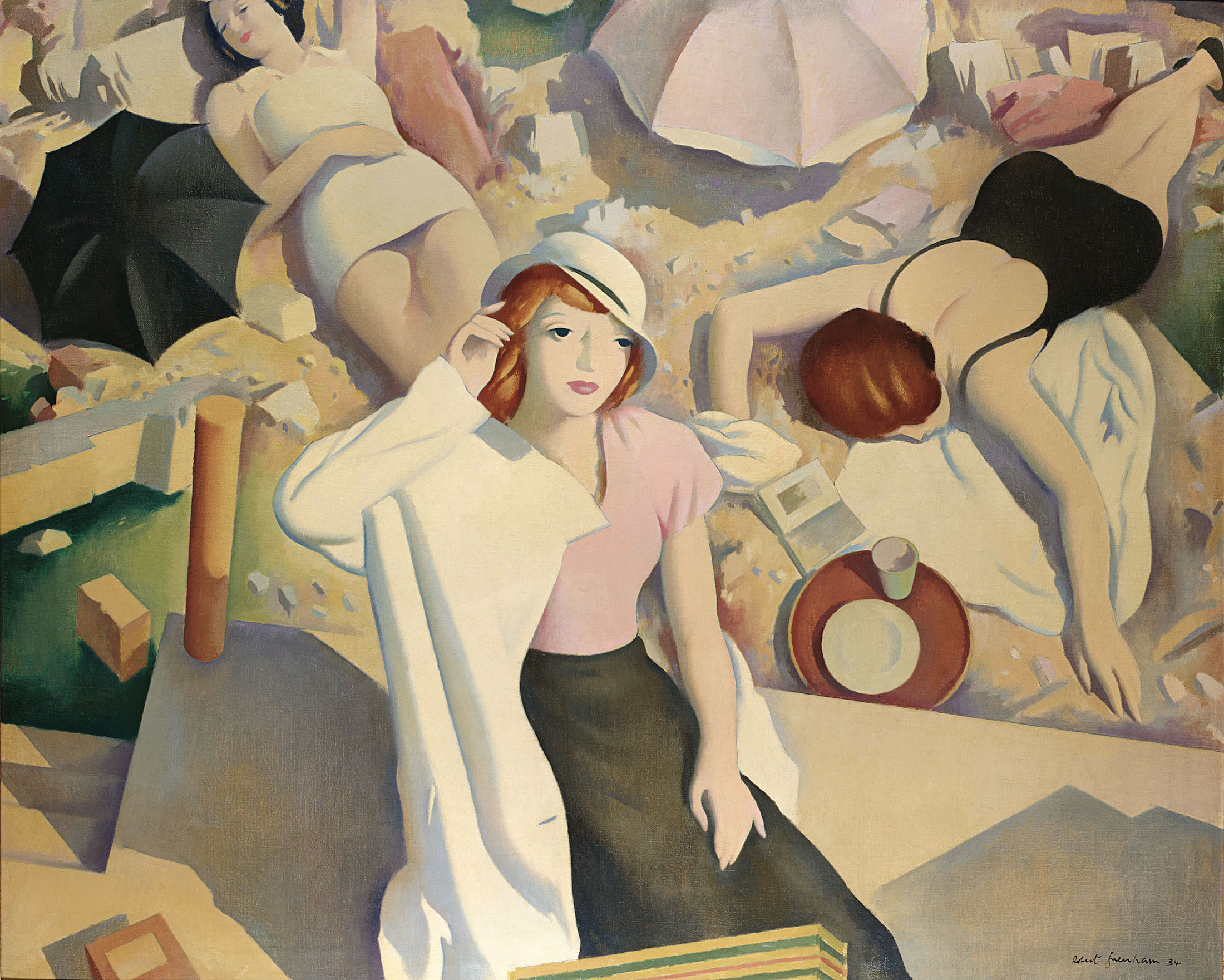
Southampton City Art Gallery deserves to be far better known.The museum has long shared a historical relationship with the National Gallery, whose directors – most notably Kenneth Clark – played a pivotal role in shaping Southampton’s small, yet impressive international collection. In 1975, after acquiring a major and very expensive Monet, the gallery refocused its acquisition strategy on contemporary British art instead.
Highlights from this collection, alongside a selection from the private Ingram Collection are currently on display in the exhibition Art Then!, British Painting Sculpture and Drawing 1910-1960.
I was wondering why curator David Boyd Haycock chose to frame this exhibition between 1910 and 1960. As he explains :
¨We begin in 1910 because of the exhibition Manet and the Post-Impressionists, curated by Roger Fry. It was a groundbreaking event in the history of British art. It brought Manet, Picasso, van Gogh, Gauguin, Cézanne to British audiences . It caused a great deal of controversy and a great deal of excitement, confusion, anger and inspired a great many artists to look again at how they could approach art.¨
Beyond Fry’s landmark exhibition at the Grafton Galleries in London, 1910 was quite a significant year in Britain, marked by major social and political shifts. The Suffragettes were violently attacked by police outside the House of Commons, accelerating the movement’s shift toward more militant tactics. The British public was starting to enjoy the entertainment offered by the first purpose-built cinemas. In May 1910 Edward VII died– marking the end of the Edwardian era. Fittingly Frederick Hall’s stately portrait of the monarch, wearing his scarlet military dress uniform, opens the exhibition.
In contrast, by 1910 all was quiet on the art front. Both on the musical and the art front front the country was a bit of a yawn. Victorian painters such as the Olympians’ – Alma-Tadema, Leighton, Poynter and Waterhouse – dominated the art scene with conservative, idealised depictions of ancient Greece and Rome, often laden with moral narratives. Similarly, the Pre-Raphaelites rejected modern life and instead painted Shakespearean scenes and pictures reminiscent of 15th century Italian art. They were often superb craftsmen, deploying skills that were based on Renaissance drawing techniques, yet they had largely run out of fresh ideas.
Initially impressionism failed to make an impact in Britain. Although Monet and Pissarro took refuge in London during the Franco-Prussian war in 1870 – Monet returned between 1899 and 1901 to paint his famous Thames series – British artists took little notice. Only Walter Sickert and Philip Wilson Steer, who were both influenced by the American impressionist painter James Abbott Whistler – championed the radical French style. They founded the New English Art Club in 1885 and organised the first impressionist exhibition four years later. However, the style found few takers in Britain, and the art critic Roger Fry ultimately dismissed British impressionism as a pale imitation of continental art.
“Truly, to be modern, one must repudiate the ancient”

Many in Britain tend to view the French as arrogant ,and around the turn of the century the attitude of French artists and art dealers toward British painting seemed to confirm that stereotype. The legendary art dealer and publisher Ambroise Vollard was hardly alone in his disdain when he told an English critic: “Ÿes, you have Walter Sickert, but who else have you? There are no painters in England.” Sickert was virtually the only contemporary British artists invited to hold a solo exhibition at a prominent Parisian gallery.
Despite this widespread dismissal, British art found unexpected admirers abroad.
As a young man, Picasso was fascinated by the pre-Raphalites and Edward Burne-Jones. One of his most accomplished early paintings, Science and Charity (1897) shows striking compositional similarities with Luke Fildes’s deeply personal and widely reproduced painting The Doctor (1891). Decades later, Picasso directly affirmed to Duncan Grant his long-standing admiration for the way Burne-Jones portrayed his female models.
Although Roger Fry studied at the Académie Julian in Paris and was a competent painter – modestly describing himself as “not a great artist, only a serious artist with some sensibility and taste.” But his reputation ultimately rests on his work as a critic. He co-founded the high-quality art publication The Burlington Magazine (which is still going), and was an expert on Renaissance art. In 1906, he was appointed Curator(and buyer of paintings at the Metropolitan Museum of Art. In that role he came across Cézanne’s paintings. This ‘discovery’ changed everything, and from then on he embraced Post-impressionism – a collective term he actually coined and used for his exhibition at the Grafton Galleries.
David Boyd Haycock explains why the exhibition Manet and the Post-Impressionists was so significant, and if the same works were in a show today, it would be a complete sell-out!
The Southampton Art Gallery exhibits a good example of Fry’s love of Cézanne’s Provence. But Fort André, Villeneuve–les–Avignon (1913) is little more than an adequate landscape in the master’s manner.
The exhibition’s first room covers the period 1910-1930, a period in which British art changed dramatically. Judging by some of the works Haycock selected fro the Southampton and Ingram collections, this transformation was not always for the better. The French influence is cobvious in Augustus John’s Port de Bouc (1910), yet he makes the coastal landscape look thoroughly unwelcoming, as if stricken by a green contagion. Mark Gertler – best known for his anti-war painting The Merry-Go-Round (1916) – is represented by The Doll (1914). Depicting an unclad wooden doll staring at the viewer amid richly coloured book spines and a bowl of fruit, it is a creepy, unsettling, and nightmarish piece.
However, it’s not all Great War doom and gloom.
Spencer Gore’s Brighton Pier (1913) captures the serene flavour of a Seurat seascape or a Pissarro riverscape,while adopting Gauguin’s flat forms and clear outlines. In many ways. Gore was the most important painter of the Camden Town Group – and arguably more talented than Sickert with whom he co-founded it. Gore was also the only member of “the English Group” represented in Fry’s Second Post-Impressionist Exhibition at the Grafton Galleries in 1912. Unfortunately, his commitment to plein air painting during a cold and wet winter in Richmond Park brought on pneumonia, causing his death in March 1914 at just 35. It was a tragic loss to the awakening independent English art scene, as his full potential was never realised.
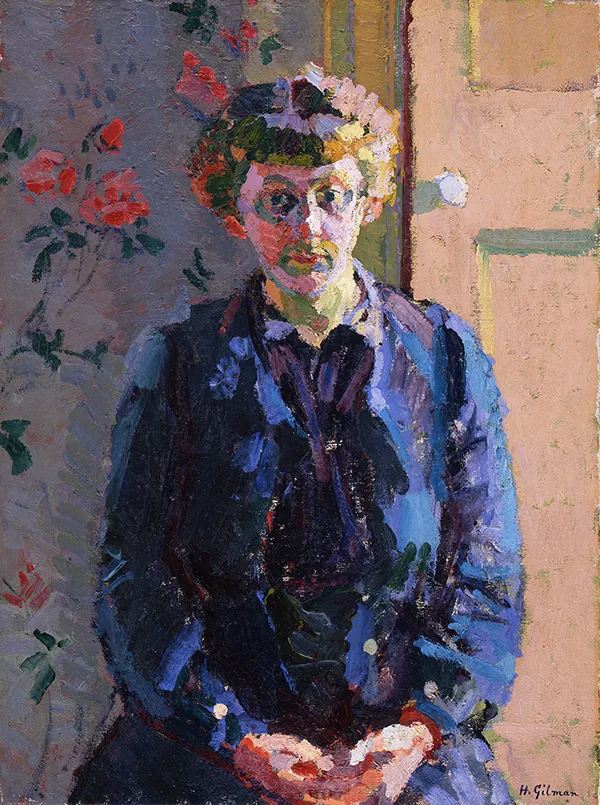
The same could be said of Harold Gilman (1876 -1919), president of the Camden Town Group The Manet and the Post-impressionist exhibition and a subsequent trip to Paris turned him into a passionate admirer of van Gogh. The Dutchman’s influence is evident in the vibrant, dotted colours and impasto application of Gilman’s three-quarter length portrait of artist Sylvia Gosse. She became a lifelong friend of Sickert and managed his art school, eventually taking it over after his death.
Sickert’s pencil and ink drawing Lady of the Chorus (1912) does not show him at his best, even if its subject – a young woman dressed in a chemise sitting on a bed in a soulless room – is quintessentially his style.
Percy Wyndham Lewis (1882-1957) is the most remarkable–and controversial – of the 30 painters featured in the first room of the exhibition. Lewis was born on his parents’ yacht to a wealthy father who was an American Civil War veteran. He moved with his mother to Britain, won a scholarship to the Slade school, was thrown out, and subsequently spent several years studying painting in Paris. Upon returning to Britain he developed Vorticism, a unique style drawing on aspects of Cubism , Futurism and Expressionism. During World War I he enlisted in the Royal Garrison Artillery, served at the front, and was later appointed an official war artist for the Canadians and the British
His Drawing of a Great War, the Menin Road (see picture above) displays the typical expressionist angularity applied by the Vorticists. Lewis was an innovative artist, but after the war he became better known for his writing, a body of work that too often was soacerbic and goading, that it on a number of occasions led to costly libel actions. When he began praising totalitarianism and notoriously described Hitler as “a man of peace,” publishers and friends bdistanced themselves from him. He recanted after a visit to Nazi Germany, but the fascism tag stuck. Following the Second Worl War he re-established himself as an insightful art critic, championing young artists like Francis Bacon
.MORE, SOON


