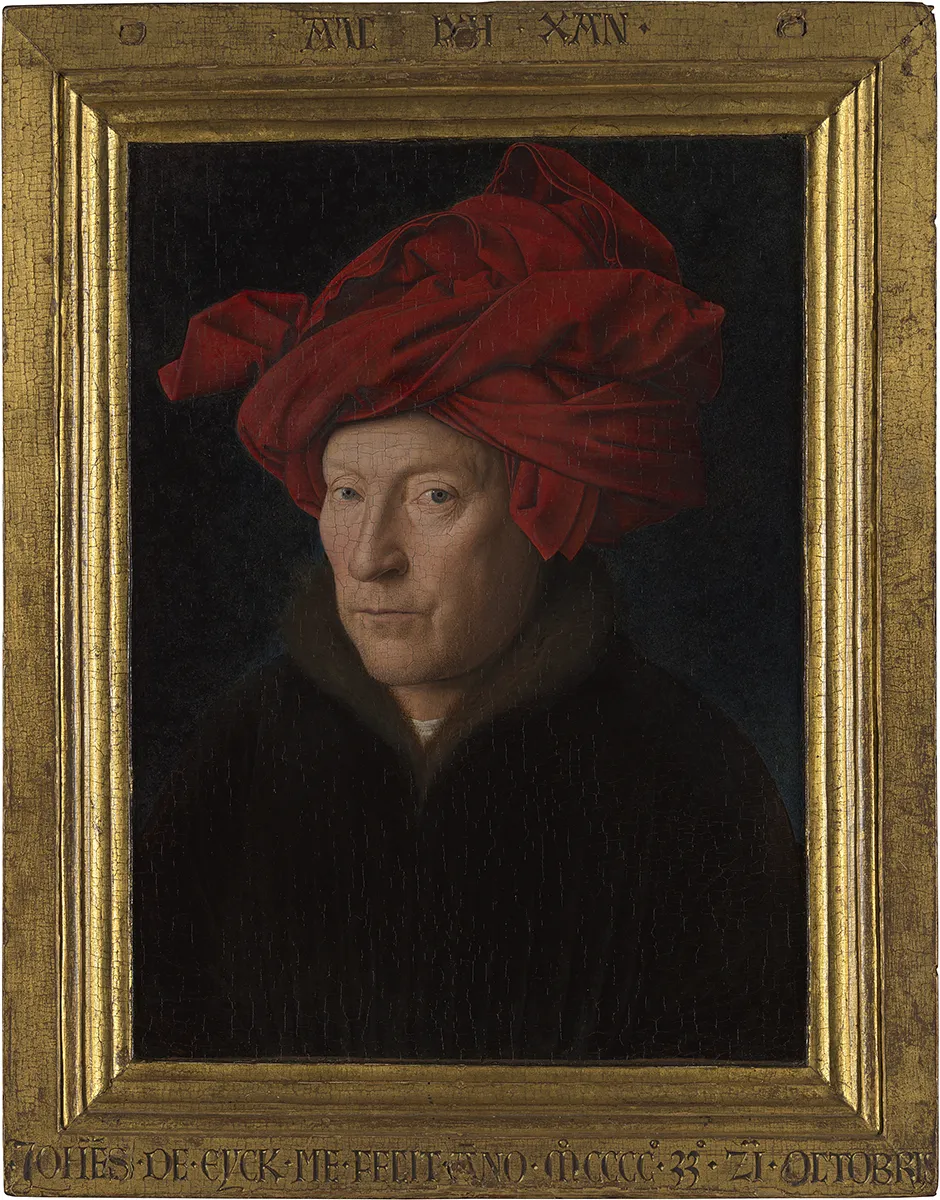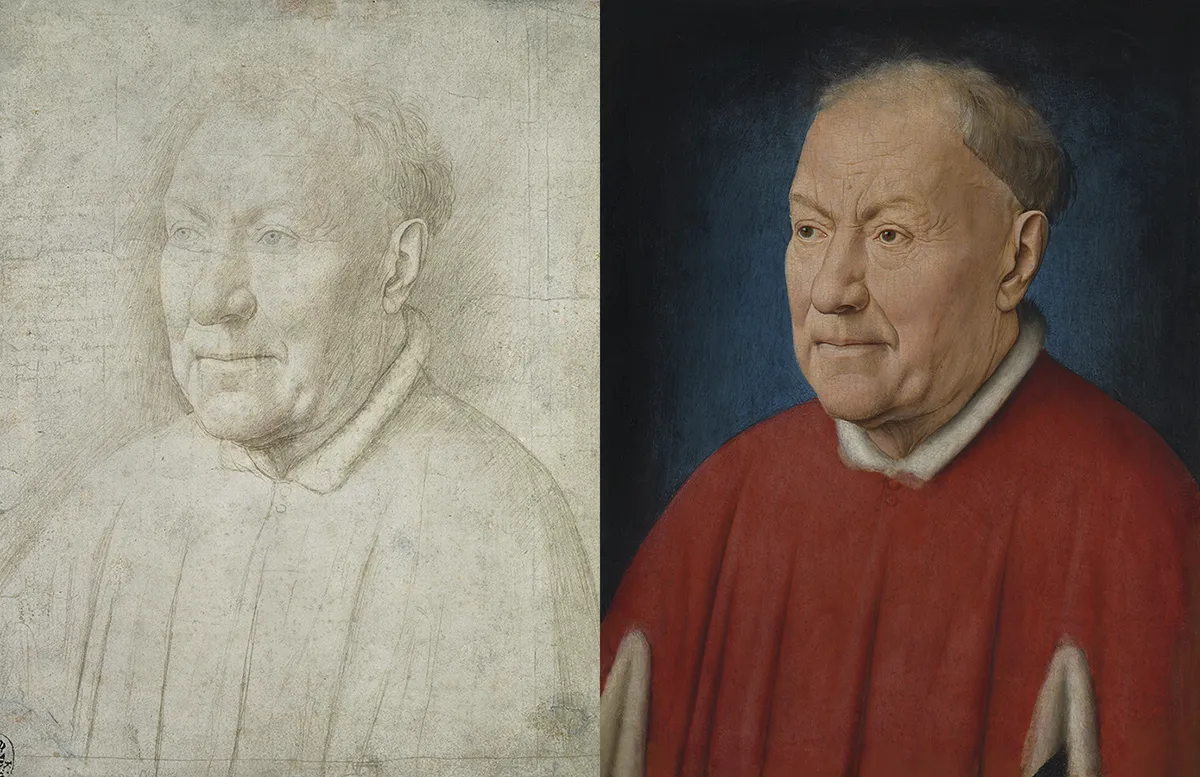
Jan van Eyck upped the ante for portrait painting, while simultaneously perfecting the emerging technique of oil painting. The National Gallery in London has brought together all the nine surviving painted portraits, along with one drawing, attributed to him. It is the first time all these likenesses have been shown together, and as an added bonus, four of the panels are encased in glass, allowing a view of the reverse side.
Jan van Eyck (ca.1395–1441) did not invent oil painting, yet his superb handling of the versatile medium allowed him to achieve exquisite detail, generating brilliant luminosity and a high degree of verisimilitude by applying thin, semi-transparent layers of colour over one another.
Giotto reinvented portraiture in the 14th century by breaking away from the traditional medieval practice of creating flat, two-dimensional and generic representations of people. A century later, Van Eyck pushed the genre in a new direction by focusing on the subject’s distinct and individual identity. As the German art historian Erwin Panofsky suggested, such portraiture also “seeks to bring out whatever the sitter has in common with the rest of humanity.” Whereas earlier artists favoured the profile view, Van Eyck adopted the three-quarter portrait, establishing a more intimate dialogue between viewer and sitter.
The intimacy that comes across in these portraits must have been surprising to the sitters and astounding to those who knew them: nothing quite like them had been seen before. In late medieval and early Renaissance portraits, patrons typically had themselves–and occasionally his wives–included in a devotional picture or altarpiece they had commissioned. However, these paintings made no attempt to capture every detail accurately, even when they conveyed a sense of a person’s distinct features.
Van Eyck’s ability to render different kinds of materials, textures, and surfaces is extraordinary: he records every hair on a dog, every stubble on a chin, and every vein in a bloodshot eye with utmost precision – a level of visual illusion that even a modern photograph struggles to match today. While van Eyck’s contemporaries in Florence, such as Masaccio and Jacopo Bellini, were still working with tempera and gold pigment, Van Eyck perfected an approach a new technique that suited his patience and diligence, offering handling qualities far beyond what was possible with egg- and glue-based media.
In doing so, van Eyck raised the stakes for his Netherlandish colleagues. Within a few decades, painters in Southern Europe were catching on and following his lead, and oil painting gradually overtook tempera as the dominant medium.
These independent portraits make up almost half of the roughly 20 works confidently attributed to Jan van Eyck, though donor portraits also appear in five of his devotional works. The most famous examples are Joos Vijd and his wife, Elisabeth Borluut, shown kneeling in prayer on the outer panels of the closed (exterior) Adoration of the Lamb Altarpiece in St. Bavo’s Cathedral, Ghent. None of these devotional paintings are included in the exhibition–and in case, the Ghent Altarpiece never travels.
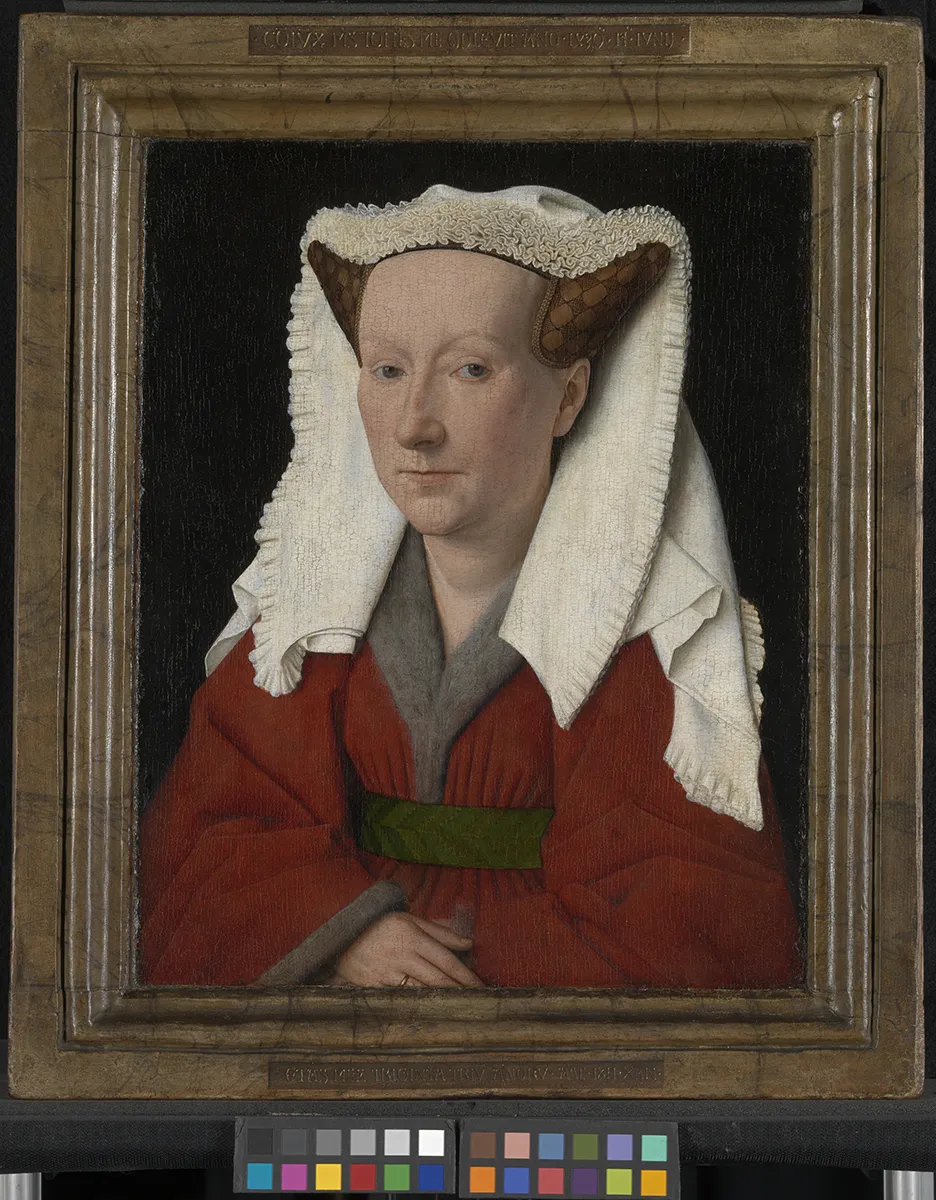
Three of the nine portraits have retained their original frames, which allows us to identify the sitters. Van Eyck put a great deal of thought–and a touch of mischievousness–into these frames, tand there is no better example of that than the Portrait of Margaret van Eyck (1439). As the excellent exhibition catalogue text states that this is: “The earliest dated portrait of a named woman who was neither royal nor an aristocrat – a milestone in the history of European painting. It is also Jan van Eyck’s only surviving female likeness and his last known portrait.
Why do I have this idea that Jan van Eyck was a rather jovial man who enjoyed a good prank? Perhaps it’s something about the Flemish mentality–I lived and greatly enjoyed Antwerp for a year and I have traveled extensively in Belgium (and yes I do speak Dutch).
Margaret certainly looks like a woman who could haold her own with a mischievous husband. She wears a horned hennin, a style of headdress that for a while was all the rage in Burgundy, France and England. Draped over her hair, is “a single piece of white linen with fluted edges folded several times on itself.” The virtuosic skill Van Eyck displays in rendering this is what Panofsky called a “calligraphic maze of pleated ruche.”
Van Eyck is making no attempt to beautfiy his wife. At first glance she may seem rather plain, yet her high forehead, thin upper lip, and pale complexion were all desirable, fashionable qualities that a gentlewoman was expected to possess. Van Eyck also,–impishly, perhaps?– shows that there is a tiny gap in her left eyebrow, which could be the result of an old scar, or overzealous plucking.
Margaret’s gaze is authorative, without being unfriendly;.and she seems to be keeping a close eye on what her husband is up to, even while gazing straight out at us.