Glyndebourne’s production of Richard Srauss and Hugo von Hofmannsthal’s mash-up opera Ariadne auf Naxos is an absolute treat for the ears. The singers, the conductor and the orchestra are nearly all of a very high standard, crowned by Alina Wunderlin’s showstopping performance as Zerbinetta. Strauss’s curious neoclassical blend of opera buffa and opera seria starts to make sense here, finally convincing this reviewer that the opera is a masterpiece. However, I have some concerns: is the set – and by extension , some of the staging – always helpful to the singers?
The history of the origins of Ariadne auf Naxos is a fascinating story in itself, one that is somewhat convolutedly reflected in the the final version of the opera.
In January 1911 Strauss and Hofmannsthal’s second collaboration, Der Rosenkavalier, premiered in Dresden to great acclaim. Yet Hofmannsthal was frustrated, feeling his brilliant libretto had been overshadowed. He believed that the 100-plus piece orchestra regularly drowned out the words and he wanted to forge a closer union between text and music by re-introducing spoken dialogue and plain recitative – a staple of 18th-century opera.
Both men felt immensely indebted to the distinguished director Max Reinhardt, who had saved Der Rosenkavalier when its original director lost his way. Hofmannsthal proposed writing a short 30-minute chamber opera as an act of gratitude for Reinhardt. Molière’s plays were back in vogue at the time, and Hofmannsthal was particularly inspired by the playwright’s dynamic collaborations with Jean-Baptiste Lully, which pioneered the comédie-ballet genre that successfully blended theatre, dance and opera.
Hofmannsthal adapted Molière’s Le Bourgeois gentilhomme (1670), which incorporated incidental music that Strauss based on some of Lully’s originals. The play – heavy on dialogue and low farce – was juxtaposed with high art; a mini-opera seria depicting Theseus’s abandonment of Ariadne on Naxos.
Strauss conducted the premiere in Stuttgart in October 1912, but combining a play with an opera proved unsatisfying, and neither the audience nor the critics took to the concept. Interestingly, Thomas Beecham – who successfully premiered this curious version of two very different halves in the UK – wrote in his biography that in its earlier form “the musical accomplishment of Strauss attained its highest reach, yielding a greater spontaneity and variety of invention…than anything that his pen had yet given to the stage.” Beecham remained the main proponent of Ariadne‘s first version.
Following the Stuttgart flop, Hofmannsthal revised the work, replacing Molière’s play with a (mainly) sung comic Prologue which follows the backstage bustle preceding the serious opera. Strauss, meanwhile, had other projects on his mind and only after having completed the Alpine Symphony and the opera Die Frau ohne Schatten, did he, reluctantly, restart the work on Ariadne. He salvaged the incidental music from the play and turned it into an orchestral suite which is simply called Le Bourgeois gentilhomme. He effortlessly produced a new score for the Prologue and persuaded Hofmannsthal that the Composer had to be a trouser role, despite the librettist’s initial fear that it would trivialise the character. Together they also trimmed the second half, toning down the commedia dell’arte elements.
Strauss fulfilled Hofmannsthal’s request for a scaled-down orchestra modeled on Baroque and 18th century ensembles. For the revised version Strauss turned to his Hausgott – his favourite composer, Mozart. The Prologue in particular is Mozartian both in form and idiom. In Harlequin’s song Lieben, Hassen, Hoffen he references Mozart’s Piano Sonata in A-Major, (KV 331). The Composer – a breeches role, much like Octavian in Der Rosenkavalier – is another direct nod to the master. Elsewhere Strauss borrowed the melody for the Nymphs’ s Trio Töne, töne, süße Stimme from Schubert’s Wiegenlied D 498. By contrast, he ventured into Wagner territory – with a touch of sarcasm – for Ariadne and Bacchus high-minded final duet. The Nymphs are direct descendants of the prophetic sisters, the Norns, in Götterdämmerung. For Zerbinetta’s virtuosic vocal feats he drew inspiration from the Baroque era combined with Bellini and Donizetti.’s bel canto technique.
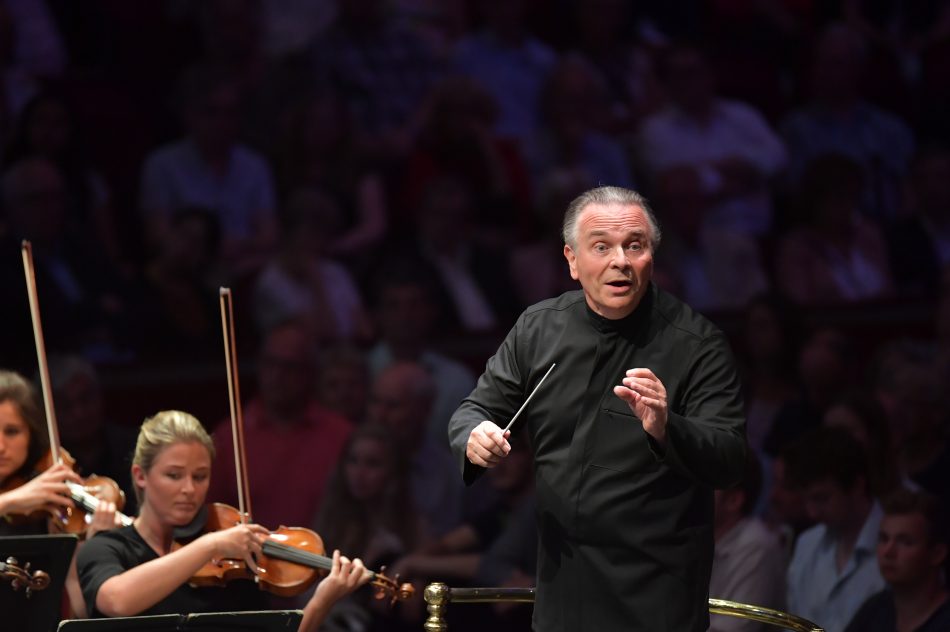
Robin Ticciati has been Glyndebourne’s musical director since 2014, and his partnership with the resident London Philharmonic Orchestra is exemplary – quite simply one of the finest operatic pairings in the country. Together, they don’t miss a beat or nuance in Strauss ‘s intricate score. The detailed phrasing, the rubatos, you get a real sense that Ticciati and the LPO know how to grade the colours to suit the singer. Although the chamber-like score calls for only 38 players in the pit, you would never guess it when Strauss pulls out all the Wagnerian stops for the ecstatic love duet between Ariadne and Bacchus, which he sets it in D flat Major – a key celebrated for its distinctly lush and romantic tone.
Prologue
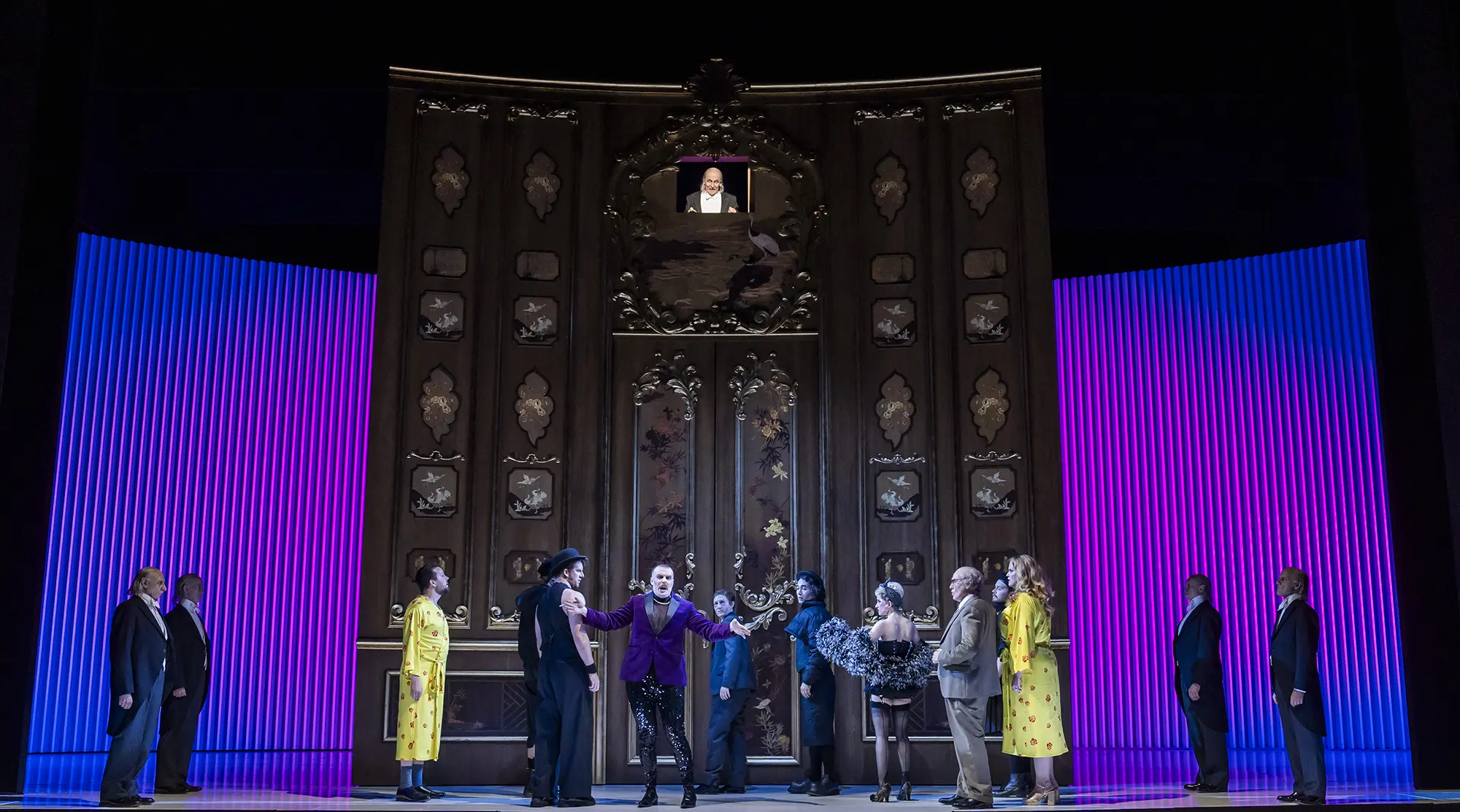
The prologue takes place in ‘the house of the richest man in Vienna” where opera singers, a composer, a music master, and a commedia dell’ arte troupe are preparing to entertain the unnamed host and his guests. The young Composer (Samantha Hankey) is set to present his heroic opera Ariadne which is to be followed by a buffa-style comedy: The Unfaithful Zerbinetta and her Four Lovers. Consternation ensues when the Major-Domo (William Relton), in a speaking role, announces that His Lordship has decided that the farce and the opera must be performed simultaneously, to allow enough time for the fireworks afterwards. Relton’s sharp sarcasm makes it clear that these creatives are completely at the mercy of their wealthy patron’s whims.
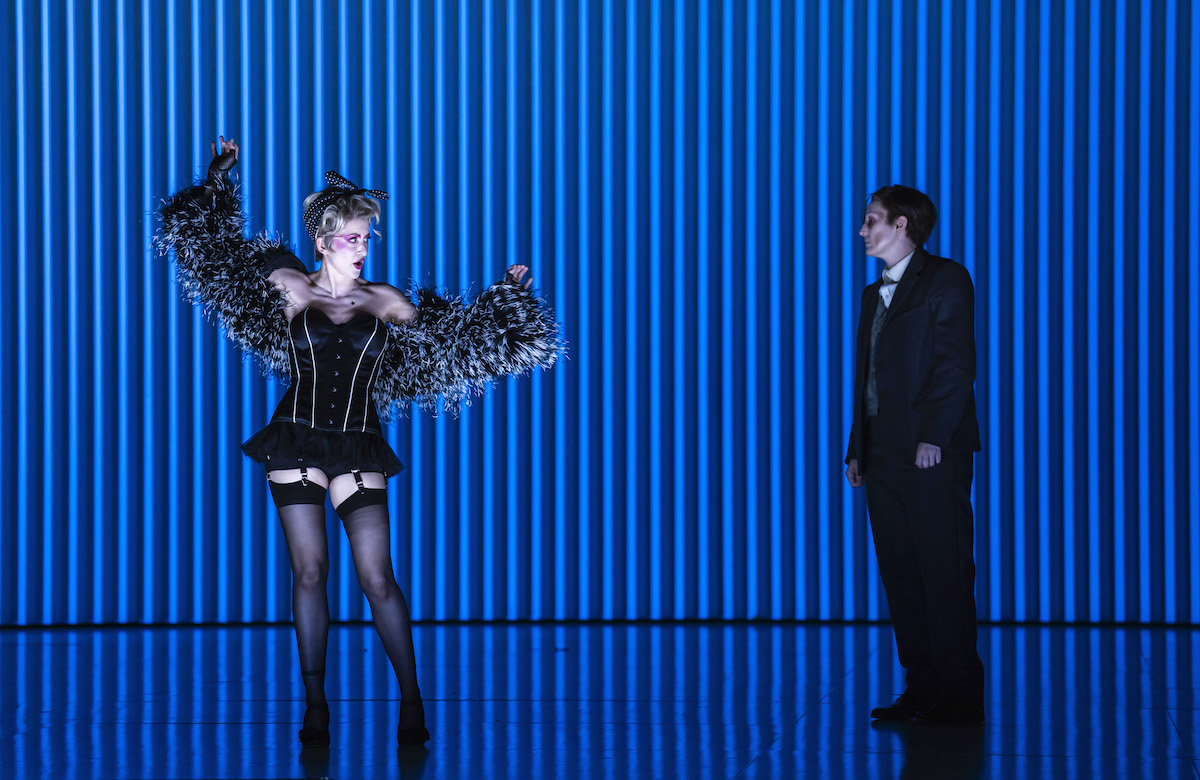
The idealistic, humourless Composer,– clad in an ill-fitting suit – is horrified by the prospect of making cuts, but he is eventually won over by Zerbinetta’s flirtatious charm. Smitten, he succumbs, though he is ultimately furious with himself for compromising his values money and the allure of a saucy comedienne. Hankey’s relaxed, rich and youthful voice is exceptionally well-suited to the trouser roles of Strauss and Mozart. Her robust lower and middle range ascends effortlessly to the heights of the Elysian fields where Musik ist eine heilige Kunst, music is the most sacred of arts. Although the Composer has no singing role in the second half, director Laurent Pelly has him every now and then popping up in the background to ensure that the opera singers live up to his high artistic standards.
Zerbinetta (Alina Wunderlin), dressed in a burlesque-inspired outfit – complete with a black satin corset, tassel boa, garter belt and stockings – is the life and soul of the troupe preparing for the harlequinade. It is no wonder that even the high-strung Composer finds her irresistible. In her cabaret costume Wunderlin owns the stage, though she would undoubtedly even without it. Her voice easily matches, and at times even surpasses, many of the famous Zerbinettas who have defined the role in the past. Above all, her persuasive coquettetishness and razor-sharp comic timing make this a truly standout performance.
Ariadne: The Opera itself
The Greek myth of Ariadne’s abandonment on the island of Naxos by Theseus was the subject of one of Monteverdi’s (now lost) operas. During the Baroque era, the tale of Theseus sneaking away while Ariadne sleeps became a popular subject for composers. Hofmannsthal stripped the tale to its essentials, infused it with some thanatos (a death drive) while replacing Homer’s fatal ending (as told in the Odyssey) with the arrival of Bacchus as Ariadne’s saviour.
At the start of the second half we find Ariadne (Rachel Willis-Sørensen) alone on a rocky outcrop. Naiad (Anna Denisova), Dryad (Ekaterina Chayka-Rubinstein) and Echo (Eirin Rognerud) – the three Nymphs – watch the Cretan Princess as she wallows in self-pity. She is the sort of woman who belongs to only one man, and now that he is gone, she only wants to die. Or so she thinks.
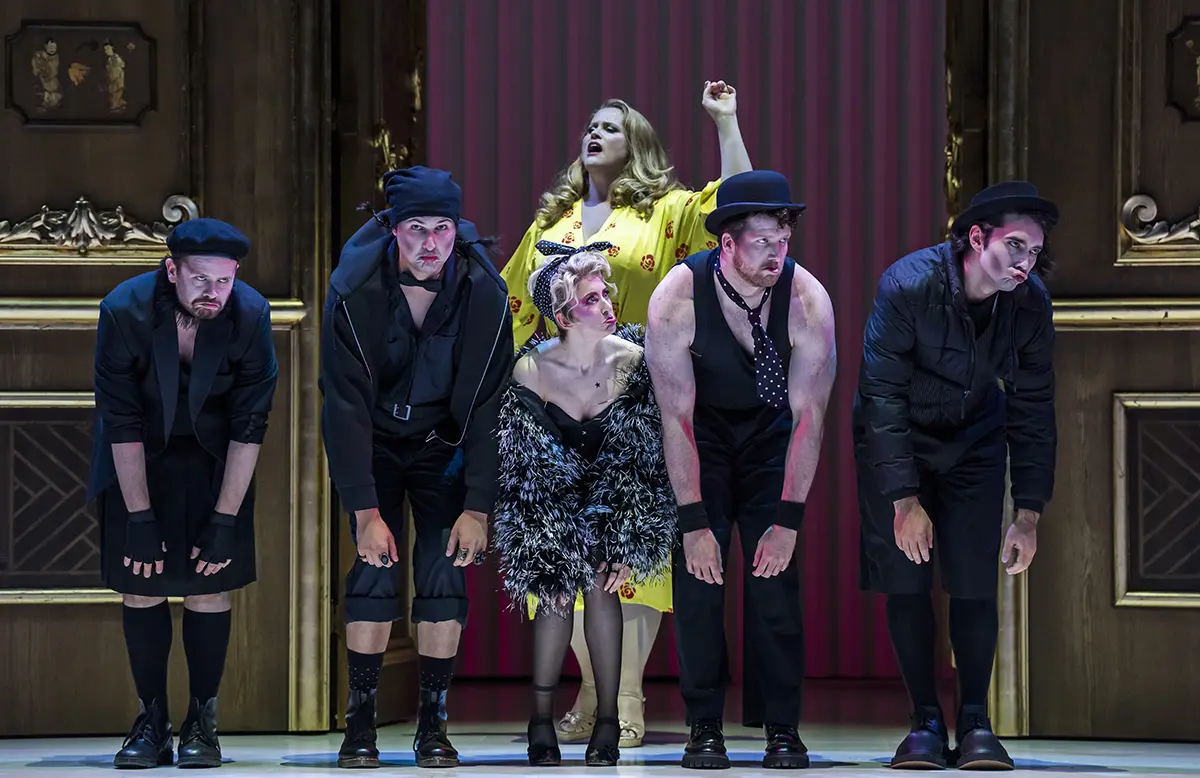
The commedia dell arte performers interrupt Ariadne’s lament with some energetic song and dance to cheer her up. Bass-baritone Mikhail Timoshenko brings charm and subtle melancholy to Harlequin’s deceptively simple song Lieben, Hassen, Hoffen, Zagen. Ariadne, however, takes no notice. Instead she looks forward to the pure realm of the dead, where she hopes to find deliverance from her pain in the aria Es gibt ein Reich. Willis-Sørensen produces wonderfully long legato lines, and her restrained but warm timbre is appropriately Wagnerian, even if her diction is occasionally murky. The comedians return with another routine, to no avail, while Zerbinetta’s pragmatic advice on moving on also falls on deaf ears.
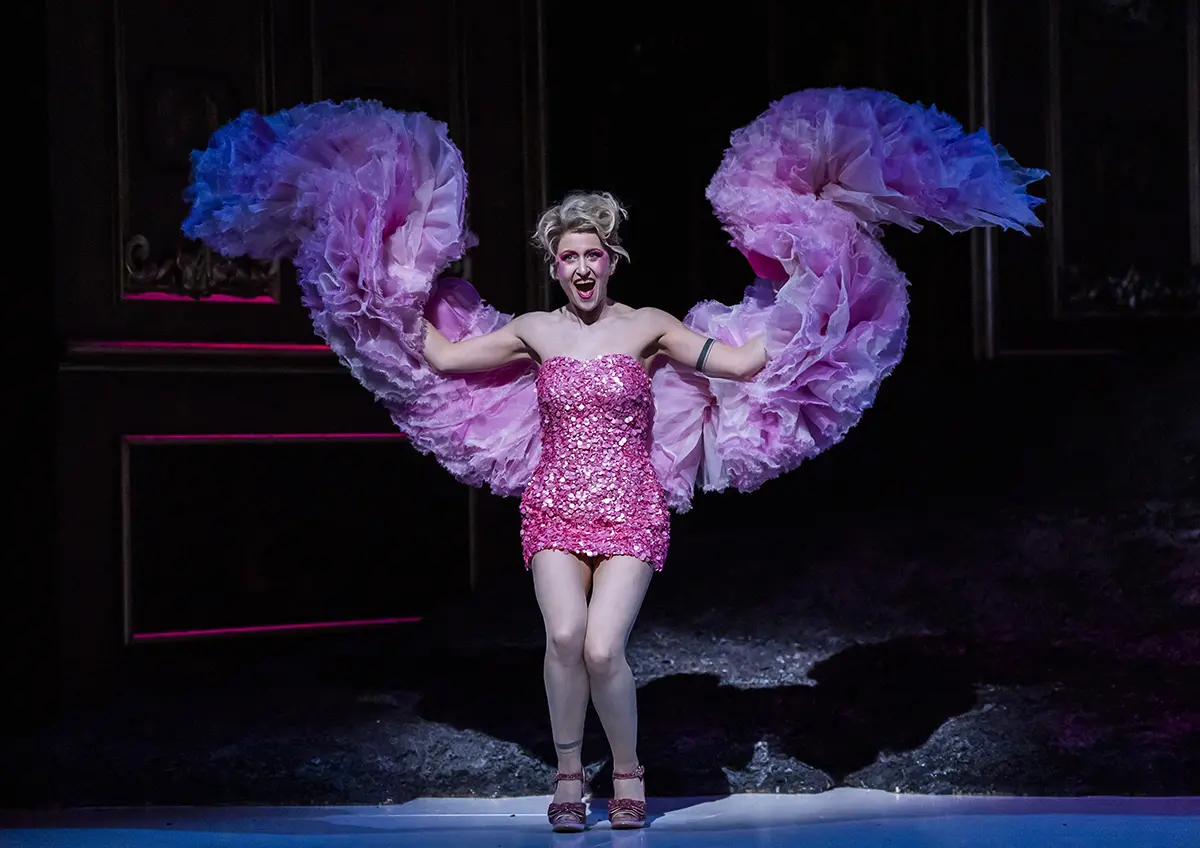
The demanding aria Großmächtige Prinzessin (Almighty Princess)– which reaches extreme levels of difficulty in the cadenza and cabaletta – opens with a chatty recitative. Zerbinetta feels that her vast experience in amorous matters qualifies her to offer some woman-to-woman advice to Ariadne. Dressed in a tight-fitting, pink strapless mini-dress Wunderlin rattles off her numerous romantic conquests. Ariadne, however, remains unimpressed and retreats into her cave. This leaves Wunderlin free to break the fourth wall and alluringly address the audience directly with her trills, decorative flourish and soaring high triplets. It is a cabaretesque Verfremdungseffekt (alienation effect) that toys brilliantly with the play-within-a play concept. Wunderlin playful coloratura ascends effortlessly to a high D, then soars to an E6 – or perhaps even the F#6 of the original 1912 version; I certainly wouldn’t put it past her. She is sensational and the audience’s response matches her performance. With constant key changes, allargandos, ritardandos, allegrettos and accelerandos the score keeps Ticciati and the LPO on their toes, while the pianist Harry Rylance deserves a special nod for accompanying much of the aria with such gusto.
Next comes the farce of the four suitors pursuing Zerbinetta. Once they finish, the three Nymphs return to excitedly announce the arrival of a stranger’s ship. Ariadne believes him to be Hermes, the messemger of Death. But it is Bacchus, singing of his narrow escape from the sorceres Circe – do I need remind you that Circe, played by Samantha Morton in Christopher Nolan’s new film, turned Odysseus’s men into swine.
Back with the action at Glyndebourne, Bacchus (David Butt Philip) instantly falls in love with Ariadne – a transformative moment for her as well. Her capacity for love reawakens, building into a 15-minute, quasi Wagnerian love duet. They prepare to leave the island (and get a room) or move into Ariadne’s cave, but not before Zerbinetta pops back in to remind us that she knew the outcome all along.
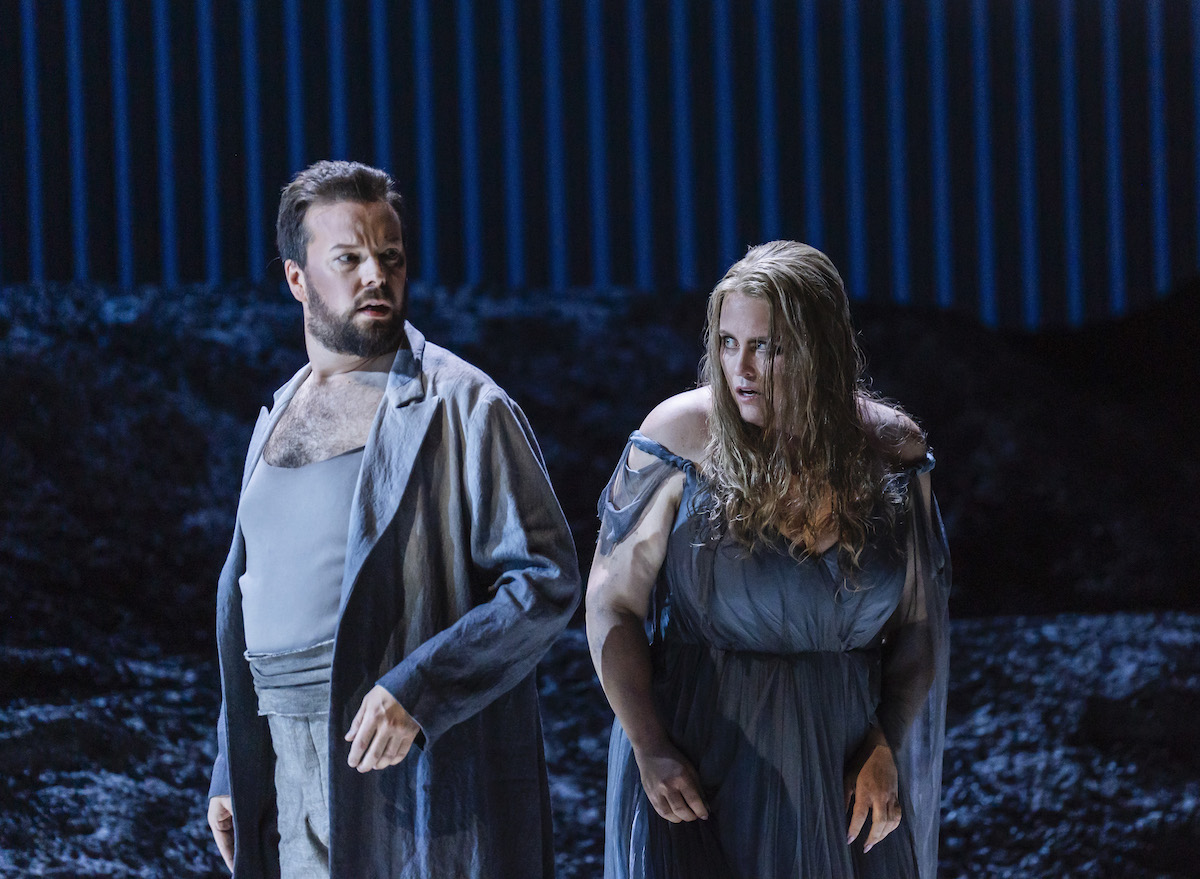
Not many tenors emerge completely unscathed from singing Bacchus, and Butt Philip is no exception. It is no secret that Strauss was not particularly fond of the tenor voice, subjecting Bacchus to a killer tessitura. Butt Philip battles heroically – you need to be a true Heldentenor to even attempt the role–and overall he remains remarkably impressive, despite a few strained moments.
The production has no real weak links when it comes to the musicians and the singing, and I have nothing but praise for the four Comedians , the three Nymphs and the Music Master (Michael Kraus) in the supporting roles.
However , I have some quibbles with Laurent Pelly’s direction and set design. Pelly has done away with most of the backstage commotion in the Prologue. The haughty Prima Donna (who later sings Ariadne ) and the Tenor ( Bacchus ) appear far too briefly and there is no sense of a bustling dressing room. Instead the preparations now take place unseen behind the grand double doors set into a massive Chinoiserie–inlaid wooden wall in classic Rococo style. The commedia routine in the Prologue could also have been more memorable.
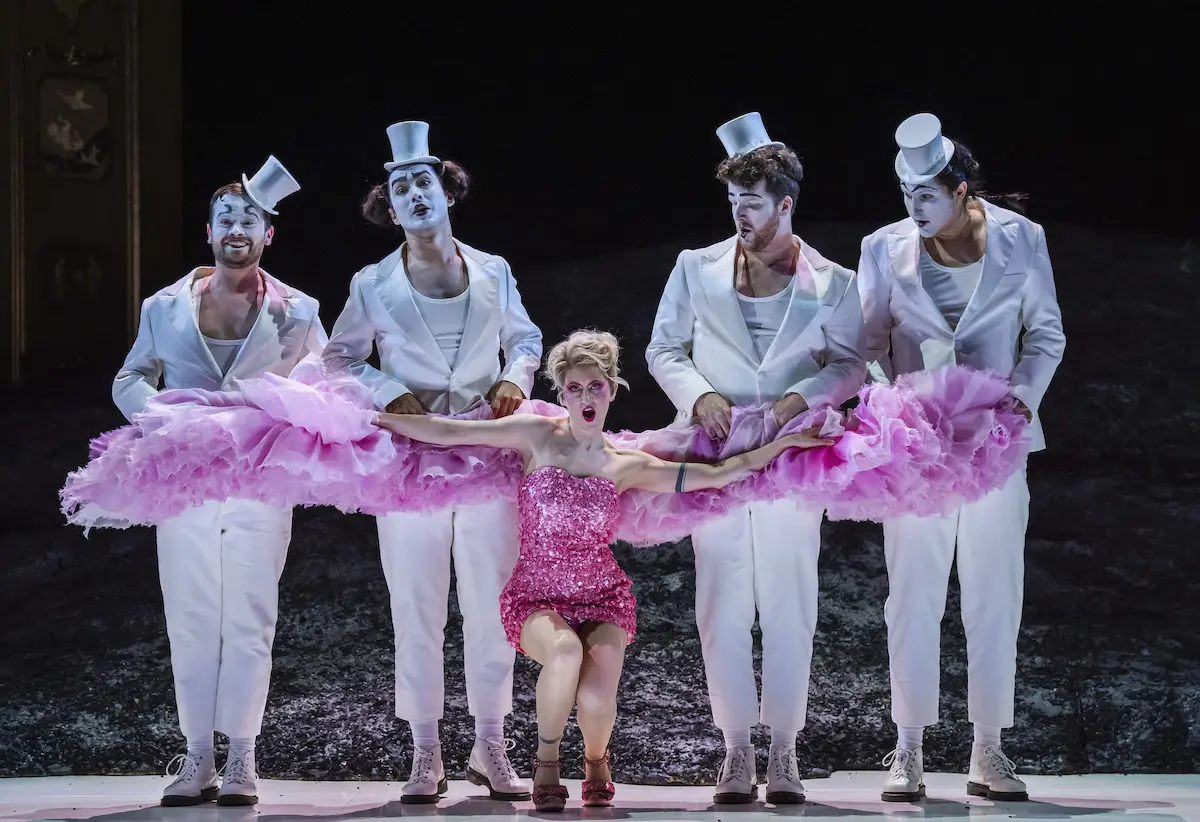
The Ariadne opera’s mise en scène is downright ugly and impractical. And why must Ariadne, a Princess, and Bacchus, a God, wear threadbare clothes – an attempt at realism, perhaps? The set depicts a desert island (at night?), featuring exposed bedrock without a scrap of plantation. Worse, the uneven, soft-looking surface forces singers to tread carefully to keep their footing. That is not very helpful.
Yet the music and the marvelous singers make a trip to Glyndebourne in August more than worthwhile. If after all this, you wonder what the opera is actually about, the Composer sums up Hofmannsthal’s high-minded concept to Zerbinetta: ¨What it is about is one of the straightforward and stupendous problems of life: fidelity; whether to hold fast to that which is lost, to cling unto it even unto death – or to live, to live on, to get over it, to tranform oneself.¨
Glyndebourne’s production has certainly transformed my view of this strange musical hybrid. It is right up there with Strauss’s very best.
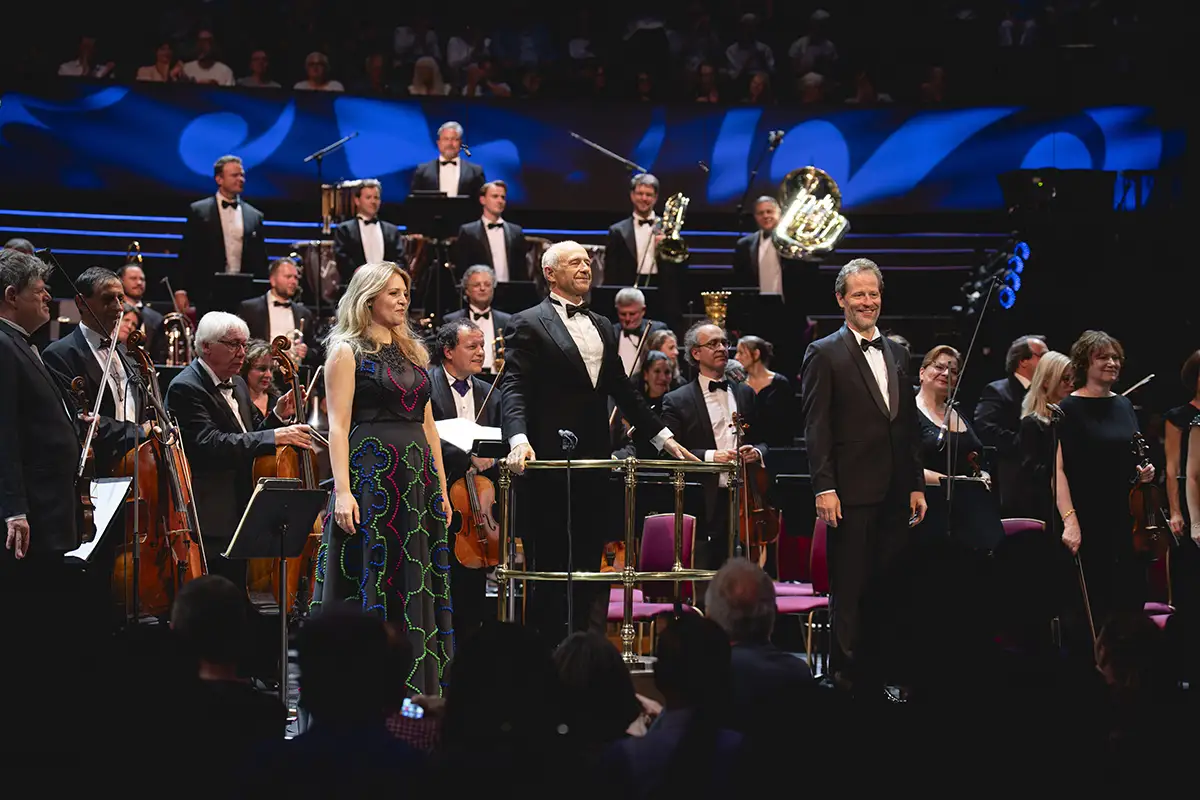
You can now also listen to the concert performance of the opera, which was presented as a BBC Proms concert at the Royal Albert Hall. Here is the link.
Available until 19 September 2026
ALBERT EHRNROOTH
Ariadne auf Naxos performance dates at Glyndbourne. 1, 3,6,9,12, 23,26,29 August
BBC Proms, semi-staged production 19 August
A review of Glyndebourne’s first –and current – production of Tosca you can find here
On my site there are a number of other reviews of Richard Strauss operas. Read about Garsington Opera’s very recent production Der Rosenkavalier here:
Finnish National Opera’s staging of Elektra was equally exciting. The review is here