An upside-down apostle, a head colossal, a crucified Christ in paint, a beaten and bound saint, a lamb readied for slaughter, a rose and a cup of water: these are a few of my favourite things in the Louvre’s exhibition devoted to one of Spain’s greatest Baroque painters, Francisco de Zurbarán.
Francisco de Zurbarán (1598 –1664) is in Spain and South–America famous for his intensely devotional religious paintings. If you are fond of images of the Virgin Mary, The Immaculate Conception, Adoration of the Magi, Saints and the Crucified Christ, Zurbarán is your man. But don’t let it put you off if you’re not too keen on religious art. The Musée de Louvre exhibition – which has migrated from London’s National Gallery* – focuses a bit more on Zurbarán’s skill and craft, concentrating less on his Christian zeal. None of his contemporaries could equal Zurbarán’s mastery of three-dimensionality; he depicted Christ on the cross or a saint as though they had been chiselled out of paint. His total command of chiaroscuro and tenebrism is all the more astounding, given that he never visited Italy. At his best, Zurbarán’s paintings are innovative, exquisitely crafted and sometimes even wonderfully bizarre, particularly when viewed outside their religious context.
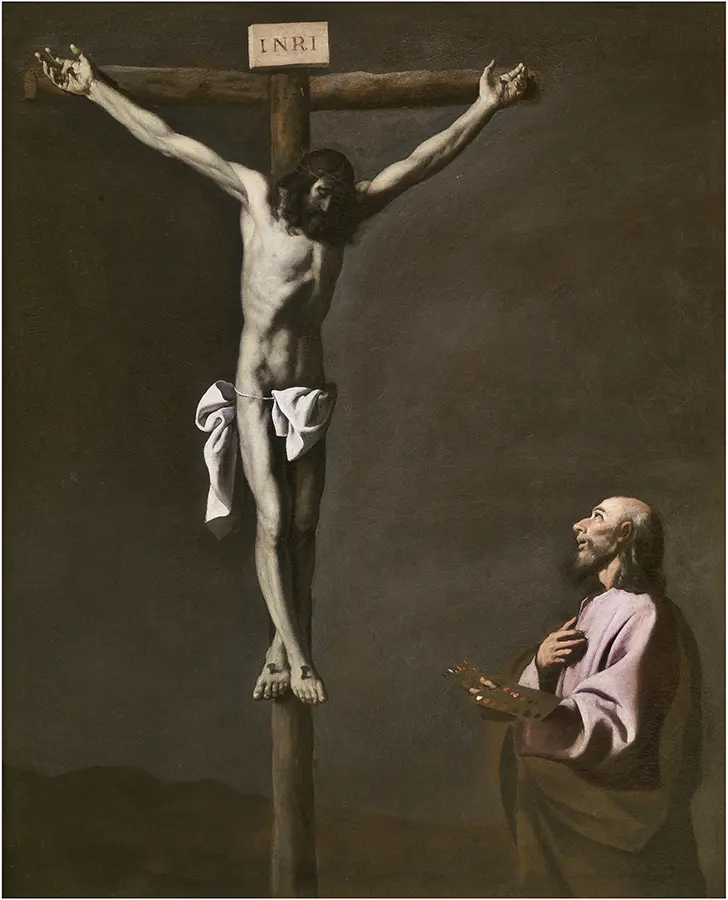
The Crucified Christ with a Painter (ca.1650) is a good example of the splendidly absurd forms that Baroque paintings could take. What we see is a man gazing reverently up at the crucified Christ, whose monochromatic, pale and lifeless body appears almost sculptural against the gloomy backdrop. In the distance, we can just about make out the dark outlines of the hills of Golgotha. On closer inspection, however, we realise that the observer is holding a brush and a palette filled with bright colours. This is Saint Luke – the evangelist, physician and artist Luke – his likeness possibly based on Zurbarán’s own features. Luke is credited with painting the first icon of the Blessed Virgin Mary and is therefore the patron saint of artists. He is, just like Zurbarán – who painted at least a dozen Crucifixions during his career–, figuring out how to represent Christ on the cross. One of Zurbarán’s earliest attempts would also become his most memorable.
In 1626 the Dominican priory of San Pablo el Real in Seville commissioned the then virtually unknown Zurbarán to paint what is now his most famous Crucifixion. The work was installed in a dimly lit sacristy and could only be viewed through a grille. Early visitors to the monastery never got close to the painting and from a distance it looked like a sculpture. Zurbarán managed to achieve an incredible sense of three-dimensionality by illuminating the perfectly toned body of Christ and contrasting it sharply with the pitch-black background. The only visible blood appears around the four nails – not three, as was customary in most depictions. Even the large loincloth has been arranged with an eye for crumpled artistry.
What makes this depiction more powerful than so many earlier representations of the same subject, is the absence of the usual witnesses to the Passion. Christ is alone, he has been abandoned. Instead of a single nail piercing both feet, Christ’s feet are nailed separately to a small ledge, creating the impression that he is standing before us. The work caused a sensation in Seville, demand for Zurbarán’s paintings soared, and he soon established a successful studio. This Crucifixion is also the earliest known painting to bear both his signature and a date.
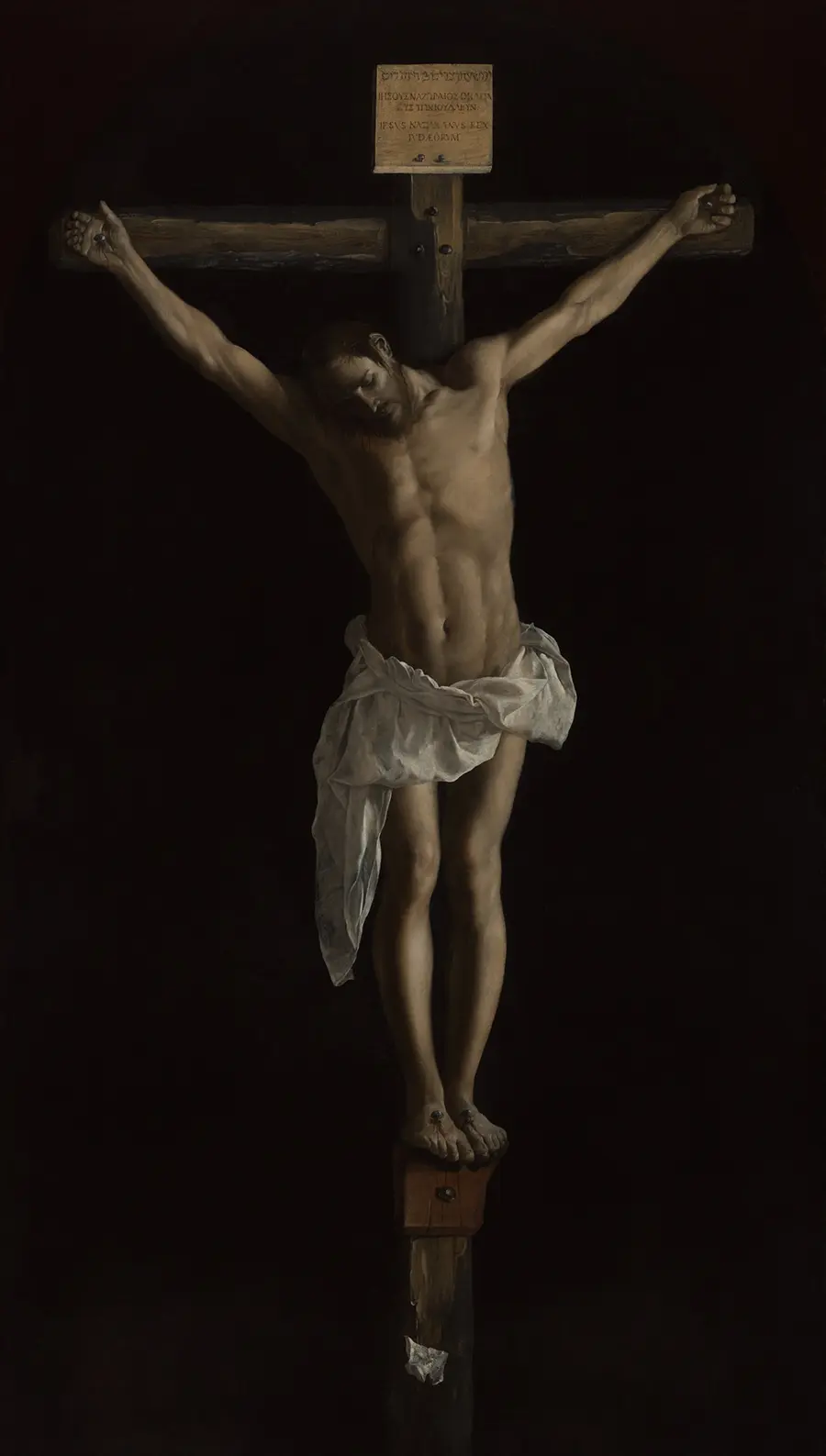
The Spanish court painter and art historian Antonio Palomino gave Zurbarán the nickname the¨Spanish Caravaggio.¨ But that was in 1724, sixty years after the artist’s death. Zurbaran’s contemporaries never referred to him by that sobriquet.
The Crucifixion demonstrates Zurbarán’s total mastery of Caravaggio’s chiaroscuro – the strong contrast between light and dark used to create volume and the illusion of three-dimensionality – and tenebrism. But where did he pick up the highly volatile Italian’s technique?
Unlike his contemporaries Diego Velázquez and Jusepe Ribera, Zurbarán never traveled to Italy and it is very unlikely that he would have seen any of Caravaggio’s paintings with his own eyes. He would, however, almost certainly have seen copies and prints of Caravaggio’s paintings made by Flemish, Dutch, French and Italian followers– the so-called Caravaggisti. The popularity of Caravaggio during the first of half of the 17th century is well documented.
Ribera based himself permanently in Naples in 1616 and sent back to Spain not only his own, but also contemporary Italian paintings. Velázquez visited Italy twice and brought hundreds of artworks back with him to the Spanish court. Both artists successfully incorporated chiaroscuro in their works.
Zurbarán became particularly adept at achieving a lifelike, Caravaggesque sense of reality, an approach that proved especially effective in his dramatic depictions of saints. In Saint Serapion (1628) the martyr is bound by his hands to two posts, giving his pose a quasi-crucified appearance. There is no sign of blood, despite the horrific torture he has endured. His over-large habit, rendered in many shades of white and intricate folds, adds to the profound spirituality that the painting radiates.
Although most of Zurbarán’s commissions came from institutions in Andalusia, his reputation spread to Madrid, and the Americas as well. His representation of Saint Francis of Assisi may have been commissioned by the Franciscan convent of Las Descalzas Reales in Madrid.
When Pope Nicholas V opened the saint’s crypt in 1449, Saint Francis’s remains appeared to be completely intact, with blood trickling from his stigmata. The pope subsequently experienced a vision of the saint standing upright and praying within a niche. Stranger things have happened, I suppose.
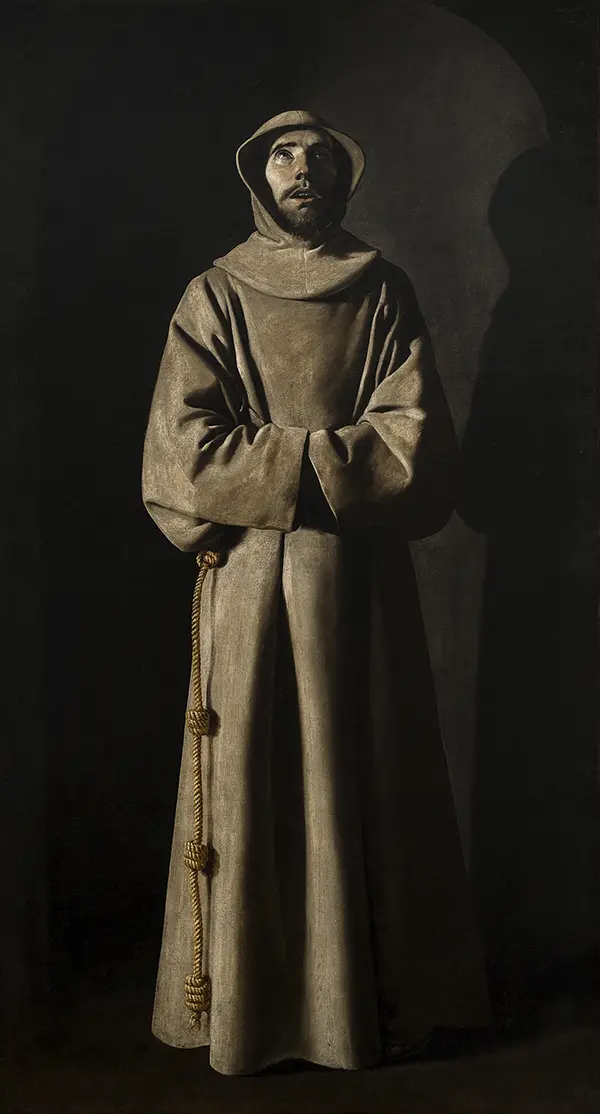
Oil on canvas, Musée des Beaux-Arts, Lyon
Zurbarán chooses to show the saint in a state of spiritual ecstasy – the transfigurative state that offers a nearer-my-God kind of experience – a popular theme in 17th century Catholicism. The saint may be dead, Zurbarán seems to suggest, but his dialogue with God continues. The sharply cast shadow against the wall of the niche and the way Francis’ silhouette has been (almost) carved out of the shadows, create a convincing illusion of volume. At the same time the absence of his hands and the strange, mask-like, slightly unhinged expression on the his face deepens the sense of mystery. The thick brown habit, rendered with tonal variations, possesses a tactility unequaled by any other Spanish artists of the period.
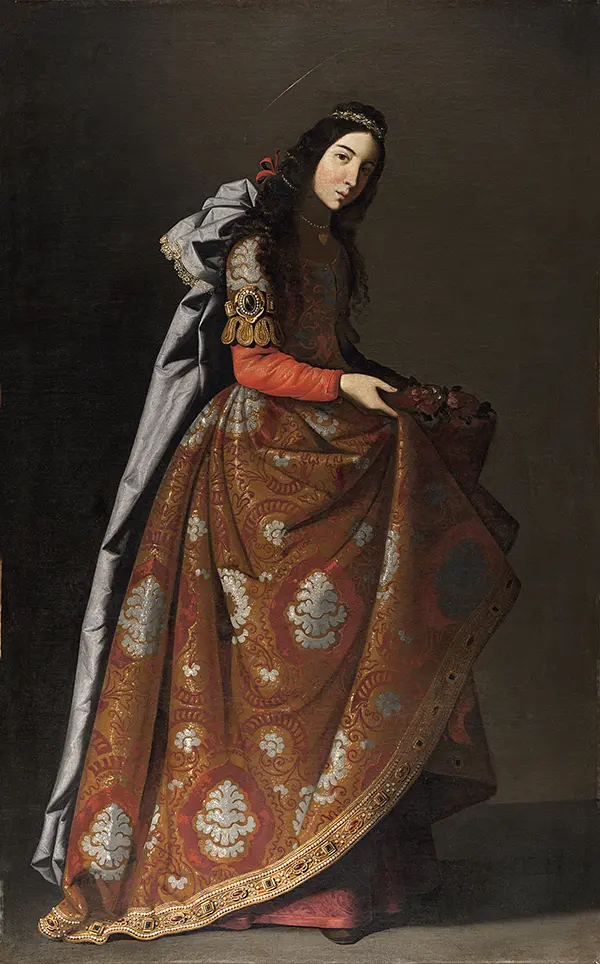
Zurbarán was the go-to artist when a religious order needed a saint portrayed. However, one can imagine that he grew tired of always having to paint martyrs in drab grey, brown or white habits. Perhaps this spurred him to invent a new genre: the Virgin Saint. He dressed his Apollonias, Casildas, Elizabeth of Thuringia and Catherine of Alexandria in colourful, costly-looking gowns, often embroidered with jewels or gold. There is no attempt at historic accuracy; rather, he dresses these holy women, richly adorned in modern gowns that would have made them ‘the belle of the ball’. They don’t dress like common martyrs, nor do they appear to be suffering, there is no sense of ecstatic union with God, they just look like very wealthy¨ladies of the world.¨ It’s no wonder then that the Spanish designer Cristóbal Balenciaga (1895–1972) drew inspiration from some of Zurbarán’s fashion statements. The Virgin Martyrs were particularly popular in South America. The catalogue states that the artist was paid in 1647 for twenty-four paintings of virgin saints, commissioned by the monastery of Nuestra Señora de la Encarnación in Ciudad de los Reyes, in Perú. Two years later he sent another fifteen saints to Buenos Aires.
Francisco de Zurbarán was born on 7 November 1598 in a small town more than 100 kilometres north of Seville, the 6th child of a successful merchant and tax collector. Recognising his son’s talent, his father sent him to Seville at the age of 16, where he was apprenticed to the now largely forgotten painter Pedro Diaz de Villanueva.
Seville was Europe’s most prosperous port on the 17th century thanks to its monopoly on trade with the New World. The city also had a flourishing artistic community and boasted more than 60 religious institutions, providing ample work for artists. Zurbarán would have crossed paths with well-established painters such as Francisco Herrera, Alonso Cano and Francisco Pacheco. Diego Velázquez – who was apprenticed to Pacheco and later married his daughter – became a lifelong friend. Competition in Seville was fierce and completing his three–year apprenticeship, Zurbarán moved to Llerena , near his birthplace in Extremadura. His first wife died after six years of marriage, but before long he was married once more to a woman who came from a prosperous family of landowners and merchants. Financially secure and much in demand with the local institutions, he built a successful career locally. Unfortunately very few of his early paintings have survived.
As I mentioned earlier, Zurbarán was commissioned In 1626 by the Dominican monastery San Pablo el Real in Seville to paint 21 works, one of which was The Crucifixion (see picture above) The painting attracted widespread praise and in 1629, the city council voted to allow him to settle with his family in Seville.
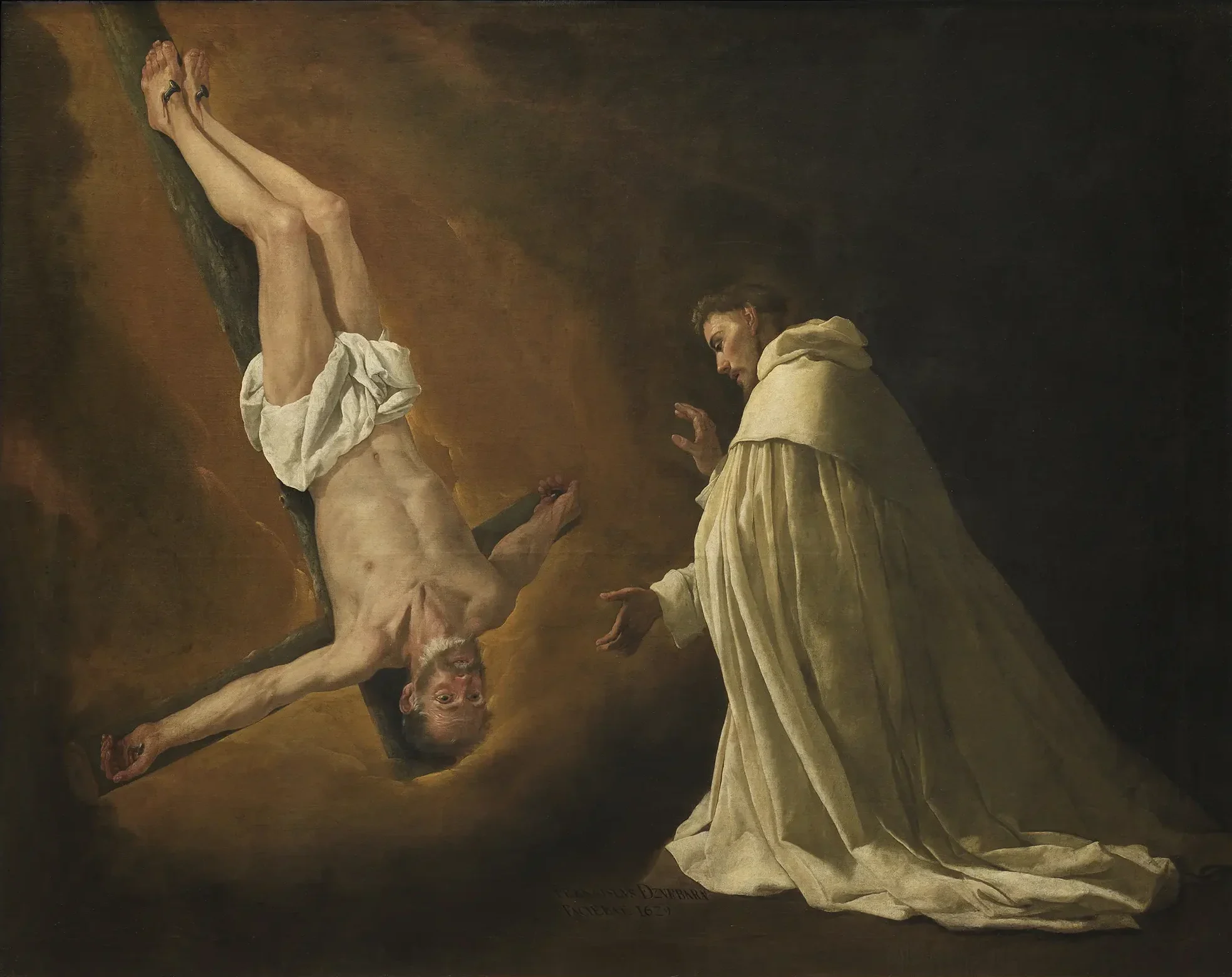
To mark the canonisation of Peter Nolasco, founder of the religious order of the Mercedarians which ransomed Christians captured by the Moors, Zurbarán was commissioned in 1628 to paint twenty-two scenes from the saint’s life. The Apparition of Saint Peter to Saint Peter Nolasco (my featured image) depicts a miraculous encounter between two Peters. Deeply devoted to Saint Peter, Nolasco had planned a pilgrimage to Rome to visit the apostle’s tomb. Instead, he experienced a vision in which Saint Peter, nailed upside down to a cross, descends from heaven on a radiant cloud. (Peter did not consider himself worthy to die in the same manner as Christ, on the cross, and therefore requested to be crucified upside down).
Zurbarán’s masterstroke is to render both Peters as real people made of flesh and blood. One might expect Saint Peter to look serene after centuries in heaven, but he looks more like he’s been suffering for a long time on the cross, maybe even eternally. Surely, that’s no way to be rewarded in heaven! His face is flushed, a vein on his forehead seems on the verge of bursting , and his eyes bulge with strain. His mouth is open as he instructs Nolasco not to make the journey to Rome. The rich nobleman is needed at home to continue his vital mission of liberating Christian captives in North Africa. Nolasco, half emerging out of the shadows, kneels in astonishment before his patron saint. His voluminous white habit, heavy with deep folds, is a superb example of Zurbarán’s skill in the depiction of drapery.
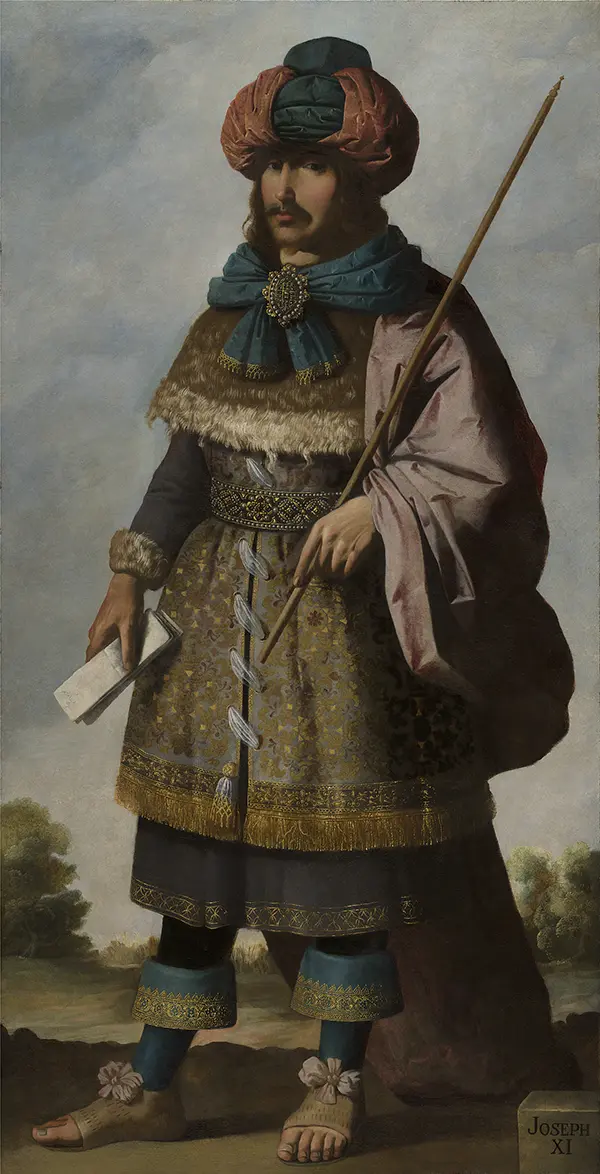
In the 1740s Zurbarán shipped vast amounts of paintings to the Americas, most of them produced by his large workshop. The most famous are the the Twelve Tribes of Israel series, portraying Jacob and his twelve sons. One surviving set is held at Auckland Palace in County Durham (with the exception of one painting, which is at Grimsthorpe Castle). These works are particularly notable for their extraordinarily detailed rendering of the different fabrics and textures.
In 1634 Zurbarán’s best friend Velázquez, King Philip IV’s leading court painter, invited him to Madrid. The king commissioned him to paint a series of ten Labours of Hercules to be hung in the newly constructed Buen Retiro Palace. Two of the paintings are shown in the exhibition, but the depictions of the Greek hero with his big club taking on the Cretan Bull and the three-headed Cerberus are not very convincing, with Hercules looking more like an awkward wood chopper than a superhuman.
After receiving only two royal commission, he returned to Seville where he undertook two of his most ambitious projects: the enormous altarpiece for the Carthusian monastery at Jerez de la Frontera and another major series, still in situ, for the Royal Monastery of Santa Maria de Guadalupe.
The National Gallery (and the Louvre?) was particularly keen to highlight Zurbaran’s still lifes, and there is no denying that Still Life with Lemons, Oranges and A Rose and Still Life with Four Vessels are fine works, that apparently were much admired by Cézanne, Picasso, Derain, Morandi and Dalí. But are they all that exceptional?
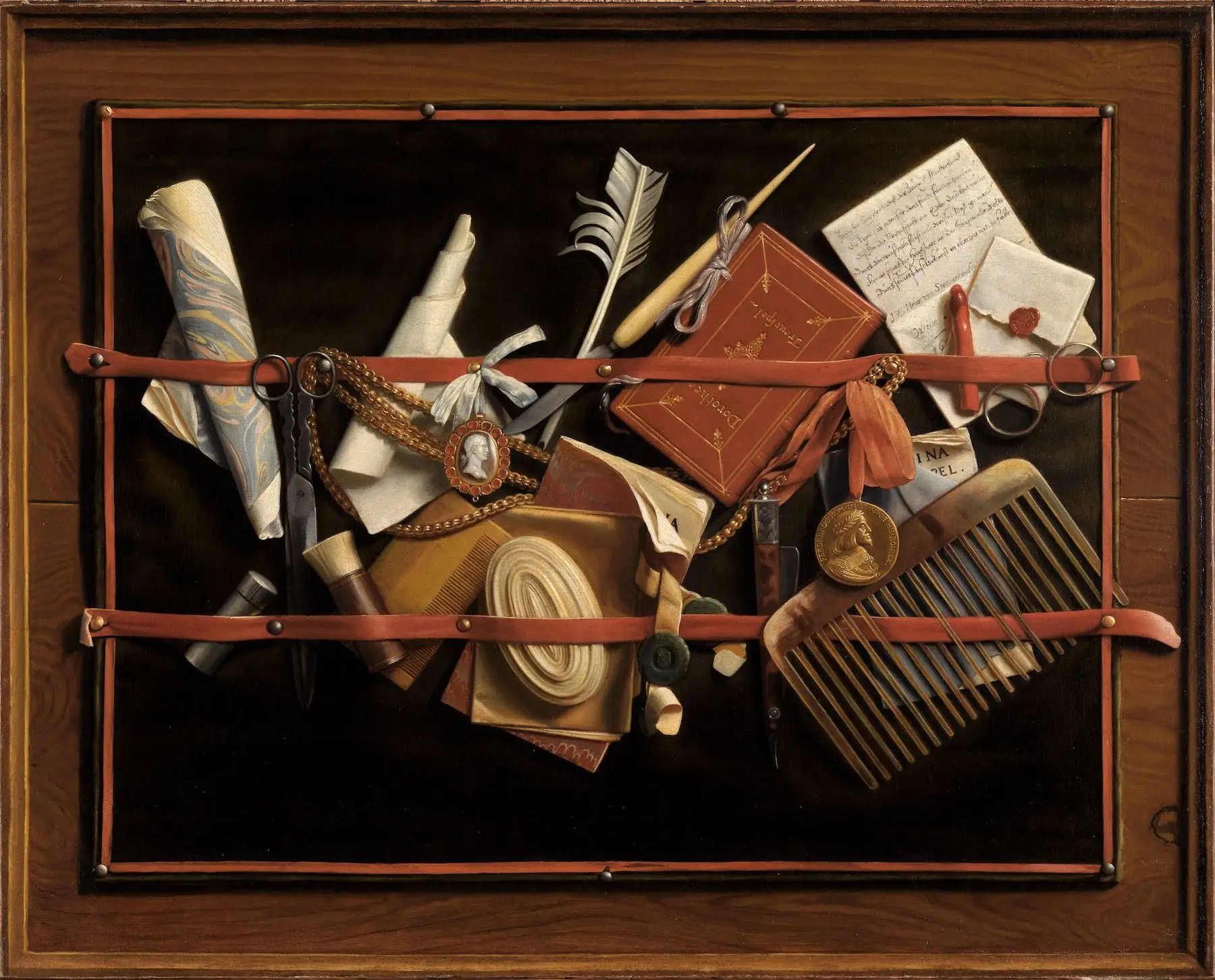
The jug, goblet and vase in the Still Life with Four Vessels , lit from the left, casts shadows that do not quite align, but then geometric perspective was never Zurbaran’s thing. Each vessel was probably painted individually. Fewer than ten still lifes by Zurbaran’s hand are known, and there is a good reason for this. In the hierarchy of genres, paintings of inanimate objects, flowers and food arrangements were considered less prestigious and therefore commanded lower prices than history paintings and portraits.
Caravaggio, of course, demonstrated exceptional skill in this genre, which requires technical precision, rather than imagination. As mentioned before, Zurbaran may have seen copies of Caravaggio’s paintings and thought; let’s have a try. I suspect he made the vessel still lifes primarily as studies, and he did incorporate vessel and fruit bowls into some of his religious paintings. A cup of water and a rose appears in several religious works, for good reason: the cup with clear water symbolises the Virgin’s unblemished purity, while the thornless rose refers to her Immaculate Conception.
For good measure, the National Gallery also exhibits ten still lifes made by Zurbarán’s son Juan. He was clearly technically more accomplished than his father in this genre and the influence of the opulent and sensual style of Dutch and Flemish painters is quite evident in his work.
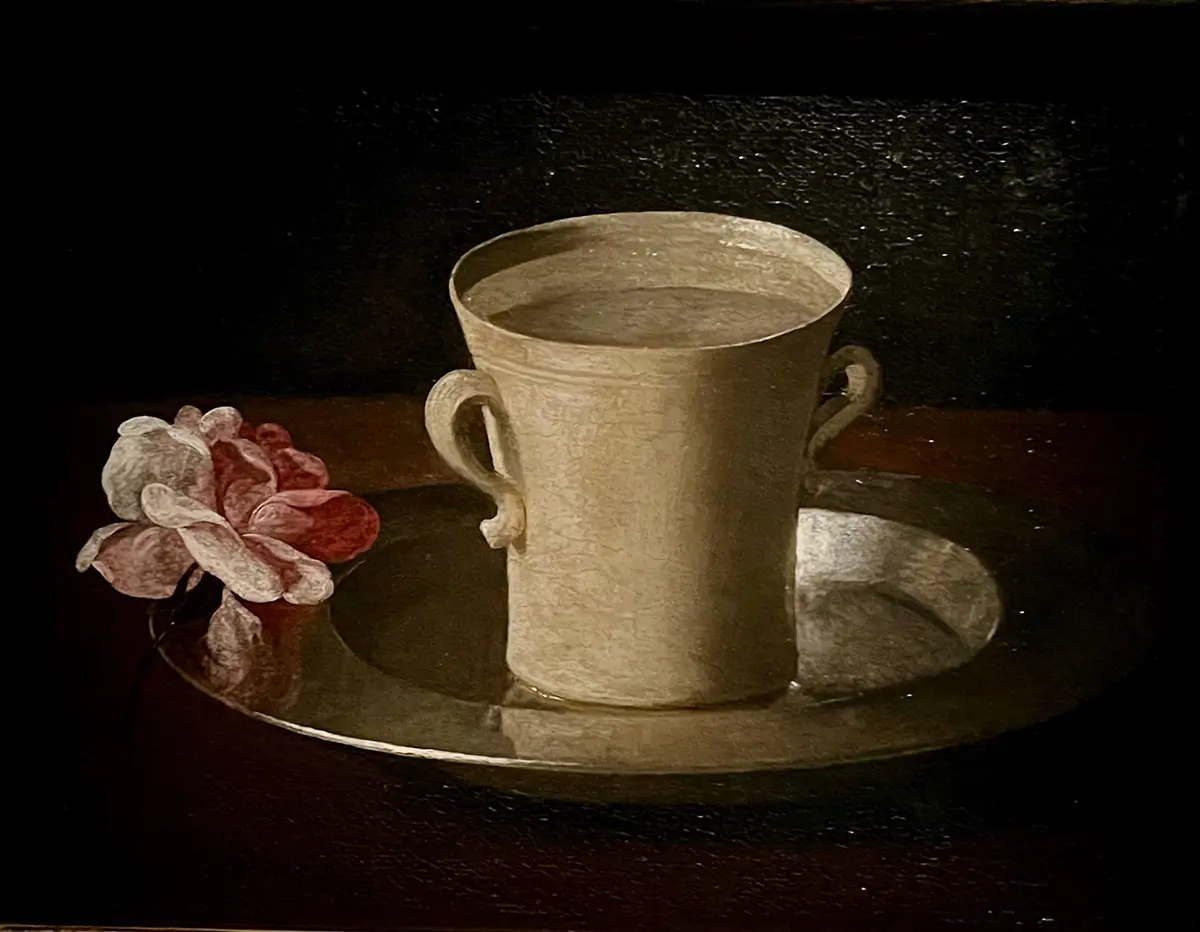
A Cup of Water and a Rose, about 1630. Zurbaran, The National Gallery, London
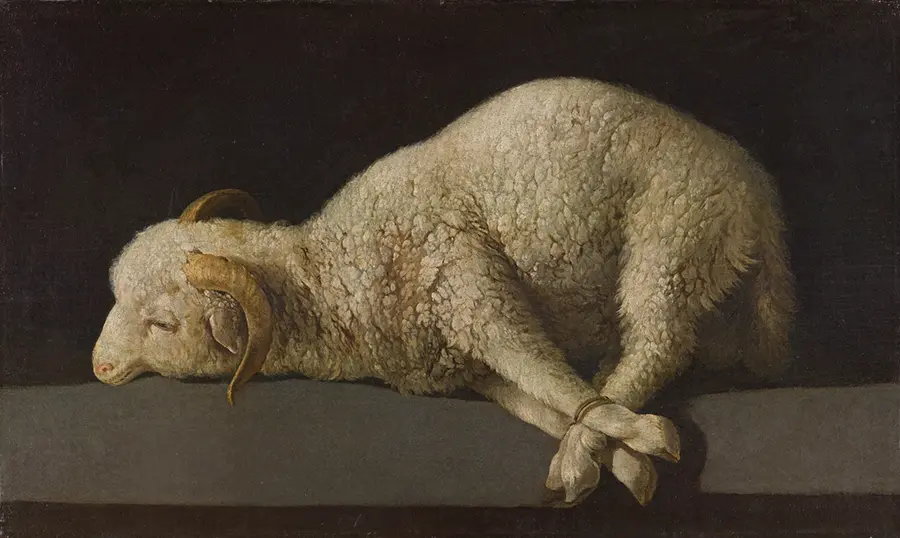
There is, however, a form of still life that Zurbarán helped develop, if not invent: the lamb with its hooves trussed, lying on a stone ledge, ready for the slaughter. No Christian could have mistaken the symbolism : The Lamb of God (Agnus Dei). Like the lamb in the painting, Christ accepted calmly that he was destined to sacrifice himself on the cross, thereby ¨taking away the sin of the world.¨ But the cutesy lamb is also a symbol of Jesus’s sweet and innocent nature.
The lamb on loan from the Prado Museum is one of at least five versions, further evidence of the subject’s popularity. This one has horns and is very much alive. Its muzzle is moist, its wool has a lovely soft appearance, and even its eyelashes can be individually distinguished. Some modern viewers, of course, will see this lamb through completely different eyes; this is not Agnus Dei, this poor animal is an innocent victim of carnism – the cruel meat-eating society that conditions people to eat innocent animals..
Almost half of Seville’s population was wiped out by the catastrophic plague epidemic that began in 1649 and continued for several years. Zurbarán’s son Juan, the gifted still life painter, was among its roughly 60,000 victims, dying at the age of 29.
Large-scale commissions from religious institutions had already begun to dry up in the 1640s, but the plague left even less money available for artworks. Zurbarán was forced to rely on private patrons. Moreover, after all the hardship and loss caused by the epidemic, Bartolomé Estebán Murillo’s softly modelled, sweet Madonnas and charming depictions of ordinary, young and beautiful people held far greater appeal in the 1650s than Zurbarán’s anguished martyrs and dark Crucifixions.
In response, Zurbarán tried to reinvent himself. His later works feature less sharply defined contours, extensive use of sfumato, more muted colours and fewer of the angular faces that had characterised his earlier style. After nearly three successful decades in Seville, Zurbarán could no longer keep up with the brilliance of the new kids in town, and he moved to Madrid.
The religious works he produced there reveal the influence of the Italian Renaissance and Baroque painting, which he could study in Philip IV’s art collection. Unfortunately many of these late works possess a blandness and cosiness that feels entirely at odds with his much superior earlier work. It is sad to see how this proud ‘Spanish Caravaggio’, who had forged such a distinctive style in Seville, became something of a poor man’s Raphael during his final years in Madrid, where he died in 1664.
Zurbarán was soon largely forgotten and only rediscovered when Napoleon’s troops looted Spanish monasteries and cathedrals during the Peninsular War, taking the works back to France. His religious paintings were displayed in galleries – the Louvre!– and private collections, where they gradually found a new audience. By the late 19th century and early 20th century, Zurbarán had acquired a devoted following in French and Spanish artistic circles. The first monographic exhibition dedicated to Francisco de Zurbarán was held at the Prado Museum in 1905, helping to revive the reputation of one of the most original painters of the Spanish Golden Age .
* N.B. This review is based on the set–up of the exhibition in London. Most of the paintings that were featured in the show at The National Gallery, are included in the Louvre exhibition.
Albert Ehrnrooth
Zurbarán
The National Gallery, London: 2 May – 23 August 2026
Musée du Louvre, Paris: 7 October 2026 – 25 January 2027
The Art Institute of Chicago: 28 February – 20 June 2027
The National Gallery in London has a fine collection of paintings from the Spanish Golden Age, including many by Zurbaran. The Prado Museum in Madrid and the Museum of Fine Arts in Seville own some of the most impressive works by the painter.
The Museum of Cadiz is lesser known, but they are the custodians of the series of paintings taken from the Charterhouse of Jerez de Frontera. Read about my day trip to Cadiz here.