Tate Modern’s latest exhibition, Frida: the Making of an Icon, features (only) 30 of Kahlo’s own oil paintings as well as works by her husband, Diego Rivera, and several of her Mexican contempories. The second part of the show displays more than 100 works by more of her contemporaries and later artists that were inspired by, or shamelessly copied her works. There is also a room devoted to “Fridomania”, the commercial iconisation of her paintings and her image.
Twenty years ago Tate Modern staged a major retrospective that brought together 80 of Frida Kahlo’s approximately 200 oil paintings. By that time she was already widely recognised as one of Latin America’s most influential artists; however, since then, “Frida”–as she is affectionately known – has come to represent many different things to many different people. Frida has been embraced by social, feminist and LGBTQ+ movements, while simultaneously eliciting a quasi-religious devotion among artists.
“I do not like to influence others. I would not like to become famous. I have done nothing deserving of acknowledgement in my life” Kahlo told her friend Olga Campos when she was already internationally fairly well established as an artist. Yet, the twenty-first century has seen her art and her image reach a level of celebrity that has elevated her to iconic status. Increasingly, however, her admirers seem to obsess more over her persona, than her actual art. Her distinctive features – her braided hair, her slight moustache and her signature unibrow– now decorate everything from tea mugs, egg cups, lipstick to tequila labels. Frida’s face has essentially become public property, the face of Mexico. It has become a free-for-all, with her likeness co-opted in the name of various social causes, political movements, or sheer commercial profit.
From a young age, Kahlo was deeply involved in political causes. She became a member of the Communist Party, had a brief affair with Leon Trotsky, and aligned herself with the ideals of the Mexican Revolution. It is hard to imagine that she would have approved of being turned unto a global trademark. Yet, that is exactly what the artist’s niece, Isolda Pinedo Kahlo, did when she obtained power of attorney over Kahlo’s property rights in 2003.
However, the U.S.–based Frida Kahlo Corporation (FKC) – formed in 2004 “with the goal of commercialising the Frida Kahlo brand”, – took Isolda and her daughter Cristina Teresa Pinedo to court in Florida accusing them of trademark infringement for setting up a competing website that sells goods that feature Kahlo’s image. The dispute dragged on and became worldwide news when Kahlo’s grandniece complained about FKC granting Mattel a license to produce a Frida-inspired Barbie doll with conventional, “beautified” features . Cristina Teresa Pinedo argued that Kahlo would not have been impressed with a doll that conceals her iconic unibrow. This bitter dispute over who owns the trademark remains unresolved and was revived on appeal earlier this year. The fight over the brand Kahlo is notably absent from the exhibition at Tate Modern, perhaps to avoid conflict with some of the owners of the paintings and photographs that are on show at the Tate.
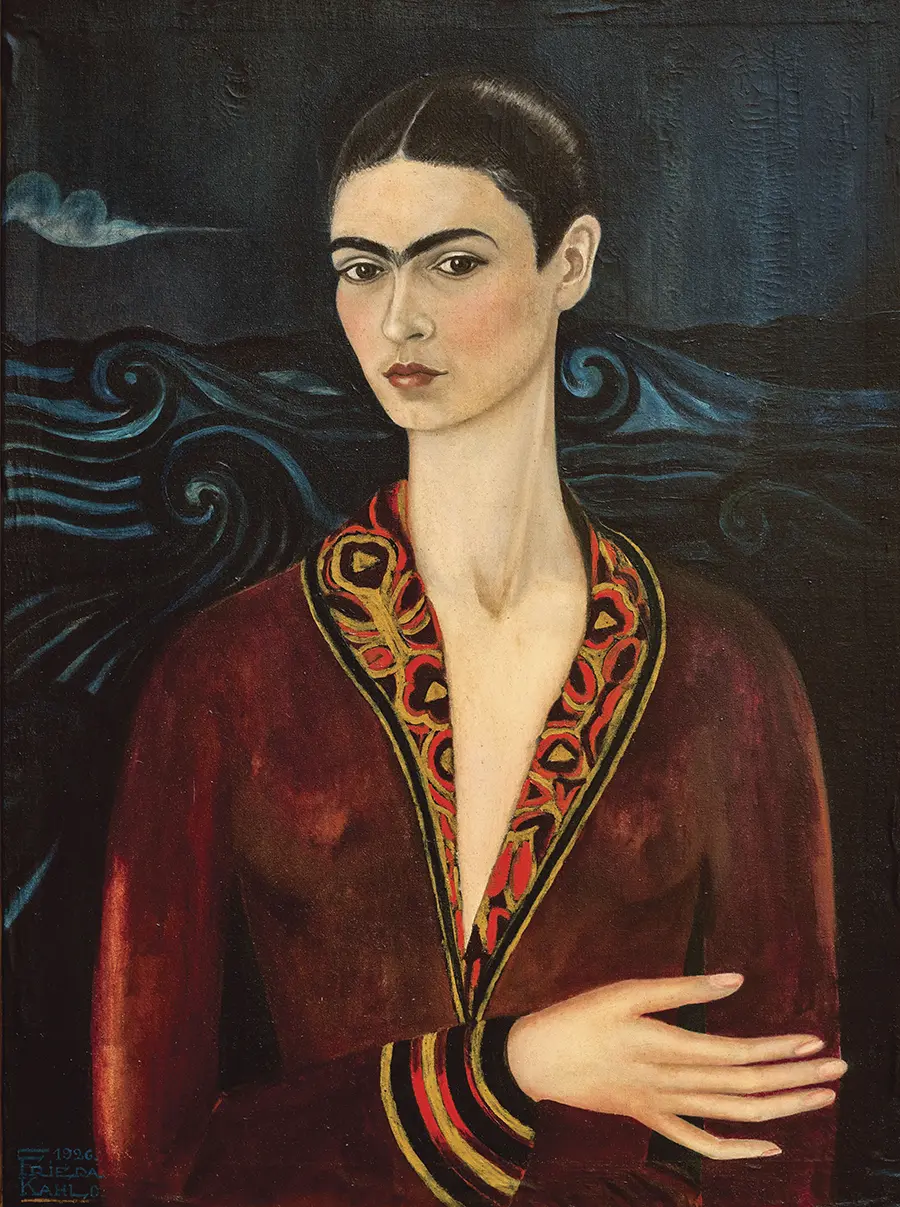
Self-portrait wearing a velvet dress (1926) is considered to be Frida’s first significant oil painting. She gifted the painting to her boyfriend Alejandro Gómez Arias, who was planning an extensive visit to Europe. The 18-year old Frida ensures she appears as attractive as possible. Dressed in a shimmering, wine-red gown with her hair neatly parted, she shows off a long neck, a symmetrical face, deep black eyes, and long elegant fingers. Her gaze is determined yet gentle and she has the regal appearance of a Renaisasnce or Mannerist princess, an irresistible beauty modeled on a Botticelli or Parmigianino portrait. However, the twirling dark blue, rather turbulent sea and sky in the background suggests that there may be trouble ahead.
The painting had the desired effect, at least for a while. She managed to win Alejandro back, until he left for Europe the following year. There is a poignant prelude to this self-portrait, which explains Frida’s teenage obsession with Alejandro.
Frida was quite an exceptional student and had the intention to study medicine. She was one of only 35 girls among 2,000 students that were admitted to Mexico’s leading institute of secondary education. There she met Alejandro Gómez Arias who she fell passionately in love with. They both joined Las Cachucas, a rebellious student group named after the distinct caps they wore. Frida had just turned 18 when she and Alejandro took a bus home from school. The bus collided with a tram. Several people were killed instantly and others died later of their injuries. Frida’s spinal column was broken, and her ribs and pelvis were crushed. Her withered leg – the result of contracting polio at the age of six – suffered eleven fractures. A handrail pierced through her abdomen and came out through her vagina. Alejandro, who was only slightly injured, found her naked and bloodied, covered in powdered gold dust that another passenger had been carrying. She survived, against all odds, largely with the help of Alejandro, but she was confined to her bed in the hospital for three months, cocooned in a full-body plaster cast. For the rest of her life she would have to wear corsets to straighten her spine. Remarkably, it was during this recuperation that she taught herself to paint. She learned exceptionally fast; a mere year after the accident, she was already producing paintings that were technically.more than proficient. During her convalescence, which lasted for more than a year, Alejandro stayed by her side. Her parents were less supportive and did not approve of her relationship with Alejandro. Though she wrote many passionate letters to him while he was away in Europe, he broke off the relationship shortly after his return to Mexico. Despite the breakup they remained lifelong friends.
It is a shame that so few of Frida’s early works are featured, but an originally untitled work known as Pancho Villa y Adelita (1927) is worth having a closer look at. Influenced by Giorgio de Chirico’s metaphysical compositions the work features a portrait of the revolutionary leader Pancho Villa alongside armed campesinos, female camp followers and the snow-capped Popocateptl volcano. In the centre sits Frida herself, dressed in a fashionable, highly stylish gown at a table. Although the painting remained unfinished, it provides an early indication of her awakening to her Mexican identity.
In her twenties Frida began moving in lively, avant-garde Mexican art circles.There she met the American photographer/activist Tina Modotti, who became both a political and artistic mentor to Kahlo. Modotti was fascinated by indigenous Mexican culture, particularly the highly embroidered Tehuana dresses from the isthmus of Tehuantepec. Inspired by this Frida adopted traditional Tehuana and Oaxacan fashion; several of her colourful short-sleeved tunics, pleated skirts with ruffled flounces are on display in the exhibition.
It is true that Frida was quite openly bisexual, though the extent of her relationships with women is difficult to quantify. She has been romantically linked with Tina Modotti, the American painter Georgia O’Keeffe, the Mexican singer Chavela Vargas and a few others. While affectionate letters survive, the physical nature of these friendships remains a matter of speculation.
Modotti introduced Frida to the painter and muralist Diego Rivera, and the two were married a year later. She was devoted to Diego, who she called “The Master” (and his penis “fountain flower”). In 1930, Frida became pregnant, but her pregnancy had to be terminated for health reasons. The couple spent much of the following three years in the U.S. where Diego’s murals were in high demand. Frida suffered a miscarriage, and two years later she was hospitalised for an abortion, followed by surgery on her leg. Meanwhile, Diego began an affair with her younger sister, Cristina, prompting Frida to have an affair of her own with the landscape architect Isamu Noguchi.
During this time her art started to take on themes of “terror, suffering, wounds, and pain.” Her pain was never anything less than intensely real, even as she constructed a mythology around her persona by weaving these themes into her paintings. Crucially, suffering holds a distinct, essential part in Latin American and Spanish culture. For instance, viewers of the recent football World Cup might have noticed coaches and players, frequently asserting that suffering is necessary to achieve anything in life. Spain’s head coach Luis de la Fuente even quoted Julius Caesar before the team’s semi-final win over France: “In history there is no greatness without suffering.” While suffering carries a primarily negative connotation in English, in Spanish the word is also associated with resilience and a state of mind that ultimately drives personal growth. Frida found a way to express her pain and suffering without a trace of self-pity. Through numerous self-portraits – which make up about one third of her entire body of work – she celebrated and exaggerated her distinctive features.
Between 1937 and 1940 a cavalcade of lovers (including the odd female one) passed though her life, she exhibited in New York and she sold four paintings to the movie star Edward G. Robinson. The French writer André Breton invited her to exhibit her work in Paris, describing her art as “a ribbon around a bomb.” While in France the Louvre purchased one of her paintings, making Kahlo the first Latin American artist to enter the prestigious museum’s collection. Despite all the health issues, the traveling and tumultuous personal affairs affairs she remained more productive than ever before.
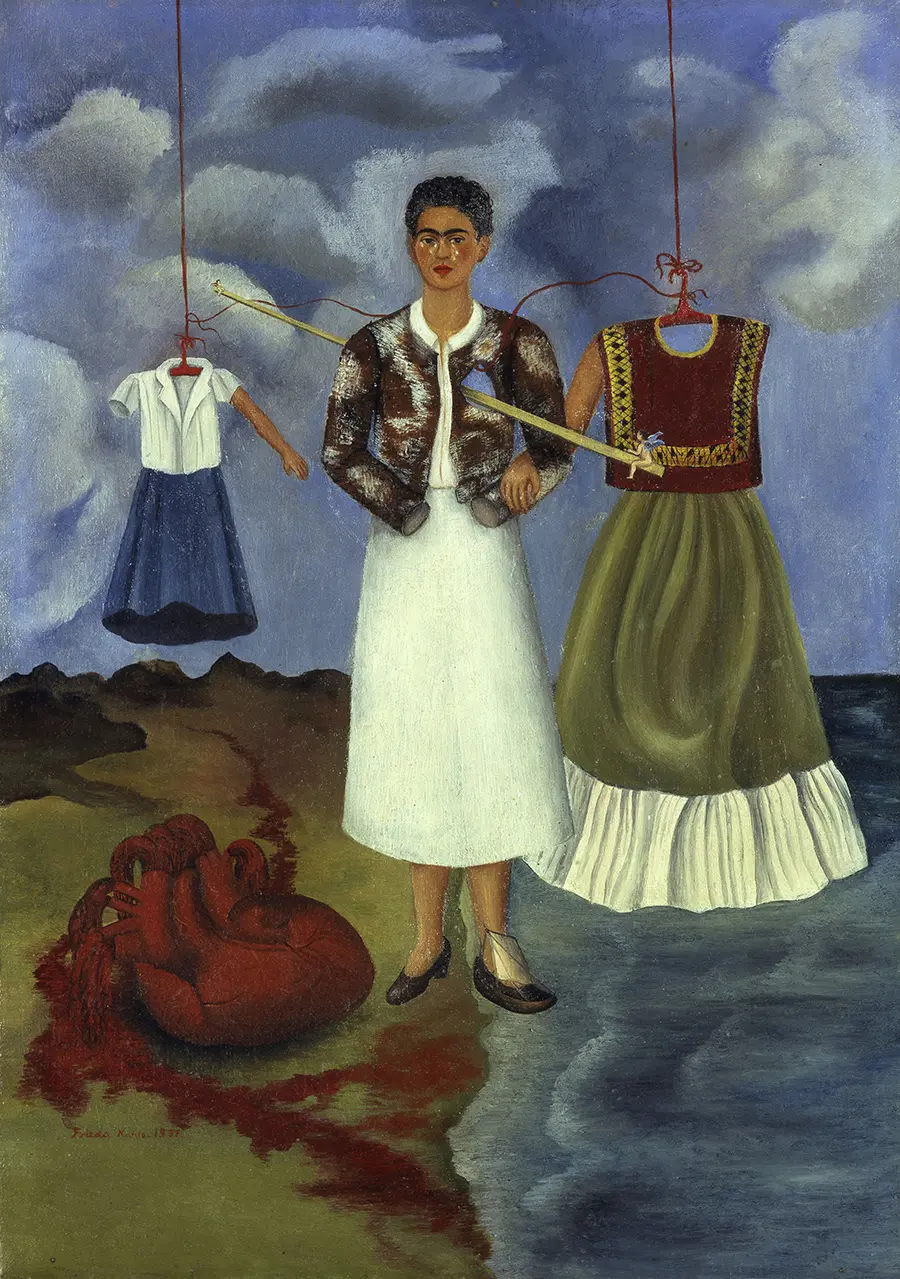
The exhibition features several remarkable works from the late 1930s, including Still Life with Prickly Pear Fruit, The Deceased Dimas Rosas (At Three Years of Age), Survivor and Memory, the Heart. In the latter Frida stands with a gaping hole where her heart should be. Her oversized heart lies bleeding on the shore sending a river of blood running to the mountains and the sea.. Through the opening in her chest pokes a long rod on which two tiny Cupids ride seesaw. Frida is shedding tears, her hair is cropped, she wears a jacket but her hands are missing. Her misshapen foot is placed in the sea while the other one stands on dry land. A Tehuana dress on a hanger hooks one human arm through Frida’s armless jacket. This dress is linked by a red string to a schoolgirl uniform in the background. There is a lot going on visually and some of it is confusing, but the core emotion is unmistakable: it lays bare Frida’s heartbreak after discovering that her husband, Diego, was having an affair with her sister, Cristina.
Frida and Diego divorced in November 1939, but Frida forgave her sister Cristina, and the Riveras were reunited a year later. Cristina lived near Frida’s home in Coyoacan and turned out to be very loyal and helpful during her sister’s final years of ill health, though some scars undoubtedly never healed.
After Frida’s father’s died in 1941 the Riveras ( who were remarried) moved into Frida’s childhood home Casa Azul, which is now a museum and pilgrimage site for devotees. During the war years Frida participated in several group exhibitions in the U.S. Despite her deteriorating health – which forced her to wear an iron corset – her productivity by and large continued at a steady pace, while she also found time to teach art students from the Escuela de Pintura at Casa Azul.
Self-Portrait with Thorn Necklace and Hummingbird (1940) is one of her most iconic self-portraits from this period and an excellent example of her most technically accomplished work. Frida had recently divorced Diego and started an affair with the photographer Nickolas Muray in the U.S.. Her pent-up anger is not reflected in her calm, strong and determined posture toward the viewer. Instead, she depicts herself as a martyr wearing a crown (or necklace) of thorns around her neck that draws blood, exacerbated by the spider monkey on her shoulder playfully pulling on one of the branches. A hummingbird hangs like a pendant from the thorny stem. The bird’s spread wings echoes both Frida’s unibrow and slight moustache. Mexicans still occasionally wear (dried) hummingbird amulets as love charms. The black cat, symbolising bad luck, behind Frida’s left shoulder seems to eye the bird. In her braided updo two butterflies ( part of her jewellery) are visible, along with two dragon flies hovering above her head. These represent resurrection, the rebirth of her soul and perhaps a new chapter in her love life? Frida gifted this self-portrait – one of her most significant ones – to Nickolas Murray that same year.
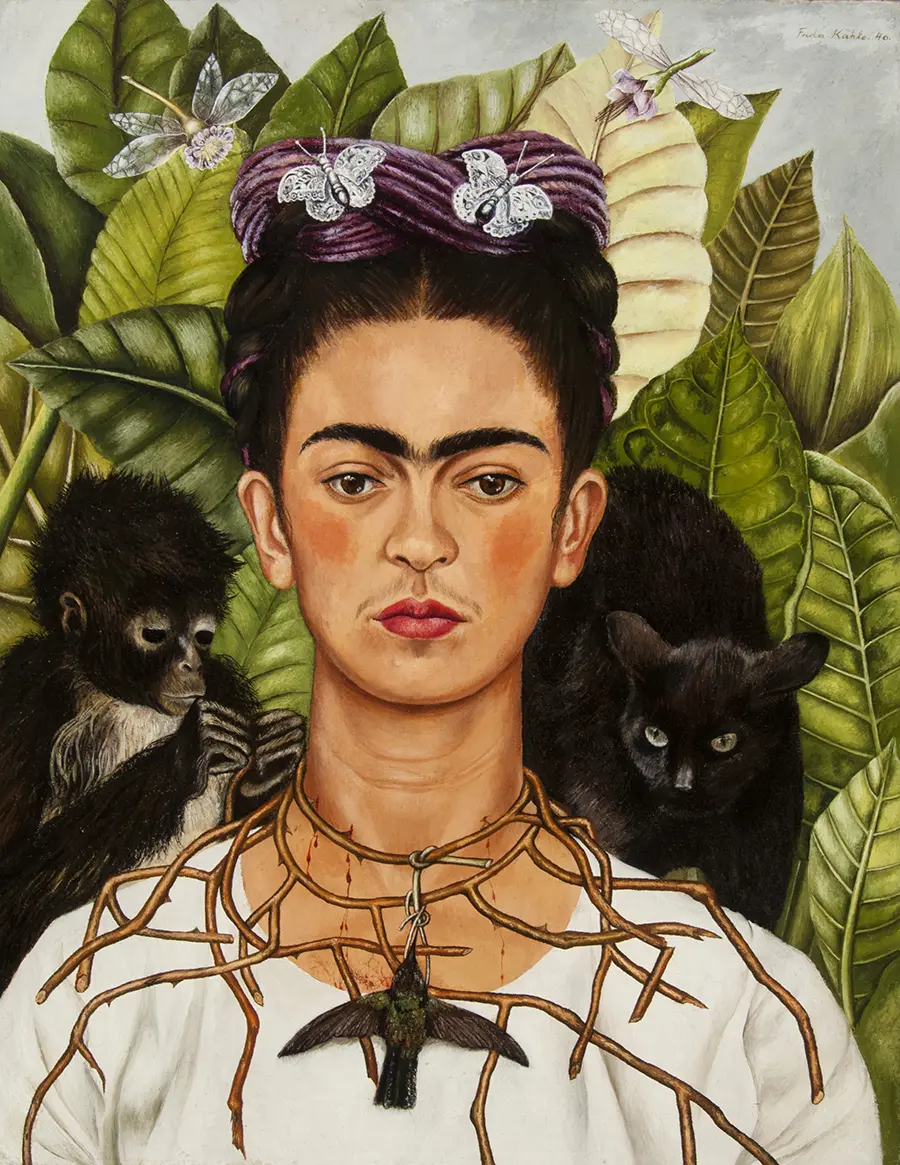
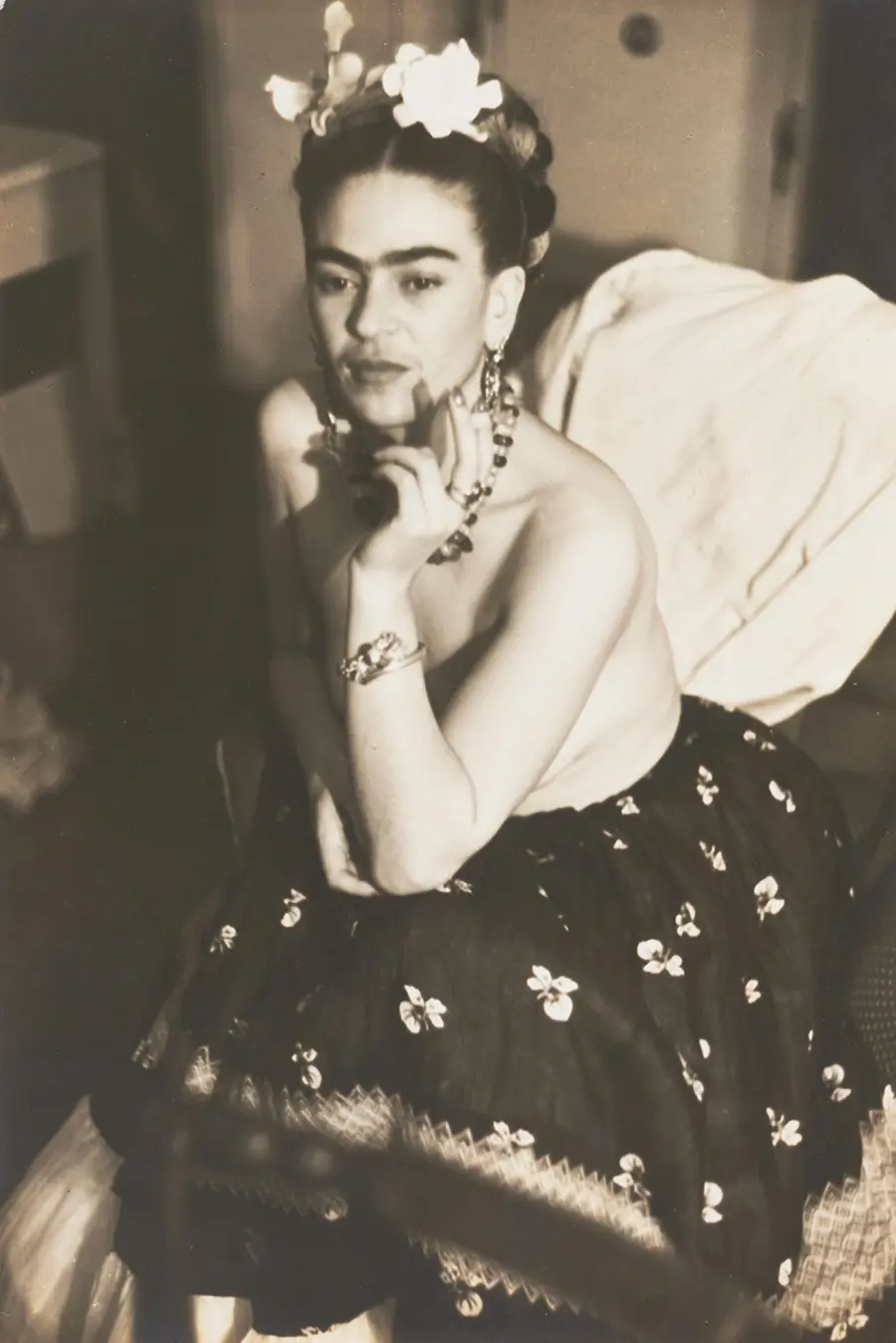
In some of her self-portraits, Kahlo enhances her androgynous features, such as her strong eyebrows and the faint moustache, she kept throughout her life. However she just as deliberately highlights her feminine beauty across most of her work. Intriguingly, there are also a surprising number of drawings and photographs where she proudly poses bare-chested with quiet pride. Intended strictly for private view, these images highlight her playful nature and her fondness for roleplay.
The 1940s were marked by deteriorating health, yet her productivity remained reasonably high until 1948 (when she only completed one painting). During this decade she underwent a risky back operation in New York, participated in shows at home and was awarded the National Prize for the Arts and Sciences of the Mexican Ministry of Public Education. She also wrote the essay ‘retrato de Diego’ for a publication honouring her husband.
At the time, Diego was far more famous than Frida, and this would remain the case until the end of the last century. Today, those roles are reversed. While Diego remains a major figure in Mexico and the U.S. , most people in Europe probably only know him as the husband of Frida. He deserves better. His sensual drawing Nude with beads (Frida Kahlo, 1930), and his candid painting of Frida Kahlo and his self-portrait drawing are featured in the exhibition. Frankly, Tate Modern would have had a far superior show on its hands had it included more works by Diego, related to Frida, and less ‘art’ manufactured by her fan-base.
Admittedly, Rivera was an ardent communist who showed too much admiration for both Stalin and Mao. Both dictators were depicted as heroes alongside Frida in a wheelchair – cast as a peace activist – in his controversial mural The Nightmare of War and Dream of Peace (952). But that’s another story.
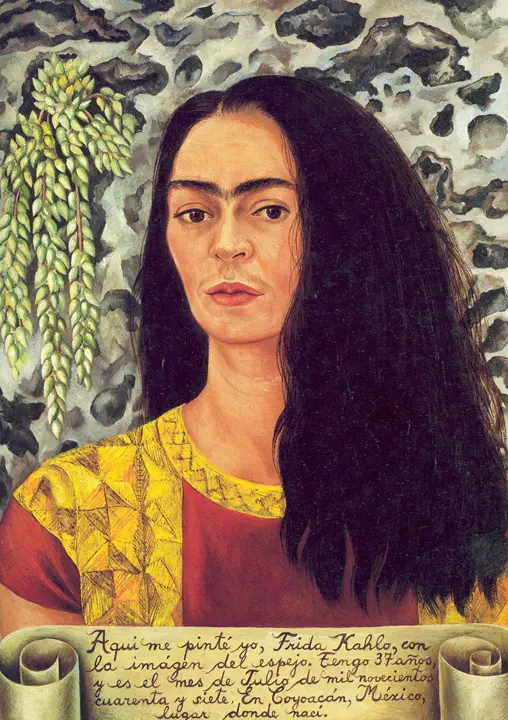
Frida’s first solo exhibition in Mexico opened in April 1953. Guests at the opening were deeply disappointed when it was announced that serious health issues hindered the artist from attending, only for Frida to arrive in an ambulance with blaring sirens and a police motorcycle escort. She was carried inside to her own bed, which had been transported to the gallery. Dressed in full Tehuana attire she drank, sang, and socialised with friends and admirers from her bed.
Four months later the inflammation in her right leg had worsened so severely that it required amputation. She attempted suicide. Later, while convalescing, she participated in a demonstration against CIA involvement in Guatamala. Eleven days after the protest on July 13, 1954 , she died at her home, La Casa Azul.
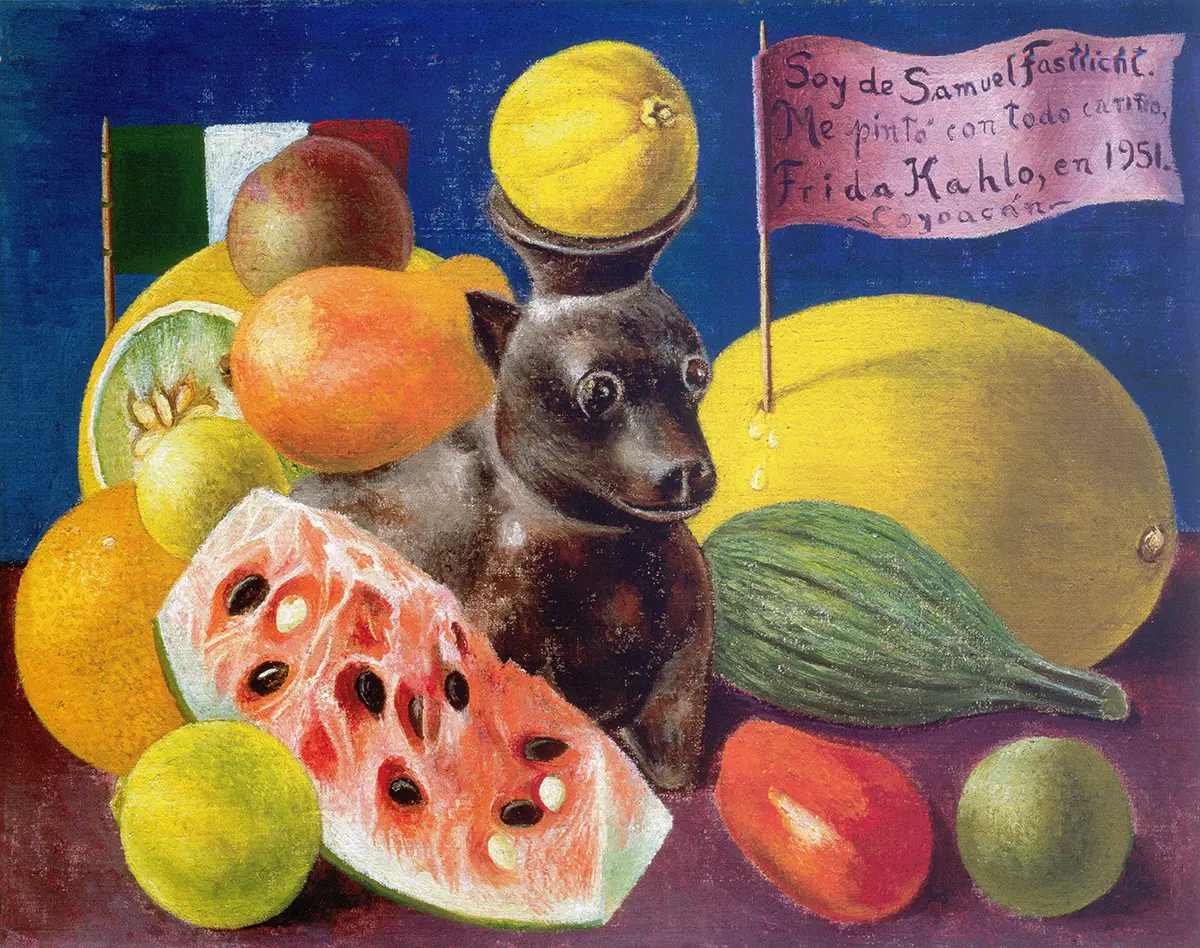
Just eight days before her death, Frida finished her final painting, sharing a batch of watermelons with the viewer. Some of the thick-skinned fruits are sliced open, exposing vivid and juicy red flesh. The black seeds are prominent, symbolising fertility and the promise of new life after the fruit is consumed. Carved into the flesh is the title: Viva la Vida (Long live life). It may sound familiar if you own the Coldplay album of the same name. This painting isn’t in the exhibition, but melons and fruit feature prominently in the featured image above, Naturaleza muerta (1951). In Mexico watermelons are closely associated with the Day of the Dead when families celebrate – rather than mourn – their departed loved ones and consume their favourite food.
In her diary Frida Kahlo’s final entry was; “I hope the exit is joyful – and I hope never to return.”
NB Oh dear, I have completely ‘forgotten’ to review the works of the 90 or so other artists who take up most of the space in the final three rooms.
Interpretations of Frida’s art continue to revolve. The response from contemporary Chicana (that is female) artists was almost immediate. They recognised in Frida’s self-image – wounded, disabled and often proudly clad in traditional Mexican dress a strong, determined Latina who refused to yield to self-pity. Frida became the symbol of quiet suffering: a modern Mater Dolorosa, or Our Lady of Sorrows, even if she viewed herself more as the Mexican Earth Mother. We see her nurturing a giant baby “Dieguito” (her nickname for her husband) surrounded by pre-Columbian imagery and plants in her famous 1949 painting The Love Embrace of the Universe, the Earth (Mexico), Myself, Diego and Señor Xólotl. The work is absent from this exhibition, but its is full of symbolism and sums up many of her deepest longings and feelings.
Frida very much wanted to be a mother, but due to her physical trauma as an 18-year-old, carrying a child to birth would have been dangerous for her own and her unborn’s health. Diego routinely abandoned the women who bore his children – yet another one of his callous traits.
Regrettably, very few of the Chicano artists in this exhibition have much to offer , beyond straightforward homage to their icon.
But if you haven’t seen any of Frida Kahlo’s masterpieces in the flesh, so to say, I urge you to visit the exhibition. Half a dozen of her very best paintings are at Tate Modern and and there are plenty of seldom seen photographs and drawings as well. Well worth going, just for celebrating Frida, ignore the ‘mania’.
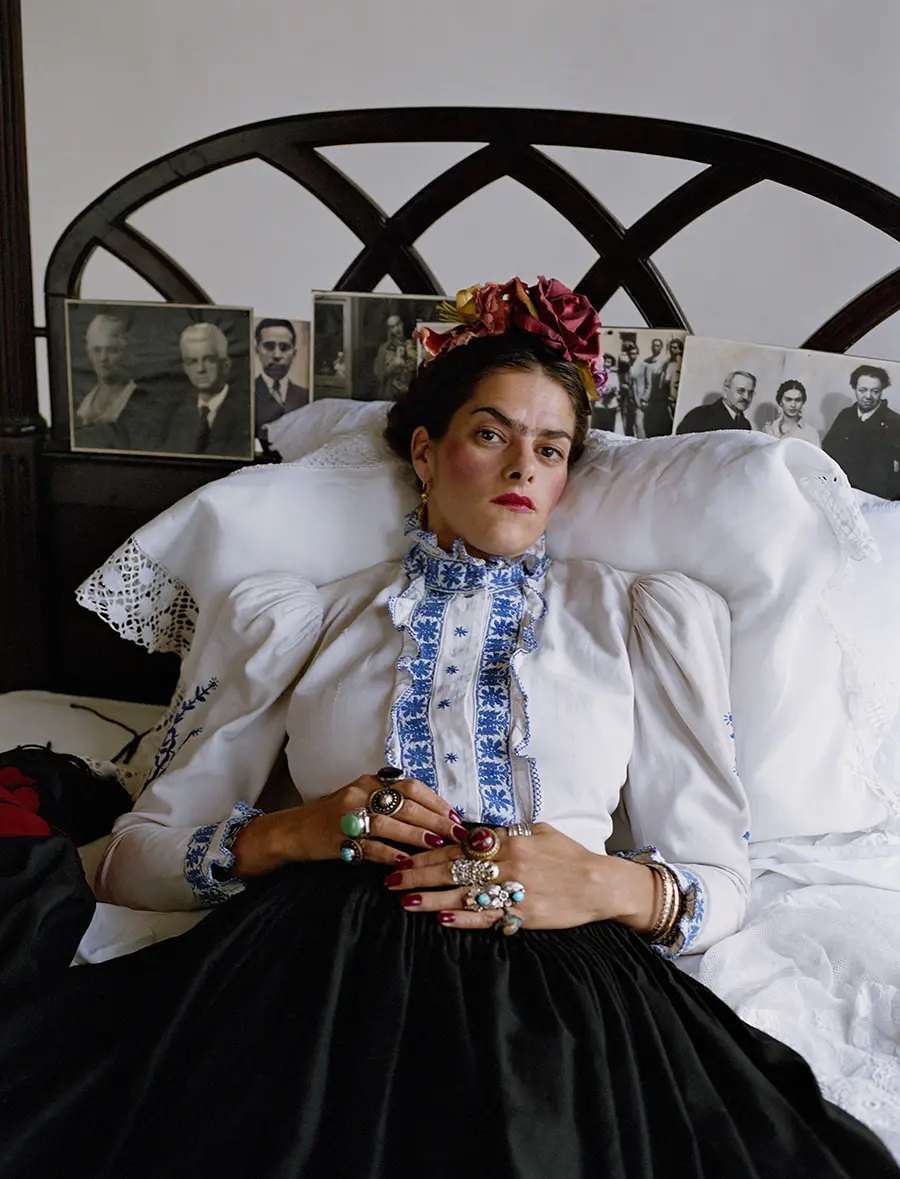
FRIDA: THE MAKING OF AN ICON at Tate Modern until 3 January 2027


