In his short life, Georges Seurat (1859 – 1891) finished approximately 45 oil canvases. Just over half of these were created during his visits to the Channel coast. Seurat’s seascapes, however, seldom receive the attention they deserve when displayed alongside his better-known, much larger paintings A Sunday on La Grande Jatte, Bathing, Asnières, Le Cirque and La Chahut. These popular works show Parisians enjoying the outdoors, the circus and can-can dancers. While these renowned works depict Parisians enjoying all kinds of leisure activities, the ‘marines’ – depicting harbour and sea views – are almost completely devoid of people. Is there an explanation for this disparity?
The last major retrospective of Georges Seurat’s work took place in Paris and New York in 1991-92. Since then there have only been a number of minor exhibitions, but the Courtauld Gallery ‘s Seurat and the Sea is the first show to focus solely on the artist’s yearly visits to the northern coast of France. The Courtauld has assembled seventeen of Seurat’s twenty-four canvases featuring sea and port motifs created between 1885 and 1890. In addition, this relatively small but impressive exhibition includes nine oil sketches and Conté crayon drawings, offering a fascinating insight into Seurat’s meticulous preparatory process.
During his lifetime the seascapes, with their melancholy and contemplative character, attracted considerable attention, particularly within artistic circles. In an essay Robert Delaunay even described him as ¨the first theoretician of light”. It’s high time these works are valued and recognised as the pioneering achievements they truly are.
Georges Seurat will forever be remembered for introducing a revolutionary painting technique that was termed Pointillism or Neo-Impressionism – a label he himself disliked. He preferred instead to describe his innovation as Divisionism or Chromoluminarism.
Georges Seurat enjoyed a comfortable bourgeois upbringing, only briefly disrupted by the Paris Commune in 1871. His family was well off and, like Degas and Cézanne, he had no financial worries. In fact, only three of his paintings are known to have been sold during his lifetime. His eccentric father spent much of his time away from the family at a cottage on the outskirts of Paris, where Georges would occasionally join him to paint.
At fifteen he enrolled himself at a municipal art school where he was instructed in copying engravings and classical sculpture. At seventeen, he was accepted at the École des Beaux-Arts, a stronghold of conservative academic teaching methods. His professor of drawing and painting, who had trained under Ingres, was indifferent to Seurat’s talen. No wonder he increasinglypreferred to spend time in the Academy’s and the Louvre’s library.
Eugène Delacroix’s use of vibrant prismatic colours and his pairing of complementary colours served as the foundation of the technique Seurat developed. He also studied several key works on colour theory, including Ogden Rood’s Modern Chromatics and Michel-Eugène Chevreul ‘s treatise Principles of Harmony and Contrast of Colours, which contained the advice to artists to apply separate brushstrokes of pure colour to the canvas and allow the viewer’s eye to blend them optically. Rood likewise suggested that adjacent dots of different colours, when viewed from a distance, would coalesce into a new single hue.
These ideas form the basis of the radical Pontilliest technique and the move toward ¨painting with light¨that Seurat and Paul Signac developed in the 1880s.
After completing a year of voluntary military service in Brest, Seurat returned to Paris and began to draw and paint in earnest. Gradually, he moved away from linear draughtmanship and academic convention, experimenting with a more tenebrous style that incorporated lessons deawn from his study of Delacroix’s theories on colour.
In 1884 Seurat submitted his first major canvas, Bathers at Asnières, to the official Salon, but it was rejected. The setback prompted him to join the newly founded jury-free Société des Artistes Indépendants, which organised the Salon des Indépendants to exhibit works refused by the official Salon. There Seurat showed his work every year until his death in 1891.
In 1886 he was invited to exhibit A Sunday on La Grande Jatte at what turned out to be the final Impressionist exhibition. He had begun work on the monumental canvas two years earlier. The critics were puzzled by the strange, faceless figures ¨cut out like poorly made mannequins¨ The critique was not entirely unfounded: Seurat set out to portray his figures in static poses, recalling classical friezes. The harmonies of colour and composition also reveal a strong debt to the frescoes of Piero della Francesca.
It was customary for artists to leave Paris during the summer in search of fresh motifs along the northern coast of France. Seurat was already familiar with Brittany, having spent his military service there. In 1885 he decided to explore the coast of Normandy where he found the small fishing village of Grandcamp (not far from Omaha beach where the Americans landed on D-day in 1944). It was off the beaten track and it offered the solitude he sought.
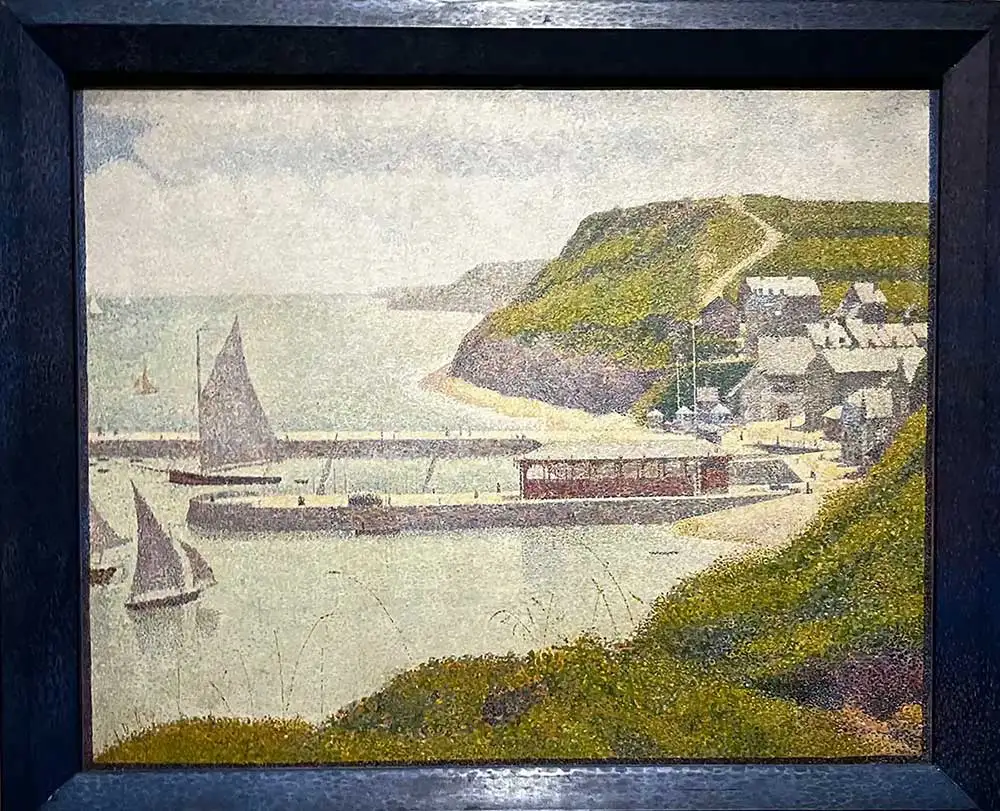
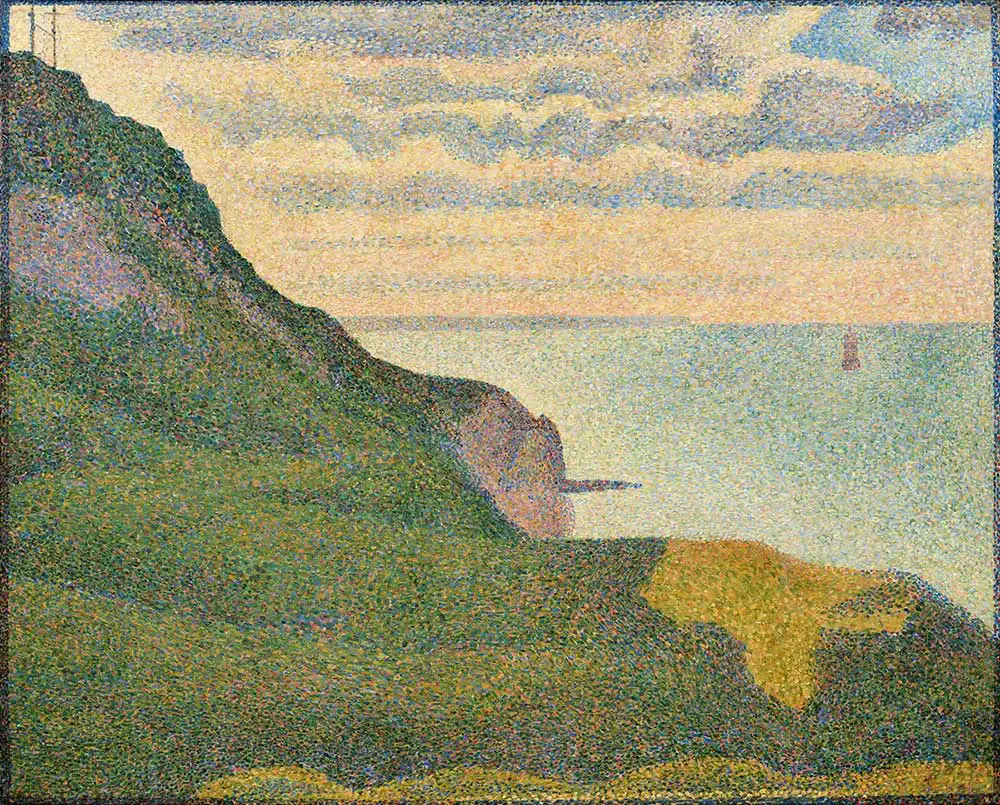
On either side of La Grande Jatte at the Impressionist exhibition hung two seascapes now included in the Courtauld exhibition: Le Bec du Hoc and The Roadstead of Grandcamp. Critics at the time admired these works for their tranquility and ¨penetrating melancholy¨as one reviewer observed, they were ¨ vibrating with fresh air, with an impression of sadness that is charming.¨
The Roadstead of Grandcamp appears to depict a sailing regatta, yet the grass, the fence and shrubs in the foreground are more prominent and dominate the composition, while the triangular sails and identical hulls of the boats create an uniformity that has a slightly dulling effect on the scene.
Le Bec du Hoc, by contrast, feels far more animated. The escarpment and cliff thrust upward, its tip breaking the horizon line as Seurat looks out over a choppy sea, punctuated by a few triangular sails in the distance. The water is rendered with short horizontal strokes whereas the cliff face is constructed through a criss-cross pattern, partially overlaid with thicker dots. Both the motif and the composition recall Monet’s Normandy paintings, although in neither seascape does Seurat fully achieve the subtle, hazy, yet luminous summer light that characterises the marine works he produced in subsequent years.
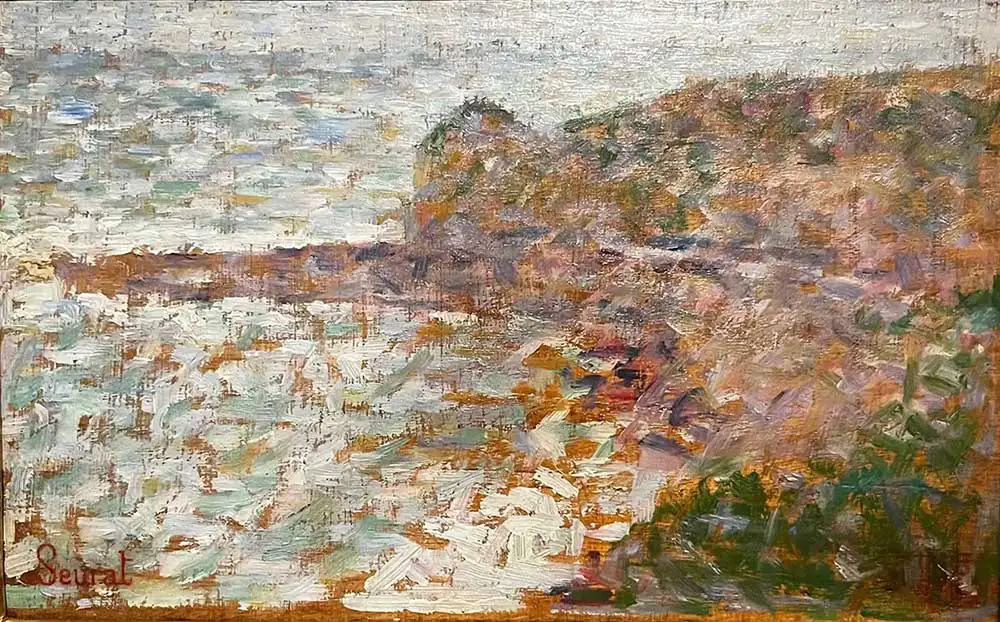
Marine at Grandcamp (1885) appears, at first glance, to be a rather crude oil sketch, yet it is quite revealing. We are so accustomed to Seurat’s – down to the tiniest dot – planned canvases that the freedom comes as a surprise. There are no dots; instead he’s playing fast and loose with short, thick brushstrokes. Such preparatory sketches were made using his travel paint box. Seurat referred to these oil studies as croquetons (from croquis, the French word for sketch). After his death 163 of them were found in his Parisian studio.
Back in his lodgings Seurat would begin work on a larger canvas, using his sketcches as a guide The finishing touches were added after the summer break in his studio in Paris. Much about Seurat’s working methods remains unknown, because he was a very private man and rarely allowed visitors into his working space.
The summer of 1886, he spent eight weeks in and around the picturesque town of Honfleur, following in the footsteps of Turner, Boudin and Monet. It proved to be his most productive seaside campaign, resulting in seven finished canvases.
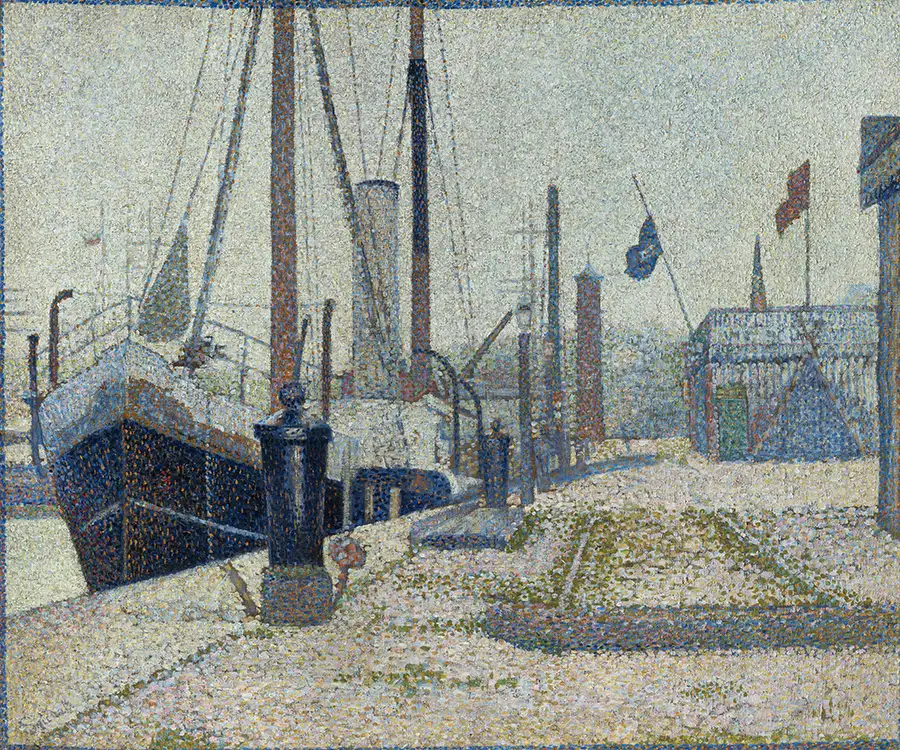
The painting of the cargo and passenger ship The Maria, moored at the quay, is slightly unusual in Seurat’s oeuvre. Here he carefully constructs the perspective – something he normally avoided (or couldn’t be bothered with?) creating a real sense of depth. The mast, the ship’s funnel, the mooring posts , cranes and towers add a distinctly vertical and mechanical vigor to the composition. The machinery assumes a central role, partly due to the fact that there are no people present in the scene. (The picture can be seen at the bottom of the story)
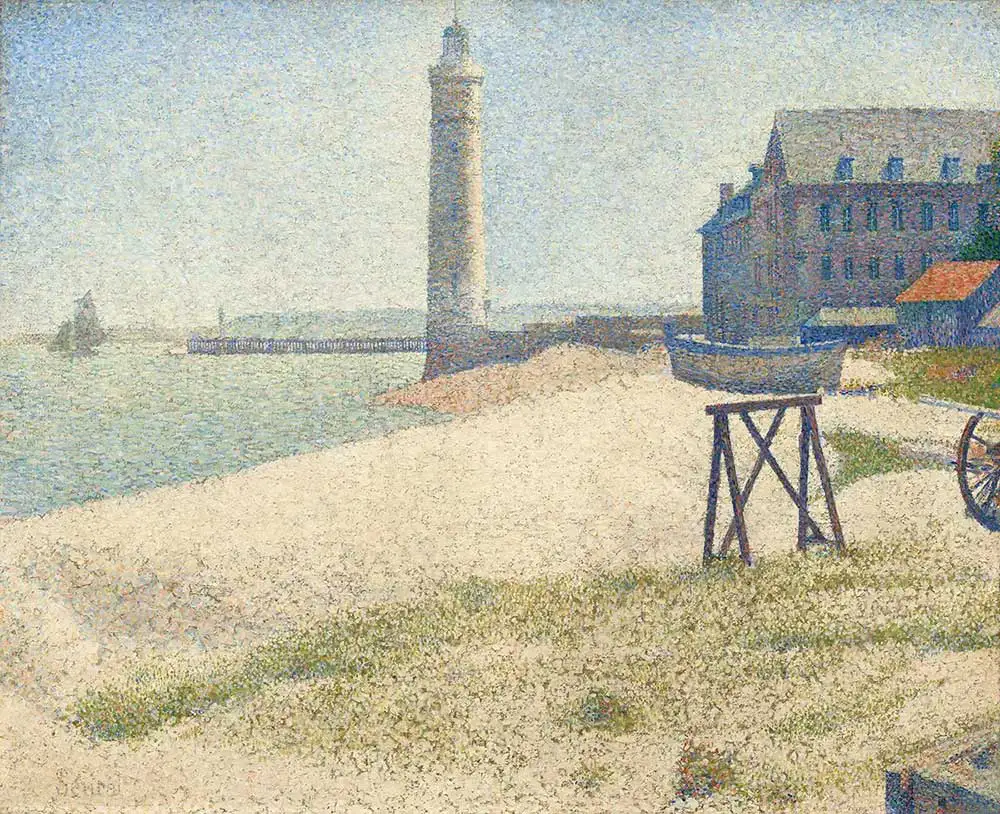
The Hospice and the Lighthouse of Honfleur was a beloved motif for 19th century painters, including Monet and Boudin. Seurat’s version is bathed in mid-afternoon light. The sun-drenched shoreline – featuring the hull of a rowing boat, a sawhorse and part of a wheel in the foreground – appears much brighter than the hazy sky above. A shadow falls across part of the hospice – which at the time was a care home for ancient mariners – setting up a contrast with the white lighthouse, which could be interpreted as a symbol of resilience and hope. The only sign of human activity is a solitary sailing boat near the pier. Seurat wrote in a letter that the painting took two and a half months to complete.
The summer of 1887 Seurat remained in Paris, devoting himself to two large-scale figure paintings;:The Models and Circus Sideshow. The following year, he returned to Normandy choosing Port-en- Bessin, a fishing village with a newly modernised harbour, as his destination. The six paintings he produced there – reunited for the first time in this exhibition – mark a further refinement in his style. Five depict views of the inner and the outer harbour.
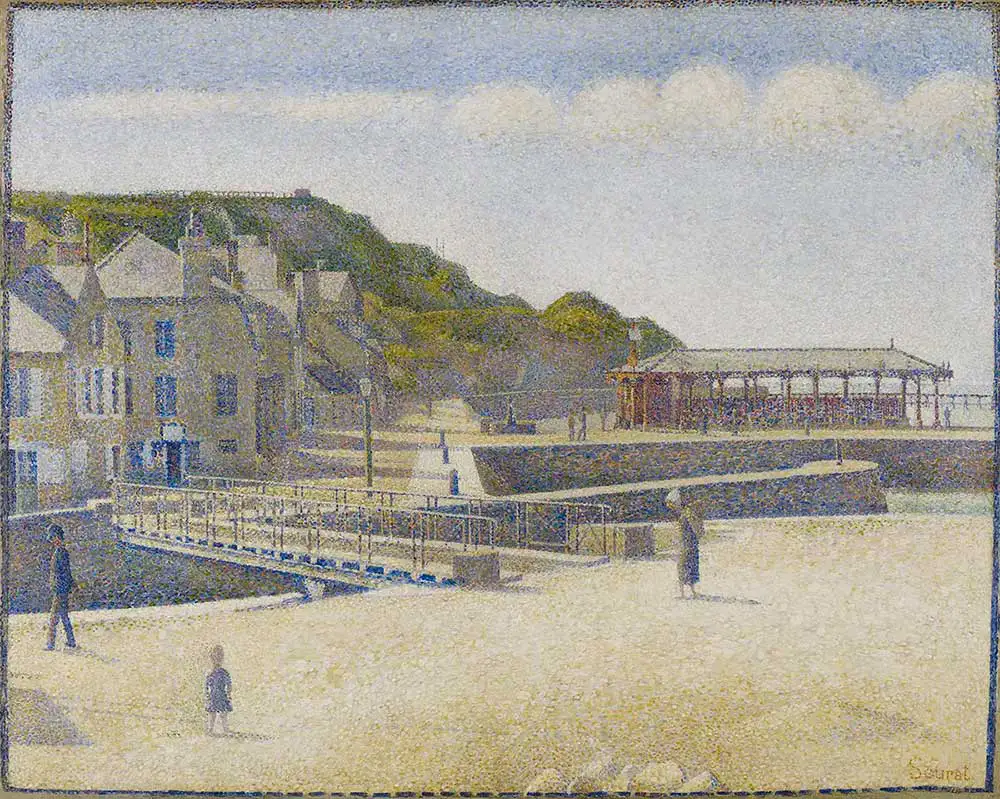
Port-en-Bessin – The Bridge and the Quays reads almost like a study in geometrics. Seurat focuses on infrastructure: the swivel bridge across the harbour entrance, the steel structure of the fish market and the sharp angles of the quay. The foreground, like in the Hospice painting from Honfleur, occupies a substantial portion of the canvas. This time however, he adds three figures: a woman carrying a basket on her back, a strolling customs officer and a small child looking directly at the viewer.
The exhibition curators have found a contemporaneous postcard showing almost exactly the same vantage point chosen by the artist; in its foreground stand two small children looking straight at the photographer. Did Seurat use this postcard as a reference upon his return to his Paris studio?
By this stage, Seurat had mastered his technique, achieving the desired ¨optical fusion¨ through the careful juxtaposition of short brushstrokes and dots of unmixed colours applied directly to the canvas. The method proved particularly suited to capturing the soft, diffused, ‘gauzy’ maritime light so characteristic of northern France in summer.
In 1889 Seurat started adding dark borders on many of his old and new marines paintings, applying them onto the canvas itself. He also painted a number of frames for his own works. Listen to the curator of the exhibition, Karen Serres, explaining what he was trying to achieve:
In the summer of 1889 Seurat spent in Le Crotoy, a town on the eastern side of the Somme estuary known for its south-facing beach. There are no dramatic vistas; the few paintings he produced that year depict sand, a calm sea, and big skies with very fluffy-looking clouds. There is a greater sense of compression in the distribution of colourful dots than in previous seascapes.
Seurat’s final summer campaign in 1890 produced four large canvases, all of which feature in the exhibition. He based himself in the fairly unremarkable town of Gravelines, 15 miles southwest of Dunkirk. He was clearly no longer interested in painting picturesque views. After all, he did not need to make a living from selling his canvases.
For the painting The Channel of Gravelines: Petit-Fort-Philippe he chose a spot where the canalised river Aa widens as it reaches the sea. This is also where boats would moor. Seurat planned the work meticulously. Two oil sketches painted on wooden panels, as well as several drawings, have survived. He stayed quite faithful to the harbour view in front of him, apart from moving the lighthouse away from the edge of the composition. It is one of the few vertical punctuations – together with the masts of the sailing boats – in a picture that initially relies almost completely on a horizontal structure.
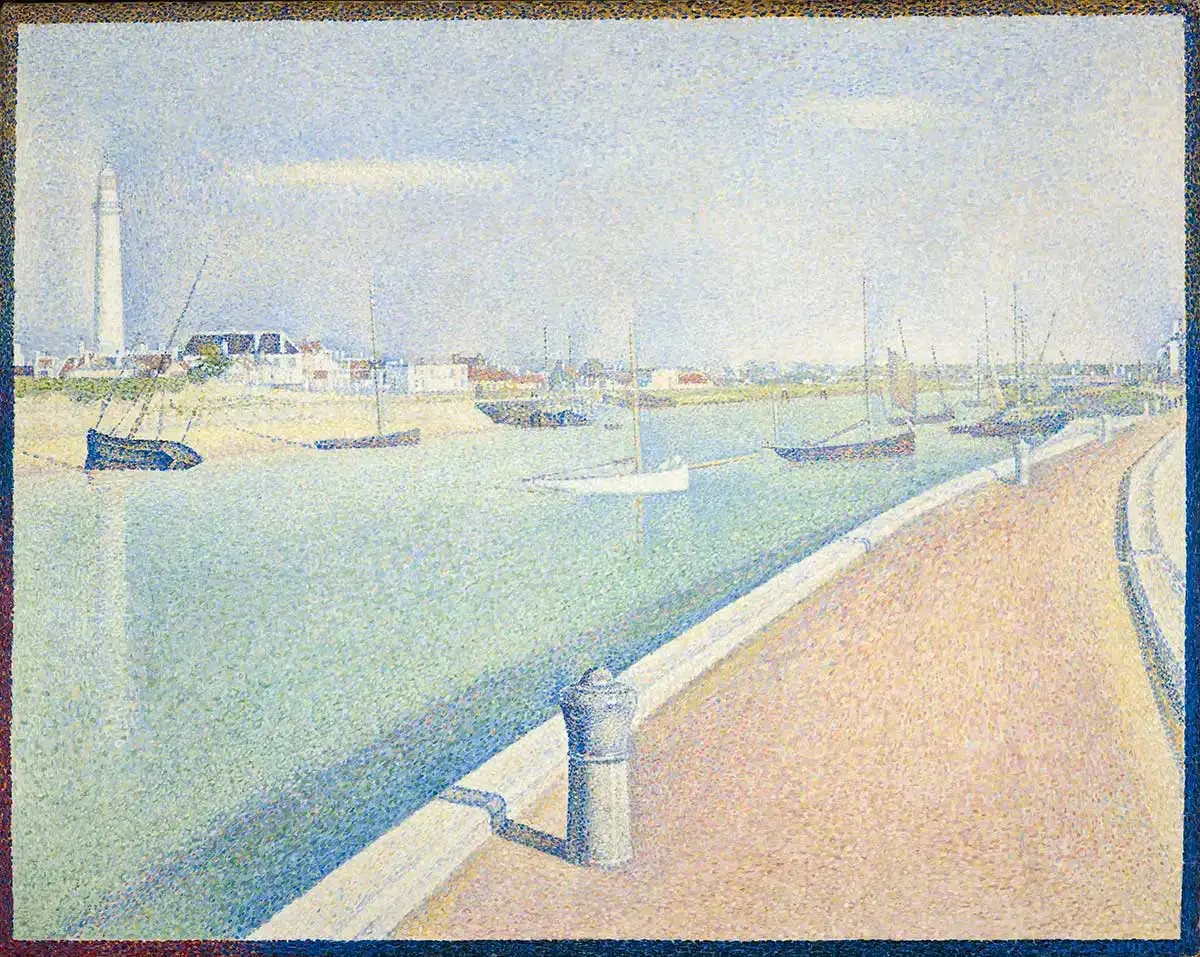
The sky, the ground and the water each take up about one third of the picture. Seurat also knew to add an element of dynamism: the orange-dotted walkway sweeps into the distance, drawing the viewer’s eye with it. In an earlier oil study, the path has less of a bend and there is a small sailing boat in the foreground. He realised that more was needed to truly engage the viewer. The craft was moved further up the river with some other boats, and instead he placed a chunky bollard close to the edge of the canvas. He loaded the sturdy post with dense dots of colour to give it greater visual weight and prominence.
Then there is the marvelous shadow cast by the bollard, which hangs almost lazily over the quayside and acts as a kind of sundial, signalling that it’s afternoon. Not a living soul in sight, not a dicky bird in the sky. The perfect rendering of the summer light and the harmony of the composition make this one of the highlights of the exhibition.
Seurat died in March 1891, aged only 31, just a few months after finishing The Channel of Gravelines: Petit-Fort-Philippe. Pointillism, the movement he had started, had at that point attracted many followers, all over the world. Many other artists learnt from his colour organisation and methodical approach, including van Gogh, Delaunay, Matisse and Bridget Riley.
He truly revolutionised colour technique by applying pure colours directly onto the canvas, side by side. By juxtaposing colours from opposite sides of the colour wheel, he achieved greater vibrancy. Without mixing pigments, he also created an optical effect that still makes artists rethink what colour can be.
With most of Seurat’s seascapes, you sense the methodical precision and the clever technique when observing the painting up close. Yet when you move away and view the same picture from a distance, the technical aspects fade away and you simply admire the way he conveys light and captures stillness in a manner that photography cannot.
London is very fortunate when it comes to works by Georges Seurat, who left behind no more than between 45 to 50 finished paintings. A handful are in permanent London collections, but when you add the Courtauld’s temporary exhibition, it becomes rather special, if not to say unique. To wrap it all up, I will let the Courtauld Gallery’s curator, Karen Serres, explain why this is a once-in-a-lifetime opportunity to see almost half of Georges Seurat’s finished works in London.:
Seurat and the Sea is the the Courtauld Gallery until 17 May 2026