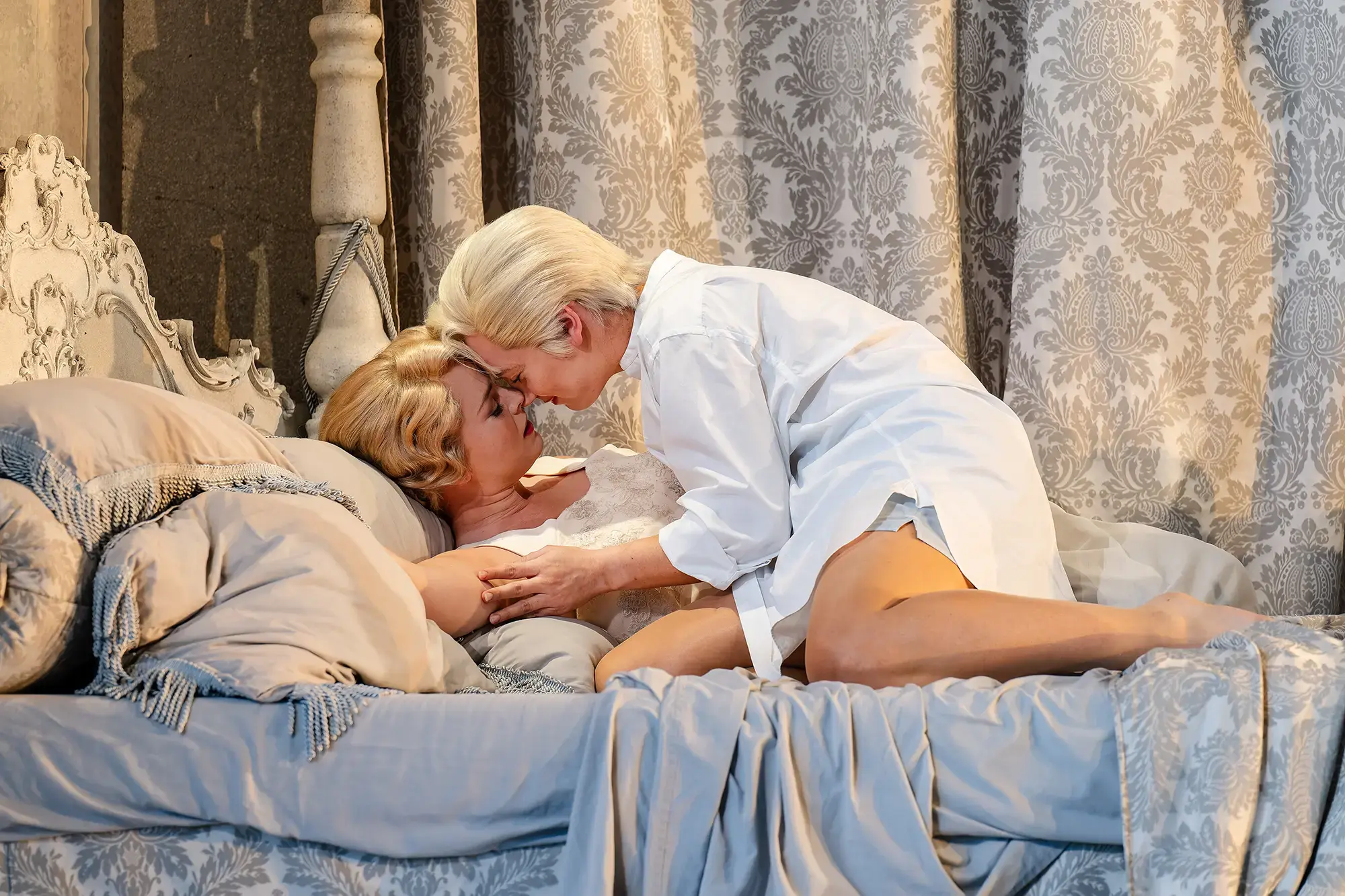
The set for Act I of Garsington Opera’s revival of Richard Strauss’s Der Rosenkavalier is dominated by a large, canopied four-poster bed, with the curtains drawn. Rather than a traditional overture; the opera opens with an introduction (Einleitung) that, as the Australian conductor Simone Young has pointed out, musically describes exactly what is going on behind those curtains. The magnificent, graphic opening bars of Der Rosenkavalier come straight to the point. The rising horn signals Octavian’s erection (yes, it really does), which lasts just under a minute and a half, after which the music softens and takes on an air of sexual satisfaction.
Octavian (Niamh O’Sullivan) draws back the curtains to reveal the Fieldmarschallin (Matilda Sterby) having a post-coital nap. While hardly shocking for today’s audiences, at the 1911 Dresden premiere the censors only allowed the Marschallin to receive her young lover while sitting on a sofa. The Lord Chamberlain’s office in the UK went even further, demanding the entire seductive scene take place in a ‘petit-salon furnished with a small table, chairs, etc.’
Today we find it more shocking that the middle-aged Marschallin is having an affair with the seventeen year old Count Rafrino, alias Octavian. Yet in the 1740s – the original setting of the opera – boys in most European countries reached the age of consent at 12 or 14. On the other hand, a 32-year old (the Marschallin’s actual age) was considered middle-aged. I am not aware of any sopranos that have sung the Marschallin in major opera houses at 32 (Schwarzkopf was 37 when Karajan was adament she was perfect for the part). Not only does the role require a considerable stage presence, but there is an awful lot of text to memorise. From a purely vocal perspective, this is not the most challenging part, but a singer must be in complete control of the parlando technique. It is not enough to sound good; the role requires serious acting ability, particularly in the two monologues – which are not arias – towards the end of Act I. Taking all these factors into account, casting directors and conductors usually opt for a highly experienced soprano in her late 30s or 40s, or even 50s. Quite a few divas of the past started out singing Sophie, progressed to Octavian, and took on the Marschallin, as their voice developed.
Matilda Sterby is a very promising discovery. Her voice is 22-karat, almost pure gold, blended with silvery tones in her upper tessitura. The conversational, sometimes rhythmically challenging passages come naturally to her. While hers is not the most lyrical voice, her timbre and youthfulness more than make up for it. There is an audible gasp from the audience when Sterby makes her entrance in a 1950s, three-tone yellow Grace Kellye-sque outfit. She could not look more ravishing while delivering her two introspective soliloquies.
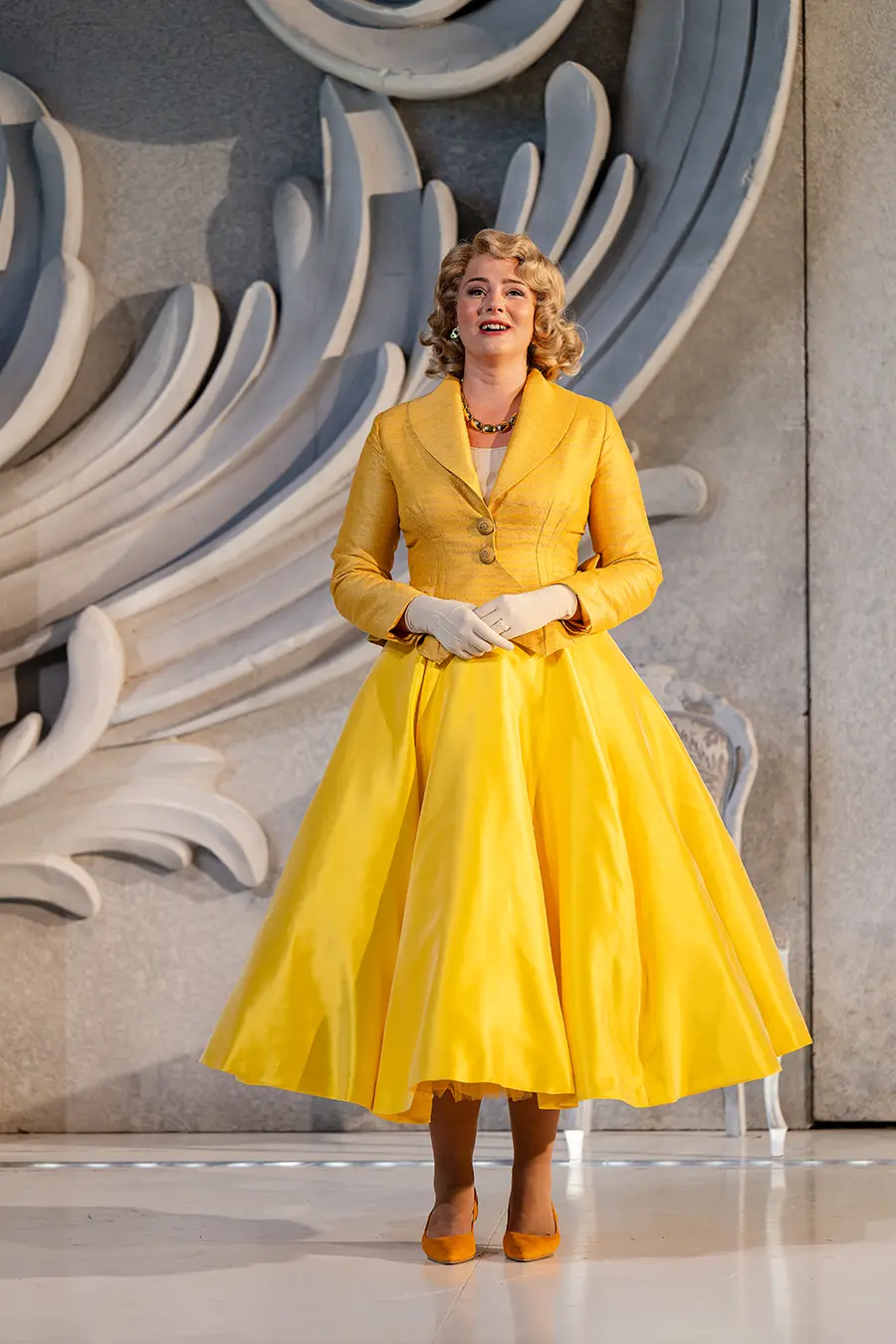
Fresh out of the convent, the young Marschallin was forced into wedlock with a much older man. Now battling with the early signs of ageing, she snaps at her hairdresser, accusing her of making her look old. When Octavian returns, she engages in a bit of ‘conscious uncoupling’ telling her young lover that he should find a lover his own age. Comedy is abandoned for serious reflections on the meaning of Time: ” Time is a strange thing/ while one lives just for a moment (without concern) it is nothing,/ But then all at once/ We feel nothing else but it.”
She tells Octavian that half the time she is merry and half the time she is sad. Is this a woman on the verge of a mental breakdown? Is she suffering from neurosis, to use a somewhat dated, Freudian term? The opera’s librettist, Hugo von Hofmannsthal, was well-read and claimed to have studied all of Freud’s works. The impact is noticeable, though the influence of Arthur Schnitzler’s play Reigen – which tackles the hypocrisies of turn-of-the-century romantic morality – may even be greater.
The Marschallin’s soliloquies can seem incongruous in an opera that, until this point has been a comedy. Suddenly, we find ourselves in a music drama. Strauss allows the words to dominate while the orchestra takes a backseat, reducing the accompaniment to a chamber sized scale. In Sterby’s delivery there is no sense of bitterness or sadness. Her tone is slightly melancholic, but there is no hint of an emotional crises. Perhaps, she just wants to do right by Octavian when she turns him away? That seems a bit unlikely. Sterby would benefit from colouring words here and there a bit more and her performance lacks a degree of emotional profundity. However I am certain that depth will come with time. I expect her to receive plenty of invitations to sing the Marschallin for many years to come – though the role of Octavian would suit her beautifully as well.
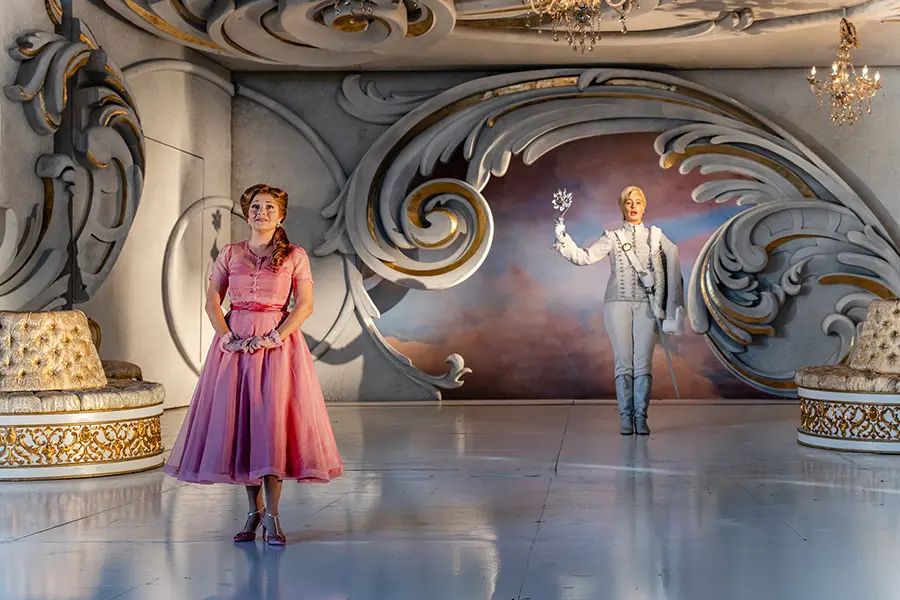
Octavian is sung by the Irish mezzo-soprano Niamh O’Sullivan, who last year received warm praise for her interpretation of the role in a production at the Théâtre des Champs-Élysées. Her voice has a dark patina that is ideal for breeches roles. Octavian shares many similarities with Cherubino in The Marriage of Figaro – the other outstanding trouser role. O’Sullivan avoids overdoing the young Count’s swagger and sex drive. In Act II she is equally convincing as the serious-minded ‘silver knight’ presenting Sophie with the rose, before chivalrously intervening when the naïve young woman is about to sign the marriage contract with Baron Ochs. Then, in the Third Act, disguised as the chambermaid Mariandel, she flirts with awkward, masculine overtones, while fending off the odious Baron. In the final love duet, Octavian and Sophie literally break the fourth wall, stepping out of the frame to address the audience directly: “ It is a dream, it cannot be real/that we two are together”
The British-Iranian soprano Soraya Mafi is ideally cast as Sophie, the daughter of the nouveau riche and newly ennobled Herr von Faninal, who tries to force her into marrying the Baron for his aristocratic lineage. Mafi’s light voice soars in the Presentation of the Rose scene (Hat ein starken Geruch wie Rosen ) effortlessly to crystal clear altitudes where not too many sopranos can venture. No wonder she has been invited to repeat the role next season in both Dresden and Houston.
Octavian falls head over heels in love with Sophie, and one could argue that the innocent girl, straight out of convent, is a simply a younger version of the Marschallin (who in Act I compares her arranged marriage to Sophie’s).
Strauss originally wanted Baron Ochs auf Lerchenau to be the opera’s main character, but fortunately, Hofmannsthal envisioned the Marschallin and Octavian as the main protagonists. The Baron is related to Verdis Falstaff and various buffoonish Viennese operetta characters – a sex obsessed ‘Don Juan of the dung heap’ and the Marschallin’s poor country cousin.
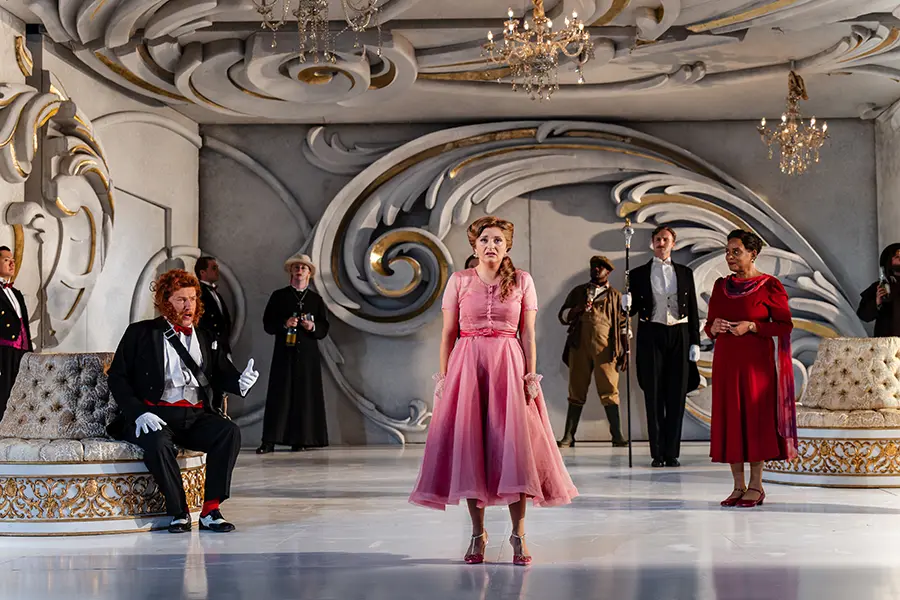
Andreas Bauer Kanabas is a versatile bass who has appeared in many of the major opera houses. His voice possesses elegance and power in the upper register, alongside a firm legato in the lower regions. A keen actor, Kanabas is not afraid to occasionally ham it up, particularly in Act II and III. It’s entertaining, but one hopes his colleagues are fine with him stealing a few scenes. As a native speaker, he is very comfortable with the Hofmannsthal’s Sprachkostüm – a re-invented German idiom that, in the Baron’s case, adopts a Wienerish sounding accent rooted in 18th century speech patterns.
Nothing could be more Viennese than the waltz and whenever the Baron appears, he is accompanied by triple-time rhythms. The waltz is anachronistic to the opera’s 18th century Vienna setting as the dance only gained popularity in the early 19th century before remaining the dominant dance style until the outbreak of the Great War.
Richard Strauss was not related to his namesake Johann, they didn’t even have the same nationality, but he respected the “Waltz King.” A clear tribute occurs at the end of Act II when the wine-suffused Baron rejoices in the “luck of the Lerchenaus” and dances to the tune of Johan Strauss’s Dynamiden Waltzer. Well, the melody is almost identical, save for a slight variation. Richard is surely also playing with the general public’s anticipation: if a composer is named Strauss, he has to compose waltzes.
However it is Mozart, not Johann, who provides the key to understanding what Hofmannsthal and Strauss wanted to achieve with Der Rosenkavalier. After the success of Elektra and Salome, they decided to move away from Greek tragedies, opting to model the opera on Cosi fan tutte (Strauss’s favourite Mozart opera) and The Marriage of Figaro. Hofmannsthal’s sources for the libretto range from Moliere’s Monsieur de Pourceaugnac, Beaumarchais’ Le Marriage de Figaro to The Diaries of Prince Johann Josef Khevenhüller-Metsch. Furthermore, the levée scene in Act I is quite obviously derived from Hogarth’s Marriage A-la-Mode satirical series of paintings. The Marschallin is a more rounded version of the Countess in The Marriage of Figaro and, as mentioned before, Octavian is related to Cherubino. There are also a number of musical references to Mozart works in the score.
Garsington Opera has assembled an impressive cast without a single weak link. The previously mentioned soloists are all very fine, but special praise also goes to Ben McArthur’s obsequious and agitated Herr von Faninal – willing to marry his daughter off to old nobility at any price – as well as Egor Zhuravskij’s Italian tenor, a bravura role that is often given a star turn in major opera houses.
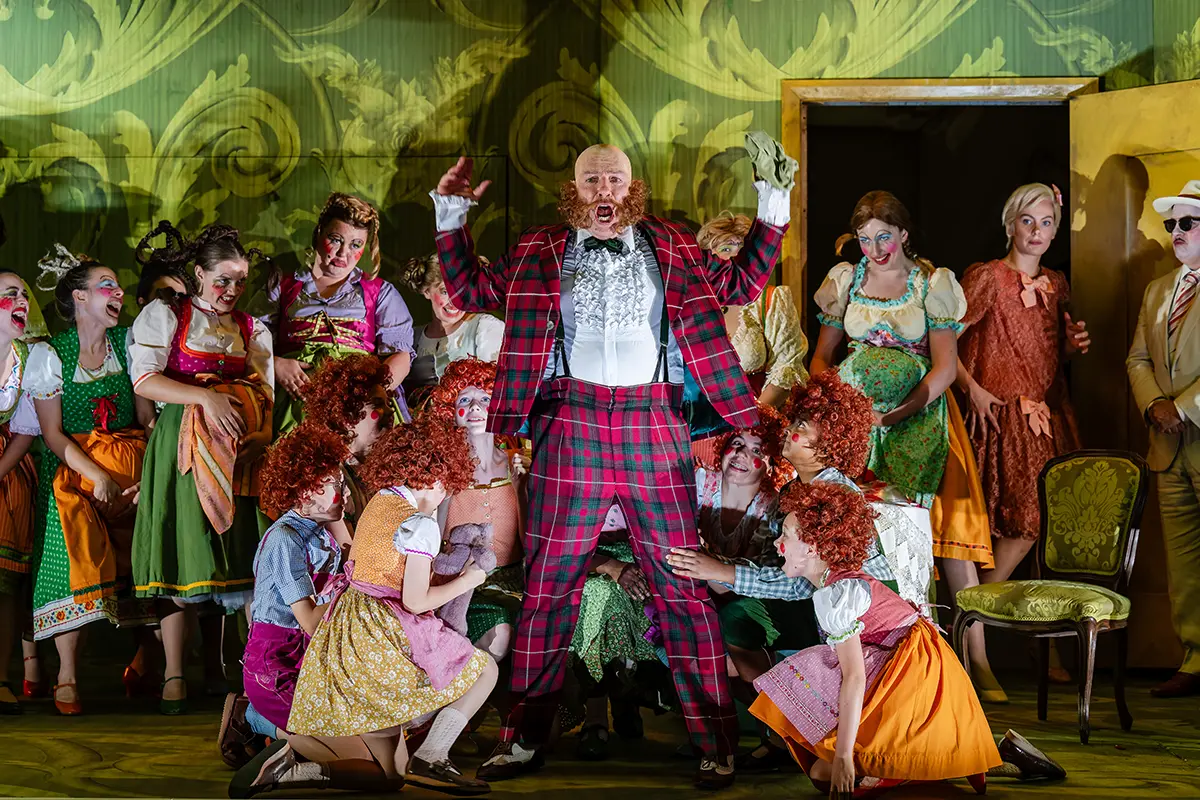
Director Bruno Ravello has achieved a small miracle on a fairly limited budget. While the set doesn’t quite match the luxurious décor stipulated by Hofmannsthal’s libretto, the singing, acting and the orchestral playing more than make up for it. In Act III, a private room in a filthy inn is fitted with trap-doors, blind windows and a large bed in an alcove. The ensuing, organised chaos is designed to humiliate the Baron and thwart his intended seduction of Mariandel (Octavian, disguised as a sexy chambermaid). Confronted with a steady stream of women and children from his murky, womanising past, the Baron is overwhelmed. Ravello’s staging of this hallucinatory and grotesque masquerade is one of the comedic highlights of the production. He has also found an inventive way to handle the silent role of the little black page – a part often cut in modern production to avoid embarrassment. Ravello turns him into a cheeky Cupid who appears whenever love is in the air.
The original scoring for Der Rosenkavalier requires more than 100 musicians, which is far beyond the capacity of the Garsington’s orchestra pit. Instead Finnegan Downie Dear conducts Eberhard Kloke’s transcription for middle-sized orchestra of only only 58 musicians. Clearly, much of Strauss’s string opulence is lost, but the texture is more transparent, giving lower-reaching instruments greater exposure. The opera has its longueurs, but Downie Dear keeps the marvelous, hard working and highly adaptable Philharmonia Orchestra on their toes by sticking closely to Strauss’s instructions: “Light, flowing tempi, without compelling the singers to rattle off the text. In a word: Mozart, not Léhar”
Hearing the Philharmonia Orchestra in Der Rosenkavalier feels truly special. Herbert von Karajan’s legendary recording (the best?), featuring Schwarzkopf, Ludwig, Stich-Randall and Edelmann, was made with this very orchestra. Admittedly that was 70 years ago, but it must be special for any member of the current ensemble to be a part of such a rich legacy.
Albert Ehrnrooth June 2026