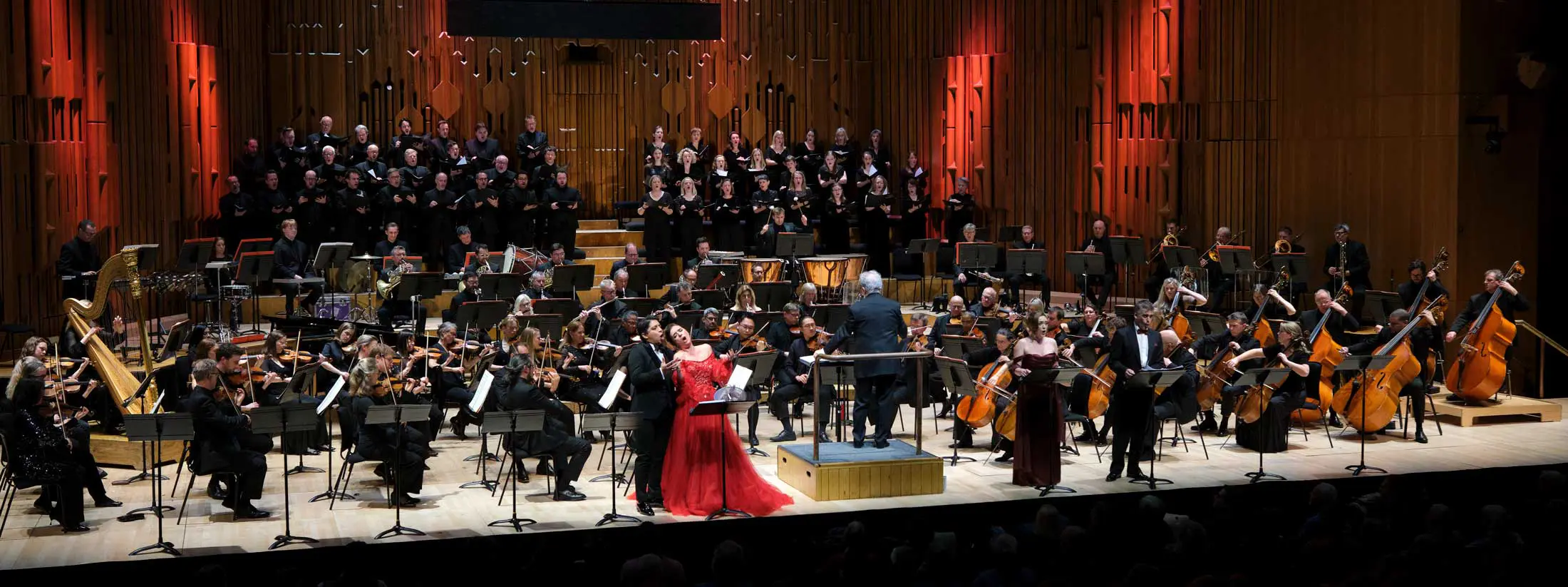
Light on drama and heavy on formulaic plot solutions, La Rondine sits well outside Puccini’s top-tier operas, but it proves perfectly enjoyable thanks to the strong performances of a cast led by the Albanian prima donna Ermonela Jaho, all under the spirited direction of Carlo Rizzi and the ever-reliable BBC Symphony Orchestra.
La Rondine remains one of Puccini’s least frequently staged operas, and for a few good reasons. It doesn’t quite fit the mold of the Viennese-style operetta, it offers very little in the way of laugh-out-loud comedy, and it lacks the dramatic intensity found in nearly all of the composer’s other works.
Despite these limitations, La Rondine contains some superb arias and duets, and provides a very pleasant evening’s light entertainment – provided your singers, orchestra and conductor are excellent, if not world class.
Yes, the opera is still a bit of a rarity, but it seems that The Swallow (La Rondine) is becoming something of an annual December event at the Barbican in London. Last year, Antonio Pappano conducted London Symphony Orchestra in two concert performances of the standard version of the work. This year, Opera Rara presented the final, revised version of Puccini’s only commedia lirica.
Opera Rara is an “opera charity, recording label and live operatic archaeologist” and they specialise in presenting rarely performed songs and operas by (mostly) well-known 19th and early 20th century composers. Since Pappano’s award-winning 1996 recording with Angela Gheorghiu and Roberto Alagna, productions of La Rondine have become more frequent and have even entered the repertoire of a couple of opera houses. Until very recently all these productions were based on the first version of the opera (1917 ), and for good reason.
After hearing his second version (1919) in Vienna he wasn’t happy and decided to re-imagine some of his original ideas. But he stopped tinkering with the opera after finishing the third version (1921), but later called it ¨this pig of an opera¨. Unfortunately the only copies of that orchestral score were destroyed in an Allied bombing raid on Milan in 1943. But the complete vocal score survived.
The back story
Puccini went to Vienna in the autumn of 1913 to attend the premiere of La fanciulla del West. He was always on the lookout for a good libretto and Vienna had a wealth of good writers. He met Lehár – who became a friend – and was impressed by his operetta Die Ideale Gattin. Lehár introduced Puccini to the director of the popular Carltheater in Vienna, who offered him a very generous fee plus royalties in exchange for a Viennese operetta. The deal was so lucrative that Puccini was tempted, but he made it clear that an operetta was out of the question, instead he planned ¨an opera – like Rosenkavalier, but more amusing and more organic.¨
The contract stipulated spoken dialogue between the musical numbers – common in operettas – but Puccini would not be dictated to and delivered through-composed music instead. He was provided with a German libretto, Die Schwalbe (The Swallow) written by Alfred Wilner and Heinz Reichert, both highly experienced librettist.
As Puccini began work on the opera, the Austro-Hungarian monarchy declared war on Serbia, the spark that set off the tinderbox that ignited the Great War. Vienna lost its imperial crown, and in May 1915 Italy went to war with its northern neighbour.
Puccini was forced to take sides and sever his ties with the Austrians. He found a new Italian publisher and the librettist Giuseppi Adami – who would later collaborate with Puccini on Il tabarro and Turandot – was entrusted with adapting the German text and change the language into Italian.
While the war was still raging the opera was premiered in the stupendous Opéra Garnier de Monte Carlo in March 1917 to great acclaim. Puccini made several revisions, and before the war had ended the opera had already been staged in four Italian cities, as well as Rio de Janeiro and Buenos Aires.
Shameless borrowing
Puccini and Adami rather shamelessly stole various plot devices from a number of fairly obvious sources. From Johann Strauss’s Fledermaus they lifted the idea of the banker’s mistress, Magda , disguising herself as a commoner to visit a working class ballroom. Act II, which takes place in Chez Bullier, recalls the café episode in La Bohème, a world the cynical poet Prunier could easily have inhabited as well. In the final scene there are clear echoes of Violetta’s farewell to Alfredo in La Traviata, when a letter exposes Magda’s past as a high-end courtesan.
Musically Puccini made no attempt to conceal his influences – or should we call them a tribute? Waltzes permeate every act, and the toast to romantic love is the opera’s most famous waltz. Even a brief fox trot finds its way into the score.
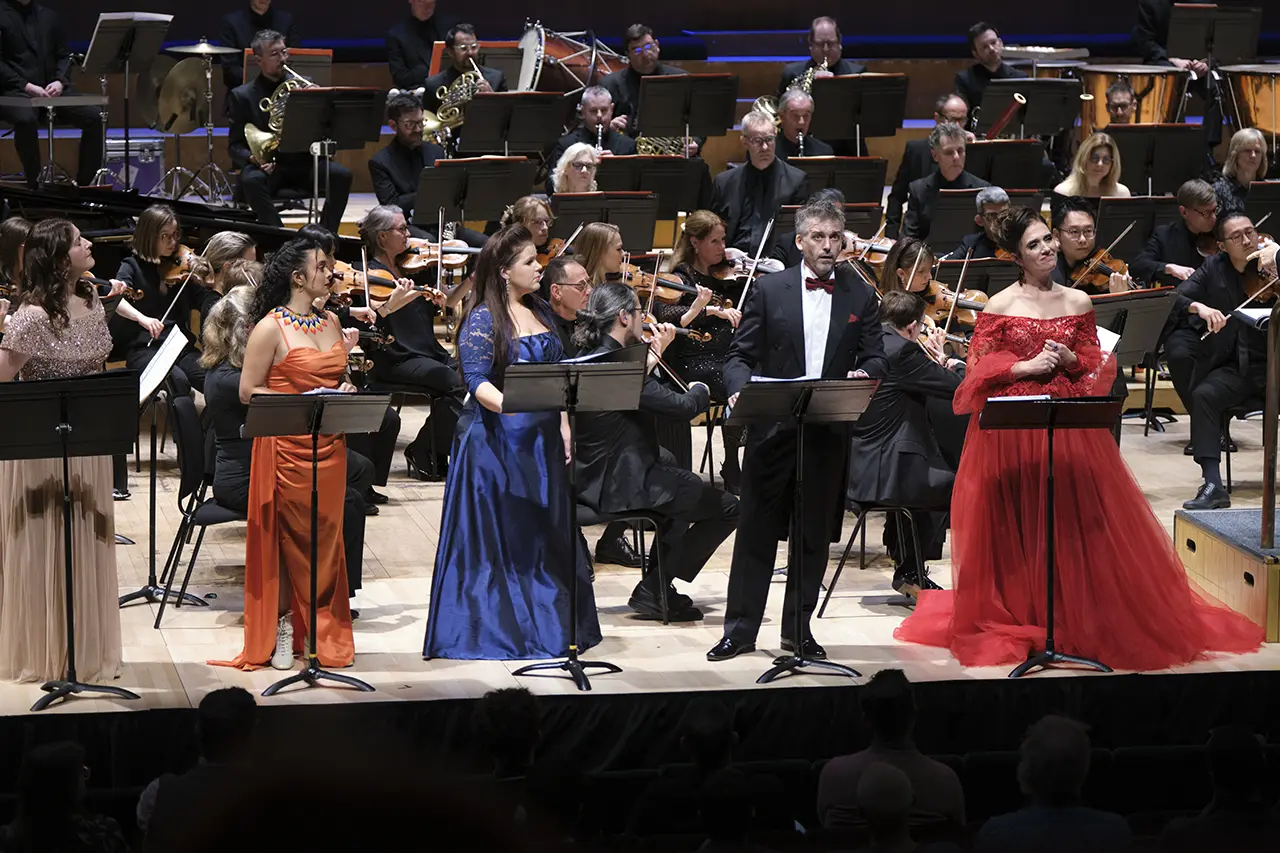
The concert performance at the Barbican
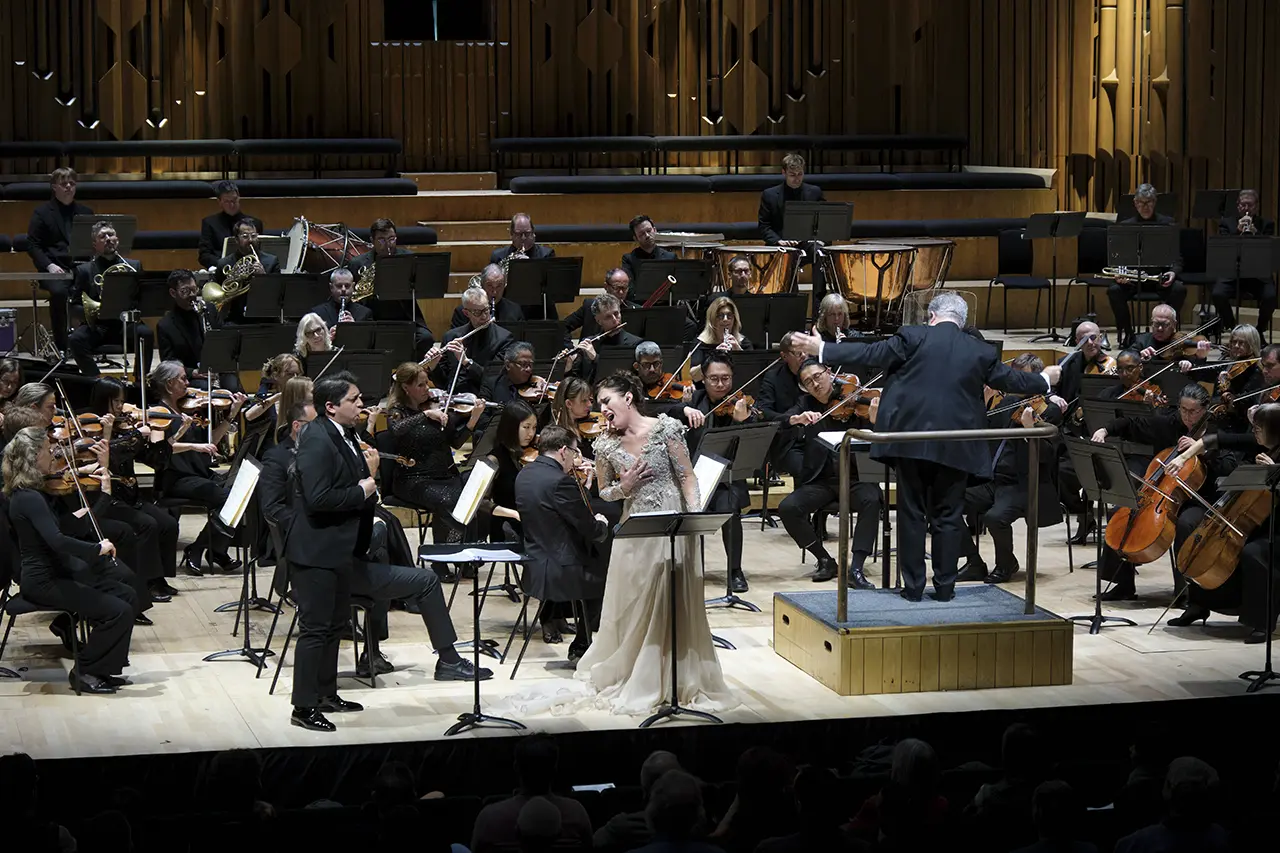
The overture of La Rondine neatly paints the emotional trajectory that we are about to experience. The BBC Symphony Orchestra is not known for its operatic credentials, but they are Britain’s most versatile orchestra. With Carlo Rizzi on the podium—one of the most seasoned conductors of the Italian opera repertoire—it was hardly surprising that the lyrical and occasionally even bittersweet score emerged with a richness and polish well above the ordinary (perhaps aided by the improved orchestration – see below).
A concert performance usually means minimal acting—though not here. Well-rehearsed from their recent studio recording, the singers seemed eager to enjoy themselves and, in some cases, to show off their acting chops.
Magda (Ermonela Jaho), a former high-class escort, leads an enviable life thanks to her wealthy patron and lover, Rambaldo (Nicola Alaimo). She is entertaining her chatty women-friends and the poet Prunier (Juan Francisco Gatell) in Paris, where romantic love has come back into fashion. Prunier has written a romantic song about a young woman who spurns a king’s riches and advances, though he hasn’t settled on an ending. Magda volunteers to supply one. In the opera’s most famous aria, Chi i bel sogno di Doretta, she basically encapsulates the plot of La Rondine. Ermonela Jaho brings her trademark deeply felt empathy to the moment, all while navigating the vocal challenges – including floated sotto voce top notes – with remarkable ease. Then Magda recalls her carefree youth and an encounter in Bullier’s nightclub with a young man she fell in love with at first sight. How different her life might have been had she followed her heart?
Ruggero (Iván Ayón Rivas), the son of Rambaldo’s childhood friend, is introduced and he asks where he should spend his first evening in Paris. The women unanimously suggest Chez Bullier’s. Magda’s maid Lisette – given a cheeky, flirtatious and captivating portrayal by Ellie Neate – persuades Prunier to accompany her to the ballroom, having ‘borrowed’ a dress from her employer. Left on her own and feeling restless, Magda decides to head to the Bullier as well, dressing as a working-class girl to avoid being recognised.
Act II is where the opera takes on an operetta-like flavour, it’s a carnival of love and kisses, packed with hummable melodies. Magda has her Groundhog Day moment – yes, like in the Bill Murray and Andie MacDowell movie. She meets Ruggero, who doesn’t recognise her, in Bullier’s and they dance. The encounter echoes her aborted youthful adventure and she decides that this time she will follow her instincts. Their duets are at times achingly beautiful, mostly set to an old-fashioned waltz rhythm, and they suggest that their future lies in the past (and is unreachable). It is pure nostalgia, and it would have sounded a bit dated to most post-war audiences.
The fabulous BBC Singers relish the crowd scenes and taking on various smaller roles. and nowhere does their interplay with Magda and Ruggero blend more seamlessly than in Perché ma cerate di saper. The tenor Iván Ayón Rivas brings a wide-eyed charm to Ruggero, a portrayal somewhat at odds with the abrupt violence he shows in the very final scene. Rivas voice is pleasant and valorous, his presence on stage is energetic, but sensibly he never attempts to compete with Jaho’s star power.
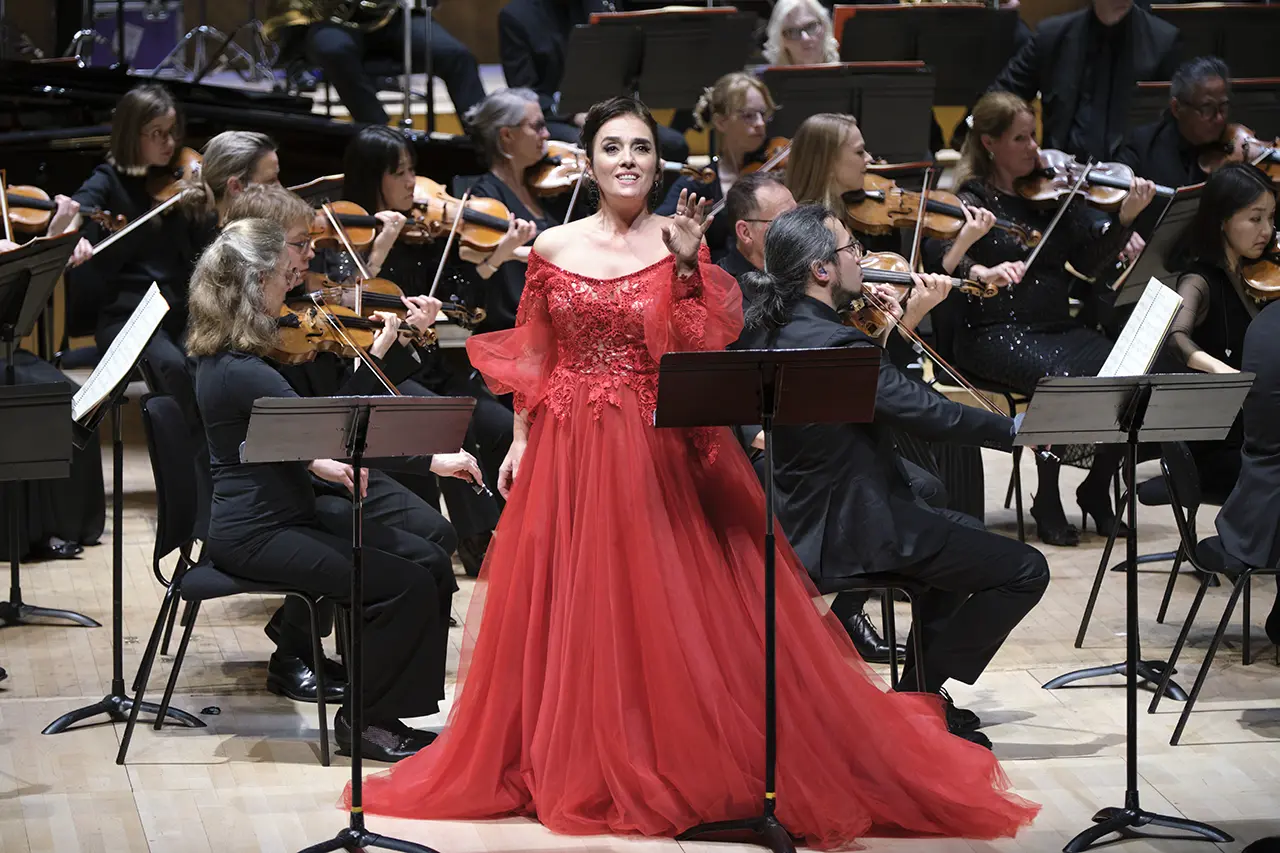
Ruggero and Magda quickly become a couple and are soon spotted by Lisette and Prunier – who, unlike Lisette, recognises Magda despite her disguise. Showered with flowers by the crowd, the two couples toast their newfound love in the delightful and Donizetti-like quartet Bevo a tuo fresco sorriso. Here Puccini’s writing finally rises to the level of La Bohème, Tosca and Madama Butterfly.
The drama only starts when Rambaldo – sung with aplomb by the baritone Nicola Alaimo – enters the lively dance hall. He dismisses the notion of ‘romantic love’ and asks Magda to leave with him. Magda however chooses to greet the dawn light arm in arm with her dream lover, Ruggero.
Act III is where Puccini made the most significant changes in his final version. For the past three months Magda has been living the romantic – though financially challenging – life she dreamed of in her youth. Ruggero remains completely unaware of her ¨corrupted¨ past. But the truth will out once he suggests that they should legalise their relationship.
Left alone, Magda agonises whether she should stay silent or confess? It’s in highly emotional moments like these that Ermonela Jaho is always at her best. (Che più dirgli? Che fare?)t Before Magda can take action she’s interrupted by Lisette and Prunier. The poet doesn’t mince his words, warning her: ¨This is not the life for you… shutting up your love in a tomb¨.
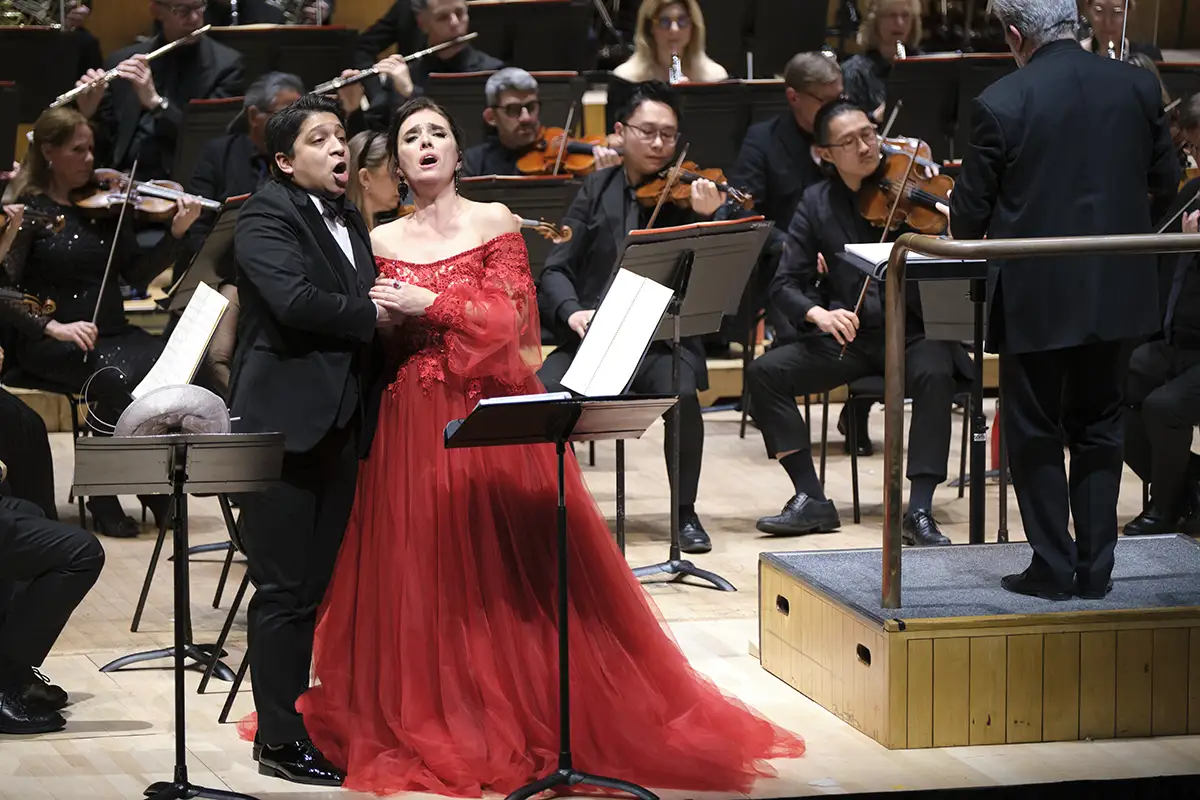
Here the opera takes a dramatically different direction from the standard version. Rambaldo– who has no role in the original third act – arrives and declares that the swallow will eventually return to its nest Che volete da me? Ruggero then enters with a letter – no longer the blessing from his mother found in the 1917 version, but instead revealing Magda’s tainted Parisian past.
This is the moment Ruggero gets very unpleasant and Magda’s plea for forgiveness is in vain (Non maledire, ascolta). He leaves in a huff, and Lisette has to comfort the heartbroken Magda.
So, instead of Magda leaving Ruggero as in the first version, Puccini opts for a more dramatic reversal: Ruggero abandons the woman ¨who has dragged me into dishonour¨. Magda leaves, – supported by Lisette – to the sound of ominous bells. But is she returning to Rambaldo and a life of luxury, or will she slip back to her former life as high-end prostitute?
It’s pure Puccini, tugging at the heartstrings, and Opera Rara’s valiant initiative to strengthen one of the composer’s weaker operas has already proved far more satisfying. In this performance, the ending of the final version is unquestionably more dramatic and potent.
Notes on the improved orchestration
It was not only the outcome of the plot that underwent major changes. In the third act, Puccini shortened Magda and Ruggero’s opening duet and reused some of the existing music to create a prelude depicting the idyllic surroundings of the Cote d’Azur, where the couple has settled. Act Three had already been re-orchestrated by Lorenzo Ferrero in 1994. For this restored version Martin Fitzpatrick prepared additional arrangements for Acts One and Three based on surviving sketches and the vocal score of Puccini’s final version. It was striking that the orchestral texture sounded more opulent and warm when set against the two recordings of La Rondine that I’m familiar with: the previously mentioned Pappano /LSO recording and the RCA Italiana Opera Orchestra performance led by Francesco Molinari-Pradelli with the wonderful Anna Moffo as Magda (1966).
The studio recording of the 1921 version of La Rondine will be broadcast in September 2026.
Seen at the Barbican December 5, 2025